VOGONS


True Covox Speech Thing

Topic actions

First post, by Great Hierophant

User metadata
Rank l33t
Rank
l33t

I am interested in the true audio output and the inner workings of a geniune Covox Speech Thing. There were innumerable clones of this device, but I would love to know how the true original sounded.

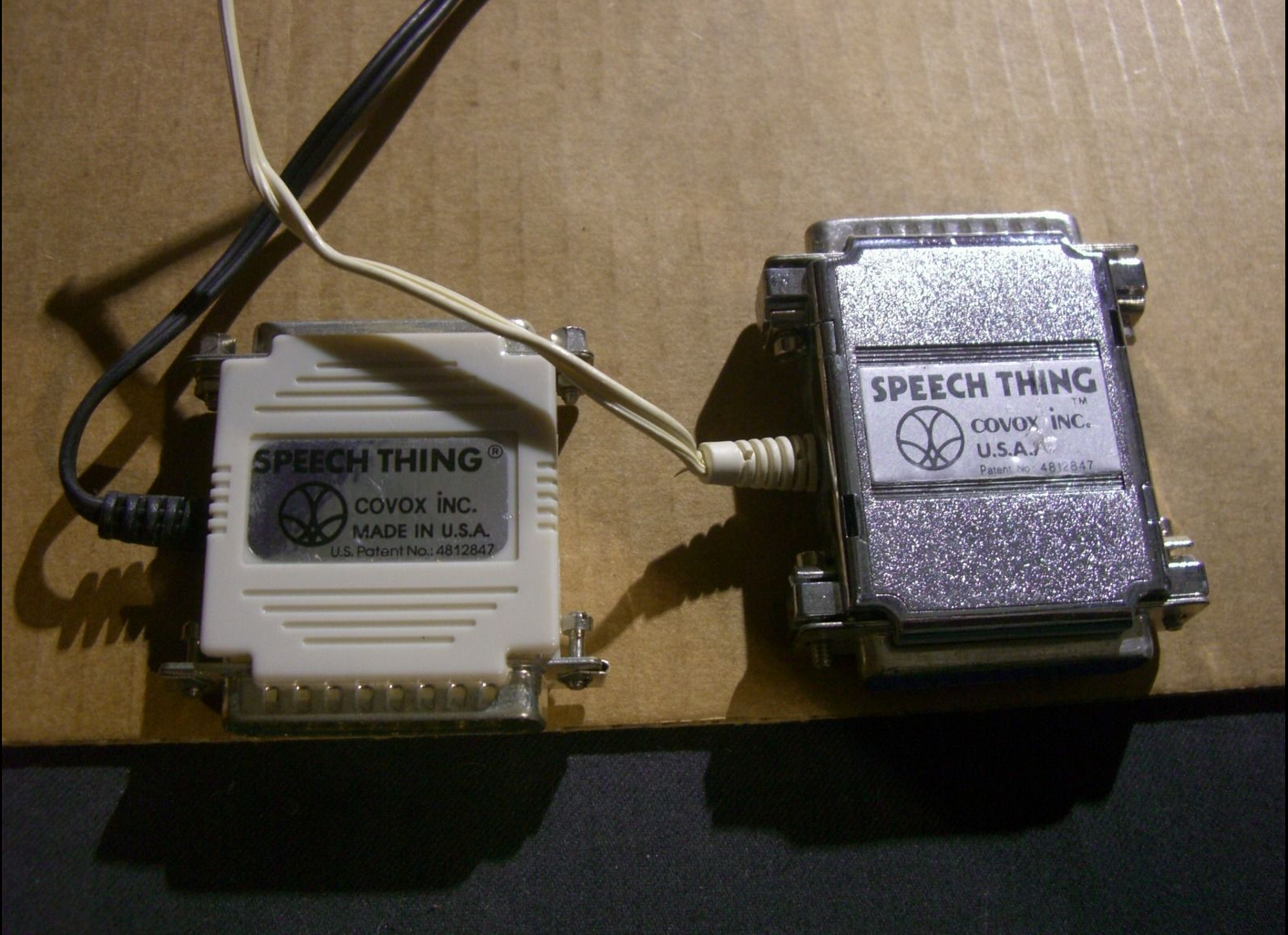
They look like this :
Covox%2BSpeech%2BThings%2B2.png

As you can see, they came in (at least) two versions. I would also be interested to know if there are any internal differences between the two. I do not know if a schematic for the real thing exists, but a simple shot of both sides of the board should prove sufficient to figure out the circuit. The differences may be cosmetic.

A recording from one of these would be nice as well 😀

http://nerdlypleasures.blogspot.com/ - Nerdly Pleasures - My Retro Gaming, Computing & Tech Blog

Reply 1 of 13, by Jepael

User metadata
Rank Oldbie
Rank
Oldbie

Have you checked the patent number?
http://www.google.com/patents/US4812847

Though I can't say if they really used the stated component values, but it gives some insight about the design.

I only had a self-made version when I was a kid. It did not even use R-2R network but 8 resistors that were approximately powers of two.

Reply 2 of 13, by Harekiet

User metadata
Rank DOSBox Author
Rank
DOSBox Author

Sheet 4 and 5 seem to indicate fancier designs but were they ever implemented or did they just use the simple resistor only one?

Reply 3 of 13, by Great Hierophant

User metadata
Rank l33t
Rank
l33t

Perhaps they did implement the more complex design at first (the silver model), then simplified it (the white model). I think the white model is the later one because the label on the silver model only has a TM for Trademark and just U.S.A. The white model is an R in a circle, which is a Registered Trademark and emphasizes the product was "Made in U.S.A." The more complex design in Fig 4 has many more passive components, and Fig 5 has a buffer chip. Both Fig 4 and 5 are designed so that they could be used for a printer port that uses an open collector data port. IBM PC compatible printer ports use a two-state data port latch, so I think that Covox eventually realized that the extra components probably were not worth it. I have also looked at several IBM PC and Tandy 1000 compatible printer schematics and all have pull up resistors on the data lines, so I am fairly convinced that Covox was probably using the design in Fig 3 for its white model.

http://nerdlypleasures.blogspot.com/ - Nerdly Pleasures - My Retro Gaming, Computing & Tech Blog
Reply 4 of 13, by Harekiet

User metadata
Rank DOSBox Author
Rank
DOSBox Author

It's amazing how you can't seem to find any images of actual covox pcb's of someone just opening their converter. Still I can't imagine them going for a more expensive design if they could get away with their cheaper solution sounding good enough. You'd have to wonder if they picked the resistor with decent enough precision or just went with whatever cheapies they could find.

Reply 5 of 13, by torindkflt

User metadata
Rank Member
Rank
Member

There's a video on YouTube about the Covox Speech Thing (https://www.youtube.com/watch?v=spOenlrSSOE) that shows a genuine Covox Speech Thing being used, it actually sounds not all that bad. At 2:28 it briefly shows the innards of what I would presume is a Covox, but it could be a clone, hard to say. Also, the Covox Speech Thing seen in that video is a different style than the two shown above, it doesn't have parallel port passthrough.

Reply 6 of 13, by Harekiet

User metadata
Rank DOSBox Author
Rank
DOSBox Author

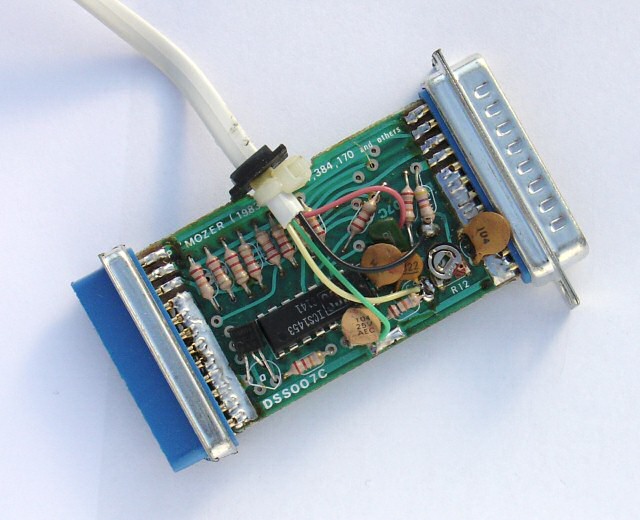
That would refer to this image
Covox-large.jpg

But i'm fairly sure that's a disney sound source with that ics1453 fifo/dac chip.

Reply 7 of 13, by Great Hierophant

User metadata
Rank l33t
Rank
l33t
torindkflt wrote:

There's a video on YouTube about the Covox Speech Thing (https://www.youtube.com/watch?v=spOenlrSSOE) that shows a genuine Covox Speech Thing being used, it actually sounds not all that bad. At 2:28 it briefly shows the innards of what I would presume is a Covox, but it could be a clone, hard to say. Also, the Covox Speech Thing seen in that video is a different style than the two shown above, it doesn't have parallel port passthrough.

Actually, its not a genuine Covox-made Speech Thing. LGR so much as states that. He acquired his genuine Speech Things after he made that video.

http://nerdlypleasures.blogspot.com/ - Nerdly Pleasures - My Retro Gaming, Computing & Tech Blog

Reply 8 of 13, by torindkflt

User metadata
Rank Member
Rank
Member
Harekiet wrote:

But i'm fairly sure that's a disney sound source with that ics1453 fifo/dac chip.

Ah, I would believe so too now that I see the product code starting with "DSS" in the lower left of that PCB.

Reply 9 of 13, by oyakodon

User metadata
Rank Newbie
Rank
Newbie

I realize it’s 11 years later, but did you ever find the images of the Covox Speech Thing you were looking for? I was an employee for about four years and it turns out I have one of the older silver ones still in my box of random Covox hardware and software. (Also a few of our other sound cards) If you need PCB shots I can crack it open and take some pictures for you. I don’t have anything with a parallel port to plug it into, however, so I can’t oblige with an audio recording.

The “Made in the USA” branding was all over our later products as something of a marketing ploy to contrast with the foreign-made sound cards from Creative. It, uh, didn’t really work very well.

I found this thread because I need a small battery powered speaker for something and I was trying to figure out if the one we bought and stuck our logo on back in the day was still in production. 😀

Reply 10 of 13, by Tiido

User metadata
Rank l33t
Rank
l33t

It is always awesome to hear from people who were involved in these products we like to talk about and use etc. ~

Photos are most welcome, even if recording cannot be had

T-04YBSC, a new YMF71x based sound card & Official VOGONS thread about it
Newly made 4MB 60ns 30pin SIMMs ~
mida sa loed ? nagunii aru ei saa 😜

Reply 11 of 13, by oyakodon

User metadata
Rank Newbie
Rank
Newbie

Here we go. I think. As long as the “attachments” feature works. Not terribly exciting, I’m afraid, so I’ve added a picture of our Midi Maestro card. As far as I can tell, the only reference to this on the internet is a thread in this forum asking “has anyone ever heard of this thing?”

Spoiler: It was basically just the MIDI section of the Sound Master II card, with no digital audio features.

I can’t take any credit for developing any of this hardware. I wrote a couple of small utilities that we included with the cards, and was responsible for some of the documentation, but mostly I just did random IT tasks.

Reply 12 of 13, by Many Bothans

User metadata
Rank Member
Rank
Member

Thanks, always very interesting to see Covox products out there.

oyakodon, was your ST in the textured chrome shell like OP's?

I have, what I believe, to be an early ST with a bright chrome shell and "Patent Pending" on it - Covox Speech Thing Versions

  • Zenith Z386SX-20, 8MB FPM, Video 7 1024i, Unhoused
  • AOpen AP43, Am5x86-133@160, 1MB L2, 128MB FPM, Stealth III S540 32MB Savage4, SB32
  • ITX-Llama, 3Dfx V3
  • Asus CUV4X-E, P3-933, 512MB PC133, Hercules 3D Prophet II MX 32MB, SB Live!

Reply 13 of 13, by oyakodon

User metadata
Rank Newbie
Rank
Newbie

Oh, mine is one of the Patent Pending variety. I never noticed that little detail on the label and it’s wild seeing the little keyboard power tap cable again. I wonder if we stopped including it for cost reasons or because the PS/2 keyboard port started being more of a thing.

Most Speech Things got sold to use in schools, I think. Covox licensed text-to-speech software from… a company whose name I have completely forgotten… and there were some educational programs that supported the TTS. I talked to a lot of teachers who were kind of frazzled about this computer the school had dropped on them and expected them to get working.

The Stewarts (owners of Covox) were pretty protective of that patent. My memory is somewhat foggy after three decades but I remember a lot of frustration around the Disney Sound Source.

It was a pretty wild time to be in the tech industry because there were still traces of the hobbyist attitude sticking around. It was on the way out though. The reason we got Sound Master II support in a few games like Star Control was that I could just call some companies and ask to talk to someone in their development department and you could actually just get transferred to a developer and they were often like, “cool, send me a development kit!”

Pro tip: if you ever want to talk to someone but have no earthly justification, tell whoever picks up the phone “Hi, I’m returning a call from <name here>.”

If you tried the same thing with Sierra who was the Big Name PC Game Company at the time, you would get shut down immediately. They wanted $50K a game to add support for a new sound card, which at the time was just a staggering amount for a small company.