First post, by ecliptik
- Rank
- Newbie
I am trying to get a Gateway 2000 16MVCARD soundcard working and am stumped on what to do next. Card is detected and configured, but sound volume is extremely faint when using Line Out and occasionally works when using Amp Out but is distorted and scratchy (sample mp3 attached). With Amp Out even when the system isn't doing anything there are sometimes pops and other odd noises from the speakers.
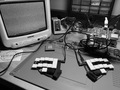
The system is a Gateway 2000 Slimline desktop with a 486DX2-66Mhz, 48Mib of memory, CF2IDE on IDE Master, 8x CDROM on IDE Slave, Gotek Floppy Emulator, Picogus (IRQ 7 and DMA 3 in USB mode) and powered by a PicoRC with a 80 Watt PicoPSU. I have tried running the system only with the sound card in case it was a power issue but same results.
Here's what I've tried so far.
- Read Tenormans excellent writeup
- Read other similar threads
- Installed drivers from Gateway 2000 SystemCD 3.5 for MS-DOS 6.22
- System configures card on boot using the JAZZ.SYS driver
- Sony CDROM interface works and detects a 2x CDROM with MSCDEX.EXE
- Replaced all electrolyte capacitors - Rubycon for 1000uf and 50uf, WIMA film for 1ufs and Nichicon for 47uf - verified all are soldered well and polarity is correct
- Replaced LM1877N-9 with new-old stock chip (and put a 14 pin round IC socket on the board for it)
- Ferrite beads are all intact and show continuity
- Tested all resistors in Line-Out and AMP Out path and re-flowed solder
- Push and bend test with no difference in sound output
- Measured 11.5v on Pin 14 of the LM1877N-9
- ISA card screwed securely into chassis
I'm running out of ideas, and don't really know enough electrical engineering to test the paths more. I have a basic multi-meter, soldering iron and other tools, but that's about it. I've tested with both known working speakers and headphones and same results. Any ideas?
autoexec.bat
GoTo %config%:PGLH C:\DOS\MSCDEX.EXE /D:MSCD000 /M:5LH C:\WINDOWS\SMARTDRV.EXE 512 256 C A-GOTO COMMON:PGLITELH C:\DOS\MSCDEX.EXE /D:MSCD000 /M:5GOTO COMMON:WINPGLH C:\DOS\MSCDEX.EXE /D:MSCD000 /M:LH C:\WINDOWS\SMARTDRV.EXE 2048 1024 /LGOTO COMMON:CDLH C:\DOS\MSCDEX.EXE /D:OPTICAL /M:5LH C:\WINDOWS\SMARTDRV.EXE 512 256 C A-GOTO COMMON:CDLITELH C:\DOS\MSCDEX.EXE /D:OPTICAL /M:5GOTO COMMON:WINCDLH C:\DOS\MSCDEX.EXE /D:OPTICAL /M:5LH C:\WINDOWS\SMARTDRV.EXE 2048 1024 /LGOTO COMMON:CLEANECHO Clean boot - no drivers loadedGOTO END:COMMONLH C:\DRIVERS\CTMOUSE.EXEECHO %config% configuration loadedGOTO END:END
config.sys
[COMMON]DOS=HIGH,UMBFILES=40BUFFERS=30LASTDRIVE=HDEVICE=C:\DOS\HIMEM.SYS /TESTMEM:OFFDEVICE=C:\DOS\EMM386.EXE NOEMS I=B000-B7FFDEVICEHIGH=C:\G2KAUDIO\JAZZ.SYS P220 I5 D1 E3 T330 Q2STACKS=0,0[menu]menuitem=PG, PicoGUS with SMARTDRVmenuitem=PGLITE, PicoGUSmenuitem=WINPG, Windows with PicoGUSmenuitem=CD, Optical Drive with SMARTDRVmenuitem=CDLITE, Optical Drivemenuitem=WINCD, Windows with MSCDEXmenuitem=CLEAN, No Driversmenudefault=PG,5[PG]DEVICEHIGH=C:\PICOGUS\CDMKE.SYS /P:250 /Q[PGLITE]DEVICEHIGH=C:\PICOGUS\CDMKE.SYS /P:250 /Q[WINPG]DEVICEHIGH=C:\PICOGUS\CDMKE.SYS /P:250 /QDEVICE=C:\WINDOWS\IFSHLP.SYS[CD]DEVICEHIGH=C:\DRIVERS\VIDECDD.SYS /D:OPTICAL[CDLITE]DEVICEHIGH=C:\DRIVERS\VIDECDD.SYS /D:OPTICAL[WINCD]DEVICEHIGH=C:\DRIVERS\VIDECDD.SYS /D:OPTICALDEVICE=C:\WINDOWS\IFSHLP.SYS[CLEAN]REM No drivers loaded
