VOGONS


First post, by dulu

User metadata
Rank Member
Rank
Member

At some point I decided that I was getting bored with tinkering with random 462 junk and stashing the more interesting artifacts away in a box. I figured I wanted to take on a slightly more challenging build— one that I wouldn’t be able to fully complete according to my own requirements within a year or two. In fact, at this point it's highly likely that it will never be fully completed. Why is that? I’ll elaborate later.

I’ve basically been looking for parts since 2021. My assumptions, including which components I wanted to use, changed over time. But by now I know enough that they’re unlikely to change any further. The assumptions are as follows:

  • components no newer than the year 2000
  • ISA sound card
  • components on blue PCBs (motherboard, GPU, PCI, ISA, RAM)
  • aluminum case
  • I allow using the newest BIOS, but only if I can demonstrate that the last BIOS from the year 2000 enables the system to function correctly
  • I allow small modifications and elements — screws, Velcro, cable sleeving, maybe some cabling
  • I do not allow the computer to contain parts that have been replaced over time; however, I do allow repairs. By this I mean, for example: capacitor replacement, replacing fan bearings, replacing the laser module in a CD-ROM drive, etc.
  • each individual component must have solid proof that it was available for sale in the year 2000. Here’s how I understand it: if the component has a serial number, it must indicate that the unit was manufactured no later than 2000. If it doesn’t have one, then proof in the form of a review, a forum thread, a photo with an intact warranty seal, etc., is enough — something that clearly shows that the given part was on the market during the required period.

As I slowly develop this thread, I’ll be talking a lot about each component used. For now there will be more writing, and once I gather more appropriate parts, there will be more photos 😀

What am I aiming for? Pretty much the same as anyone who has taken on a “millennium build” — to be able to play DOS games, to have high compatibility () for Q3A to run well (my online playtime in that game used to be close to 5000 hours, ).
Above all, the computer just needs to look cool while being equipped mostly with rare, collectible components. Also, it's very important to me that the machine clearly looks like it's from the late ‘90s rather than the 21st century, even though an aluminum housing will be used

Reply 1 of 12, by bofh.fromhell

User metadata
Rank Oldbie
Rank
Oldbie

Love the challenge!
Did my Y2K "monster" build a bunch of years ago now and its still rockin hard.
I used the same rules you have except the blue one =).

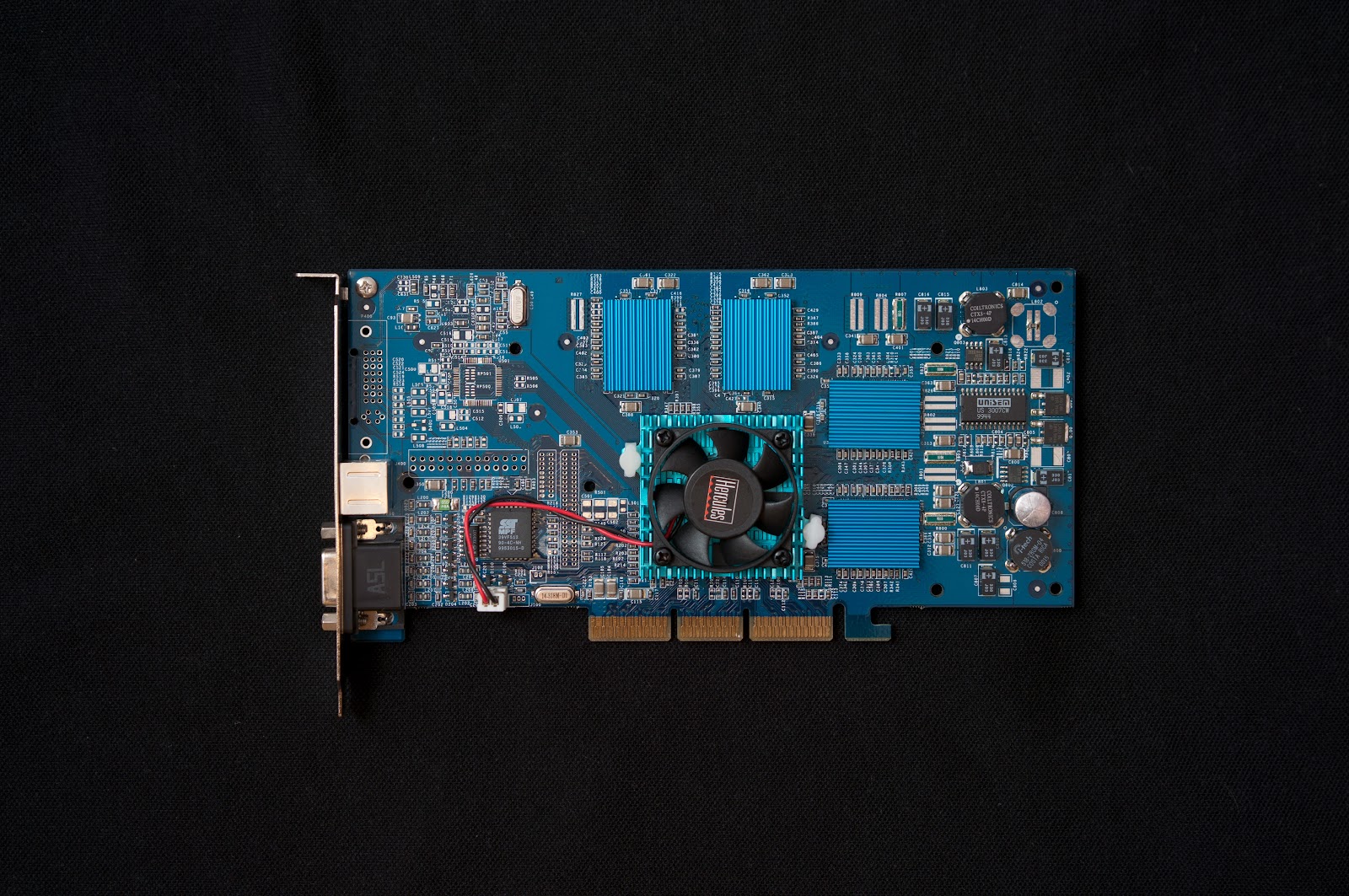
So in my mind I already see a Hercules GF2U on some Gigabyte i815 board.
Not sure if there's blue memory, perhaps one of the brand names had some.
Sound card will probably be easy, I'm sure Hercules has you covered there too.
And I cant remember if any other cases then the Cooler Master ATCS cases that qualify, when did Lian-Li become popular? a few years later?`

Anyways looking forward to see what you come up with!

Reply 2 of 12, by dulu

User metadata
Rank Member
Rank
Member

1. Case
A few years ago, back when my early plans still involved building the machine around a Thunderbird 1400 and a Hercules 8500, I discovered the Lian Li PC-60 and wanted to own one for a long time. This is how original PC-60 non-usb from 2000 looks like. Notice the square piece of plastic around the button, later cases don't have it

(source: dansdata)

15pYp8vP0QUOHhUVJlPU4bvYssGWuPsfa

That changed when I came across the Cooler Master ATCS cases — after that, I completely forgot about Lian-Li. Which one is better and which one someone prefers is purely personal preference. As for me, I remain on the CM team : )

1YyFz2tsUiPxc5xvnCmJVq_LZOVi9yaDY

I could write a separate essay about ATCS case here, but I will focus only on the most important ones.

In the year 2000, excluding server and HTPC cases, the following ATCS models existed: ATC-100, ATC-200, and ATC-201. These models are relatively well-known to anyone who has been into old PCs for a while, but with the ATC-200 and ATC-201 you need to pay attention to the fact that there were two versions of each. The first versions are from the year 2000, and the second ones from 2002. I’ve encountered at least one thread where someone was working on a “millennium build” but had a 2002 version of the case. It’s also worth mentioning the Praetorian PAC-T01, which was an evolution of the ATC-201 and came out in 2005. As for the ATC-100, as far as I know, only one version existed. That case uses a 120 mm side-mounted fan with a duct directing airflow toward the rear panel, and because of that I didn’t consider it. It's about future plans related to the installation of the glass.

1F0_dRfZ4AL-Mve7Et65teufmcwvZ3zcI

A small side note: there’s an infographic floating around the internet proudly claiming that the ATC-100 was the first aluminum PC case for a home computer in history. To this day I haven’t been able to find any source confirming this claim. If anyone has reliable information about this, I’d be very grateful : ) (Completely ignoring the fact that in the photo we see not an ATC-100 but an ATC-210 from 2001..)

1iZI-L73DMjXUKdjyxSeR0DrCTw-8FVQX

The visual differences between the 2000 and 2002 versions of the ATC-200 and ATC-201 are as follows:

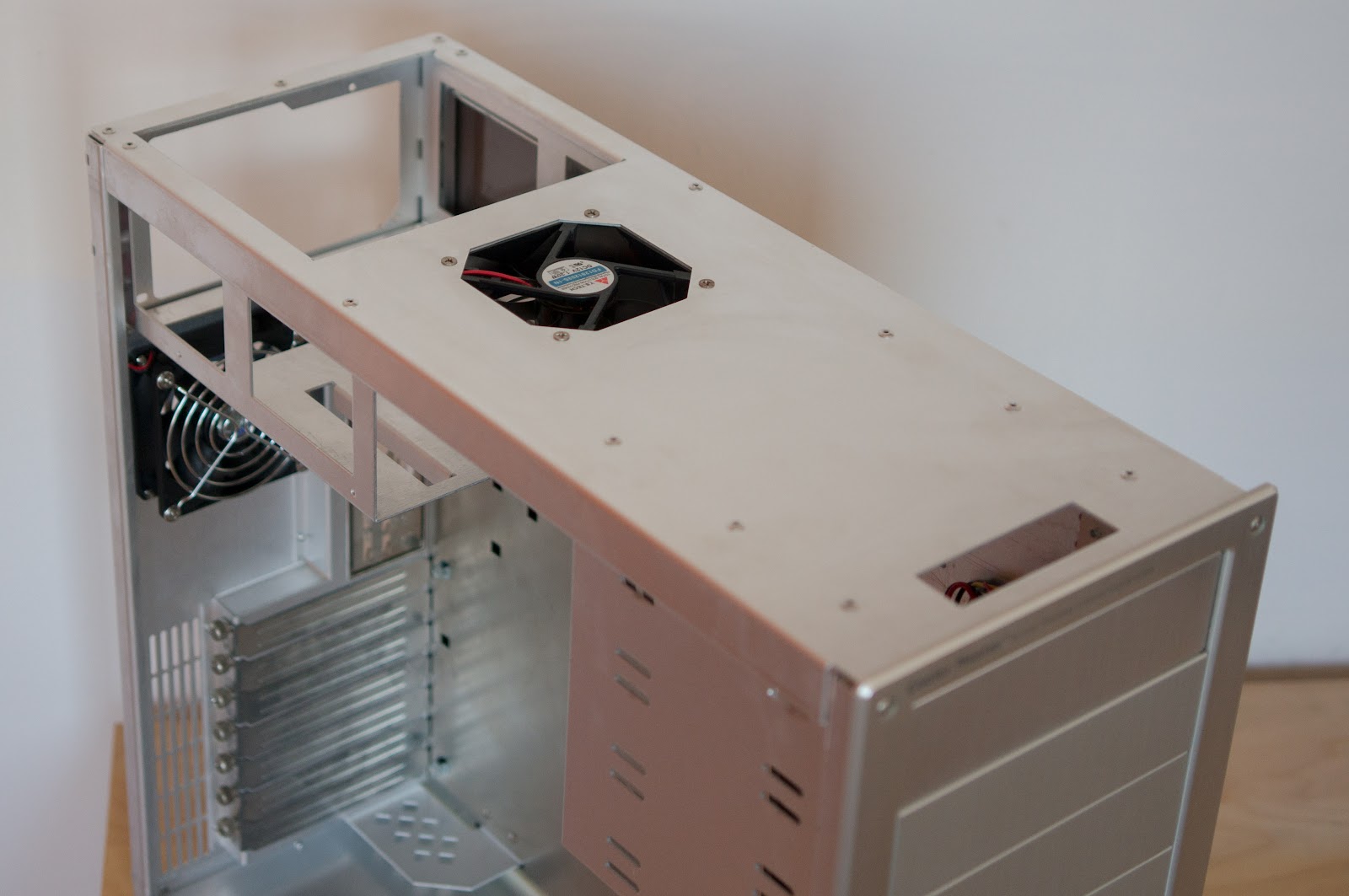
  • The 2000 versions have a removable top cover under which the fan screws and a "hole" for inserting the power supply are located. Because of this, the side panels from the 2000 series do not fit the 2002 revisions. The 2002 cases have the fixed top, and the PSU is installed from the rear.
  • The 2002 versions use threaded motherboard standoffs, whereas the 2000 versions use press-fit standoffs that snap into square holes in the motherboard tray.
  • The 2002 versions have just a hole for the rear fan where you attach a grill, while the 2000 versions have a stamped/cut-out pattern and do not require a grill. There’s also an additional cut-out pattern near the expansion slots.
  • On the 2000 ATC-200, the mesh front panel reaches all the way to the edges of the case, whereas in the 2002 revision it is the same as in the ATC-201.
  • On the 2000 versions, the motherboard tray and expansion slot covers are not actually aluminum — a magnet test confirms this 😀 The 2002 tray is aluminum and is also much more rigid.
  • There are also minor differences in the PSU cage design, which will turn out to be crucial later in the story.

Availability
To figure out how difficult each case (2000 "pre-facelift", ofc) was to obtain, I looked at the number of available online photos, archive listings, etc. My conclusion is as follows: the ATC-200 is the easiest one to find, and that’s the one I started hunting for. I found photos of the ATC-201 on only two websites, in very low resolution. There were relatively many photos of the ATC-100, and they appeared more recent. The black version, however, is another story entirely — a German collector claims that after years of searching he never once came across a black ATC-100. (He has all atc`s without black atc-100 and pre-facelift atc-201

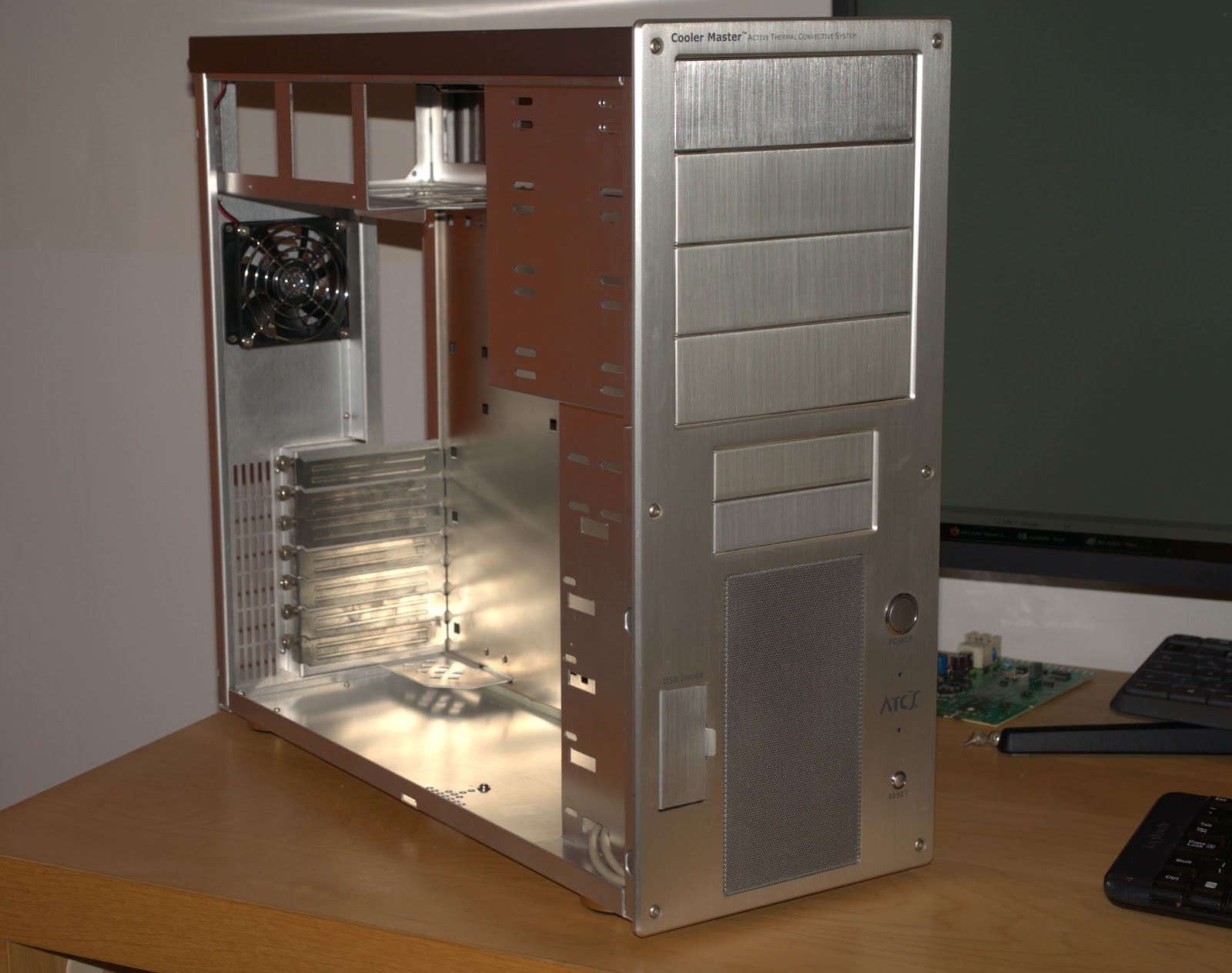
And after 3 years of hunting ATC-200, i scored this: "Pre-facelift" Cooler Master ATC-201-SX

1BRWW9bLdSKqXrszSSPymRph35v5M_MDf

1tiMRoLiJh5p-QfV1_V4RdE6BZrMZTJwj

1A8zx-FPW6jn4Dpb-GznoK58uWXkkfgwO

1RxPMdviuHrXR7rvmJ2egqIjuWAxJoOA9

1koeA6Av2iM2jzn2teniHwi6xKMxLVBDw

1aN03d1vFNkQYzTkFe_je1ppMetUZsBaO

1bpq5beLBs3TwXuGrEtrTZOIOe5fDg8Q1

1IgpQkit4d-SjVSCJWP9aozzf7VRZB2Jh

17dgHcdLh66Wmt8j94pPdJY5K_SZ8-QeY

1sagM0ek9ak9Z1LB_HbNA0C7sFY2Vb5Yx

1RCixHGEtXR21zjGS3fwG3_3PlUqPcFyg

1Tg9MdMRQhLusprAXGEPkNsIceLiSj5p-

1a2GLVvJDjnyVeXtk4HKjqduj5hjyaBIS

1W0JIDZbUxtn63fEsYhHC83pgwhm0BEDg

1xPxVnqWBgO6Os0vDSgoc2iZ_2TTwH5hO

1T7RUtpJgyYTeyBVsUS0CaBl3A4l8ecY0

1BShZyCOUz86gr8Tp0l4BG4yVREow66VY

I don't know if anyone will share my opinion, but this removable top makes impression that this case comes from the PIII era. In the first 5.25" bay you can see a different shade of the drive cover, because it comes from a PAC-T01-E1 — a model five years newer — and it was installed only for the photos. The case arrived with a full set of four factory YS-Tech ball-bearing fans. The fan markings aren't visible in photos from old reviews, but you can guess they're original because later versions had a 3-pin connector. These fans have a Molex. As I mentioned earlier, unlike the facelifted 2002 model, it turns out that the motherboard tray is, for some reason, not made of aluminum. Fortunately, the zinc coating is thick, and I’m hoping it won’t start rusting in the future. The slot covers are also steel. Unlike the ATC-200, this chassis has one additional 5.25" bay and features two front USB ports. The case arrived with a box containing all the original screws, standoffs, and the motherboard I/O shield still in protective film.

Proof

The oldest mention of this case comes from July 2000, from the archived Cooler Master website, which interestingly references two color variants — silver and black. The black version is missing its product image. I know that the "SX" marking means black color, because the black version of the ATC-100 is described in the same way on their website. In the December 2000 capture, the black version’s graphic was removed entirely.

1T2jLvUP_B31yBwcrQ9fWUTfuA-gnXr0L

1KHWvcpRSEYAOHQM4x4nL57vmM0AnCdPv

Another mention comes from September 2000 on the AnandTech forums, where users were trying to find anyone who actually owned the case. One user mentioned that the manufacturer had told him they were experiencing a “shortage” and that the cases wouldn`t be available in November. I’m not able to determine whether this was a pre-launch shortage or whether the first batch had already reached end users, but based on the GAMEPC review from December, they weren't.

The final, definitive proof comes from another AnandTech thread, in which, in December 2000, a user confirms receiving the case and expresses excitement about it (the same excitement I’m feeling — 25 years later).

1PfuUsEyzeliRFa98TqK2HfNVx56aYwms

I admit that December is the upper limit of my assumptions. This was also one of the reasons I considered the ATC-200, as its proof date is from mid-2000. However, I couldn't ignore the condition of the case and the fact (which 99% of users will agree) that it looks much, MUCH better.

I'm including saved webpage screenshots in PDF format as an attachment to this post. I highly recommend reading the revelations about how aluminum housings better cool components because they conduct heat better xD

Reply 4 of 12, by H3nrik V!

User metadata
Rank l33t
Rank
l33t

That case is so sexy it makes LianLi's look kinda basic!

If it's dual it's kind of cool ... 😎

--- GA586DX --- P2B-DS --- BP6 ---

Please use the "quote" option if asking questions to what I write - it will really up the chances of me noticing 😀

Reply 5 of 12, by dulu

User metadata
Rank Member
Rank
Member

2. Power Supply

I don’t remember exactly how I began searching for information about power supplies from the year 2000. I paid particular attention to the Enermax EG-465P and its derivatives because they had gold fan grills. Unfortunately, the earliest reviews I found were from 2001.

I browsed eBay and various reviews looking for a power supply that would be in some way unique — there were models in gold, blue, or with a galvanized steel housing that looked deceptively similar to aluminum. Of course, there were also fully aluminum units. However, all of them came from 2001 or later.
I wanted to completely settle the matter of the case and power supply, so in the end, only two models from the year 2000 remained on the battlefield:

  • Enermax EG-351P-V(e) — March 2000
  • Enermax EG-451P-V(e) — October 2000

The first delivers 32A on the +5V rail, the second — 44A. Because of that, the 451P would have been the nicer option. However, it had one crucial issue — availability. Although photos of it were floating around online, despite long eBay monitoring I think I came across only a single unit, and it was in very poor condition. The 351P, on the other hand, was relatively easy to find.

In the end, I purchased the EG-351P-V. Even though one might think the 451P would be nicer option beacuse of beefier 5V rail, the 351P has one major advantage — unlike the 451P, it does not have a P4 connector, which makes it a much better match for the components it will be powering.

1WImF26blLmsATF8URTzcrg0B0SbGkGXZ

Purchased at a good price as untested, in very good cosmetic condition. That didn’t bother me, because I was planning to refurbish it anyway. After it arrived, it turned out to be fully functional, and not a single capacitor inside was bulging, which suggests it hadn’t been used for long. It features an interesting function - a cable with 3-pin connector with sense cable only, that allows you to monitor the RPM of one of the fans. This, enables automatic emergency shutdown of the computer in case of fan failure. ATX20 cables are factory-sleeved, which would indicate that sleeved wiring existed already in the year 2000 😀
It’s also interesting that this PSU has something I haven’t seen in any other unit — not even modern ones: the Molex connectors are gold-plated. This really adds to the impression of dealing with a high-end product. 😀

Refurbishment

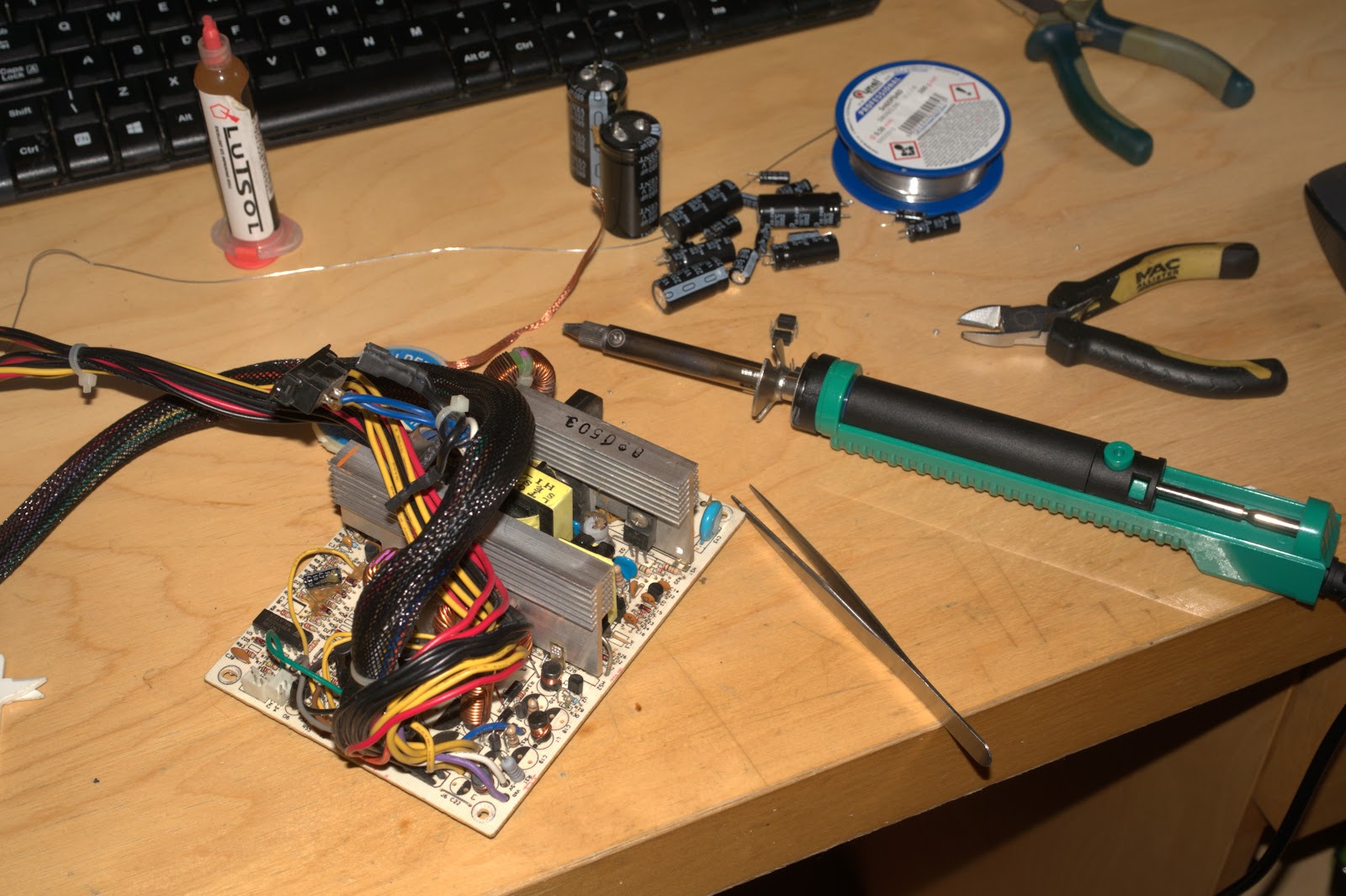
With help from the German forum Hardwareluxx, I managed to select capacitors and optocouplers according to the original specifications. The power supply is old enough that its design did not include any Low-ESR capacitors. I tried to choose replacement capacitors so that their ripple current rating was at least as high as the originals. One forum user mentioned that the ripple current shouldn’t be too high either, but based on my understanding of ripple current, I don’t really know what impact that would have. In any case, the final capacitor selection looks as follows — only Japanese brands were used.

1HuRJKnIi9gGgqz49GdMt8rgEgvRJXqrm

I’ve seen various PSU restorations done by users on that forum, and I have to admit that this one is exceptionally easy to repair, because the components are not densely packed and are easily accessible.

1SpyXc00tZoE3FYtGzONW4ul_jHUzsFAq

1n5AKjax7nIo87o7xCEqqcEAFYjF067Lh

1WmuxNgUrVvd-AvAIovpljQM_j20nj1S5

10YteGzZrparfp3YUMxRbXkI-ebSifxi9

1Gq1ZKDETz4X7wVOLKuaJjZZtJwaeH7si

1wMlv1Lph9L_swoZwn9JWB6WuJkOB2Bs1

1VTpYnR4wKed5KCHTRoLiWiXTN40pfKH9

1oY8ELhFnDDkXBdlrBtFXlmgky8BDjAwB

1rXG2LaUXV3NmWJsFeMvGjZBP-tBPiugk

1hrV0QxNZojBvKYO_yJRwTqfPH2Bs7jdW

1YF-H6zXu_7pAv-T-7yJvUJjOcMuPWUX7

Next, the bearing in one of the fans was replaced, because it was making a bit of noise.

1wmbhQoKX2lP2y6XeNDAJHaOBRq9SBOit

12Iq6m2H2Cn5J5SppvQJUE02N-vilrafT

After installing the power supply, I did two more things. First, I moved the sticker so it would align properly with the window in the PSU cage. In its original location, the center of the sticker was half-covered, and it had been applied slightly crooked from the factory.

11AGDIxDK0iR2Smpe6X3x-gvK5Fdf0cTp

1J_saQghNftlKFzJ-dsJKm08Exj3P-6rt

Second, as I mentioned in the section about the case, it is old enough that the designers clearly didn’t anticipate power supplies with a bottom-mounted fan. At the time, the standard was still PSUs that pulled air in from the 5.25" drive side. Because this PSU doesn’t recess the fan grill into the housing the way later models do, the grill collided with the PSU cage, preventing the unit from being mounted straight. I solved this trivially — by attaching the fan grill from the inside.

1IsMAB_qYZKeQ5yX8Fw1fB3em_AhcGihU

1K-_C_WaNtBJ8KWDC474COwcELvb7akh0

I don’t have the knowledge to test the PSU in a proper service-level manner, but I can monitor the voltages. For the 5V rail, I’m getting 4.99V at idle and 4.97V under load, so the output is stable and almost perfectly centered within the spec (the ATX standard allows 4.75–5.25V). I also checked the temperatures of the PSU components under load. The hottest spot is one of the coils, to which the temperature sensor is attached, and it reaches around 45°C. Everything else, including the heatsinks, runs cooler.
For comparison, I disassembled the previous power supply I had been using to run my hardware for the past few years, and several of its capacitors were reaching temperatures above 70°C. So I’m confident about the condition of the PSU after the overhaul.

Proof

I have two pieces of evidence: a review from pcstats.com from March 2000, and an email from Enermax support stating that the first digit in the serial number indicates the production year of the power supply: 0 for the year 2000, 1 for 2001.

1WkU3S9LoPJ7gPiSl-4w13JYHCTuR0rGu

17WWOMoRdD-6jgVNvXBCBCcN2sxGBezYD

I'm including saved reeview webpage in PDF format as an attachment to this post.

Reply 6 of 12, by dulu

User metadata
Rank Member
Rank
Member

By the way, if I upload a screenshot of a website that may still exist, the contents of the PDF file aren’t technically my own. So what kind of license should I choose in that case?

Reply 7 of 12, by chinny22

User metadata
Rank l33t++
Rank
l33t++

You have set yourself some very strict rules.
Most period builds are simply if that bit of hardware was available in the year of choice Not the actual manufacture date.
And don't think anyone will criticize you for not using Velcro, screws, etc that aren't dated!

I wish you luck on your build, it will be interesting

Reply 8 of 12, by dulu

User metadata
Rank Member
Rank
Member

3. Motherboard

If you want a blue motherboard with an ISA slot, not newer than the year 2000, we have a few options. We’re only considering the highest-performance solutions available in the year 2000, so curiosities like this are excluded.

1QUDMEapkyftd9FsJu80YyAiGtyLDNH8Y
J-BOND PCI 500C-A, source: retroweb.com, autor: matt

Below: Big blue 2000 three

1Ws9FE_Cc3LZ-hp6l-kupHFSKrB9fPMBH

  • GA-7ZXR / GA-7ZX: based on the VIA KT133 chipset, so we’re limited to FSB 100 and “B” CPUs. The fastest "B" CPU available in the year 2000 is the Athlon 1200. FSB 133 boards from 2000 based on the AMD 760 chipset do not have an ISA slot, just like the VIA KT133A. Moreover, KT133A was not present in 2000 AFAIK. The CPU itself is the easiest to obtain of the three options (at least if you don’t have a psychological barrier against paying $40 for a Socket A Thunderbird). Main issue is finding a motherboard with the correct production date — the earliest review dates back to late 2000. Performance sits in the middle of the three. The unit I owned was manufactured in 2001.
  • GA-7VX: both the motherboard revision with an ISA slot and the Slot A Athlon 1000 are very hard to find. Just a few days ago I scored the board; its production date is week 19 of 2000. It is currently faulty. The performance of the Athlon 1000 “Orion” should be the lowest of the three, but as we all know, a Slot A–based retro PC has the highest “street credit” : )
  • GA-BX2000+: based on the Intel 440BX chipset, which supports FSB 133 in this case. It is the only one of the three that provides native ISA support. When paired with a Pentium III 1000/133, it should deliver the highest performance of the three. Having four DIMM slots is an advantage, but in this case it becomes an additional challenge when you want to fill all of them with a Yeti blue SDRAM modules. Both units I own were manufactured in the 8th and 32nd week of 2000 respectively. There is also a twin board, the GA-6BX7+, but it uses Socket 370. From my observations, it is very rare, and I definitely prefer slot over socket.

First idea for the blue build was based on hardware from 2001 — a GA-7ZXR board, an Athlon Thunderbird 1400, a Thermaltake Volcano 7+, and a Hercules Radeon 8500. Until now I haven't had the opportunity to get a Non-LE version od Hercules 8500, but the cooler and motherboard were among the first components I got. I wanted the 7zxr instead of the 7zx in my build because it was a better model with RAID and the PCB was full ATX size

I really wanted to use the Volcano 7+, best looking 462 cooler IMO. But the earliest review I found was dated 2002*, and anyway, I couldn’t get a Hercules 8500, so the plan shifted from a 2001 build to a millennium build. I wanted to stay with 7ZXR but pairing it with an Athlon 1200 (AMS3B, FSB100) and Alpha heatsink, PAL6035 or 8035. At that time, I still didn’t know that Gigabyte motherboards have a sticker indicating the production date.

* Recently, I went through reviews and searched the Web Archive more thoroughly than before, and it turned out that there is a review of the Volcano 7+ cooler from mid-2001. This means that the 7ZXR paired with this cooler is historically accurate, and I could have used it to build a proper 2001-era PC.

A few photos from that period, i added everything blue I had on hand to the photos. There are both GA-7ZX and GA7ZXR.

1NaB2FEvG4_JMwqMyuqt4bd5rIgVgx44S

1draeert-7_oL3vgDlLVSHMf45oGqt3x4

1qkFMJvfaIrfWvMQ1Usv4oZqVdgEGmIXv

1eZEGG9Q23ukbCP-WG9LRf8Bt_SRYpYUy

Along the way, I also get three GA-BX2000+ boards. One dead , two working ones. Back then I wasn’t planning to use them in my build. The timeline looked like this:

10.2021 — Thermaltake Volcano 7+
10.2021 — First GA-7ZX — died on a benchtable, fried northbridge - scrapped
10.2021 — Second GA-7ZX — later sold to catch some money to buy GA-7ZXR
05.2022 — GA-7ZXR - sold
11.2022 - First BX2000+, bought as untested, dead on arrival, scrapped
02.2024 — Second BX2000+ - working
12.2024 — Third BX2000+ — bought in a scrap package, working, with no heatsink

In the end, I changed my mind and went with the BX2000+. 7ZXR looks too modern. The appearance of this board doesn’t evoke the ’90s at all — it could just as well be from 2005. It has integrated audio, what doesn't suit me visually with an external sound card. GA-BX2000+ PCB has a more matte finish. Based on the 440BX — surrounded by plenty of enthusiast folklore.
What about the 7VX? If the board can be repaired and I ever get an Athlon 1000 Orion, I might reconsider, in another two years I could easily change my mind again 😀 For now, I think I won’t use Slot A anyway, due to the presence of integrated audio and the fact that its performance is lower than a Pentium III 1000/133. Time will tell.

As I mentioned earlier, one of the boards was defective and ended up being scrapped. I now have two units. One came from the scrap box, missing the heatsink which I replaced. Both mobos are 100% working.
The heatsink attached to it is from AliExpress; it looks identical to the original one, just in black. This is a temporary solution—eventually it will have an orange heatsink. It’s attached with 3M-8926 thermal conductive tape, the best I could find/buy, with a thermal conductivity rating of 1.5 W/m·K. There`s also two-component thermal glues with better thermal conductivity, but I don’t want to use them for obvious reasons.

1aw5RtQZV6MChZhW9PvUwU1a44K46bwLP

1HoUpCDz3k9i-oTLyd5YfhHFLwwlUUO3e

Both boards had Sanyo capacitors near the slot, while the other casps are GSP or Choyo. Since I wasn’t able to find reliable specifications for the originals, I replaced all caps, on both boards with recommended by Users Panasonic FR.

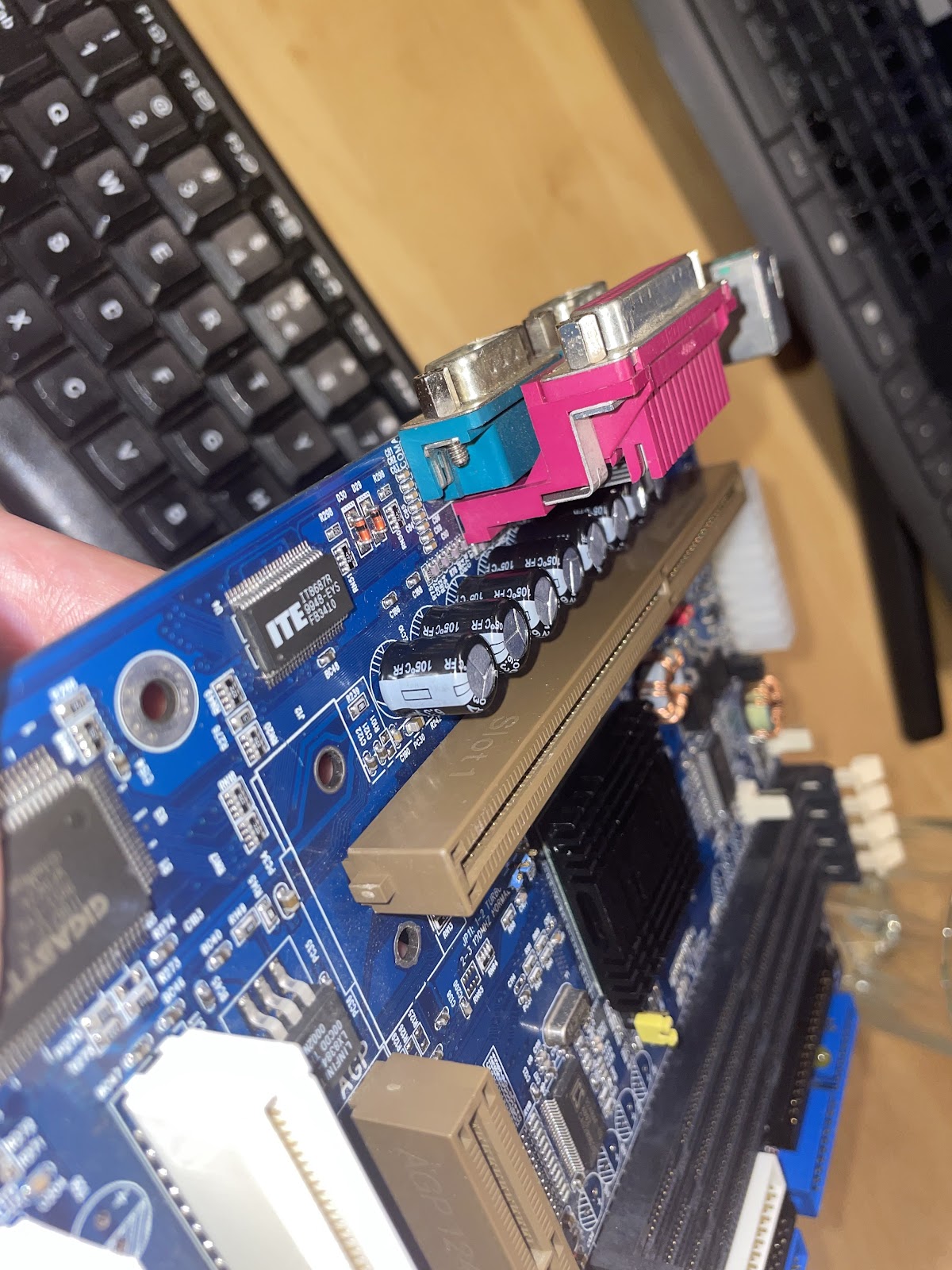
1ANRSVVNGnCCMvmsg-JPfADZLxQvLTBca

1IPluhMEAMgLpwm22INNU637t5RtZhegj

Solder quality demo

1o4JNVzAMp8j6outqEjWgEYyKmyia2wJh

And board after lifting : )

1rtKMTNo-4Slv-7XWP0eHzyI_m5Ruu1Lr

Useful facts

The board has JP20 and JP21 jumpers, labeled as “Close for VOODOO.” In reality, closing them bypasses the voltage regulator on the motherboard (a TO-220 near the AGP slot), and the graphics card is powered directly from the PSU. With the jumpers open, a GeForce3 Ti500 was unable to function properly on this board, as it would hang shortly after entering 3D mode. This is described in more detail in this thread:
Troubleshooting Geforce 3 TI500 after professional reflow - hanging due to too high temperature

The board has "Turbo" JP11 jumper and for the past two years, I haven’t been able to figure out what it actually does. If anyone has an idea, I would be extremely grateful.

1nXjyAkWJn5LhaAhiyT3yDXrMFAFDk_P7

Proof

Nothing special. I didn’t find a dedicated review of the motherboard itself, but I did find a mention of it in a review of the Matrox MG-400 GPU from February 2000. In addition, we have the release dates of the various BIOS versions on the manufacturer’s website via the Web Archive. Since the motherboard has a production date sticker, that serves as the most important piece of evidence.


1a9PKctAcb4M8d5CBLCJWmtPXNxq7Tcas

Reply 9 of 12, by bofh.fromhell

User metadata
Rank Oldbie
Rank
Oldbie

"Turbo" was usually a slight boost in FSB.
Like 68 MHz or 103 MHz.
MB makers pretty much stopped adding it when reviewers caught on and started making sure there were no cheating going on =)

Reply 10 of 12, by dulu

User metadata
Rank Member
Rank
Member

I mentioned earlier that one processor *should* be more powerful than the other. Comparing them isn’t straightforward. There are no direct comparisons, and on top of that, both Thunderbirds and Coppermine CPUs ran on FSB 100 as well as 133. Personally, I’m interested in comparing the processors that fit the boards I’ve shown
PIII-1000/133
Athlon 1200/100 (Thunderbird)
Athlon 1000/100 (Orion)

Below we see a showdown between Coppermine and Thunderbird in the Tom’s Hardware article “Benchmark Marathon: 65 CPUs from 100 MHz to 3066 MHz.” The test motherboard was an Epox EP-BX7+, so the results reflect the 440BX chipset at FSB 133. Very close results between them.

1PBZ9hQ2vwsOW2F-aJFIw-EIrTTOdqDpH

Below we see a comparison of processors from a review of the Pentium III 1.13 GHz under Windows 98. The Athlon 1200 isn’t included, but the Athlon 1100 can already be faster. In games, the PIII wins, but the difference between it and the A1100 is so small that the A1200 would probably take the lead.

1hvaHsI3zVsJFQCYsnopP1UDTxDnJwWvW

Orion is at the bottom of the ranking, but I’d still be very interested in seeing a comparison between Orion and Coppermine at FSB 100 across different clock speeds. Based on scattered bits of information, at lower frequencies Orion takes the lead, while at higher clocks (800 MHz and above) Coppermine comes out ahead.

bofh.fromhell wrote on 2025-12-14, 16:21:

"Turbo" was usually a slight boost in FSB.
Like 68 MHz or 103 MHz.
MB makers pretty much stopped adding it when reviewers caught on and started making sure there were no cheating going on =)

There is in fact a minimal difference in the CPU-Z frequency readout, but we’re talking thousandths of a megahertz. The FSB is reported identically in all cases. Definitely something worth looking into 😀

Reply 11 of 12, by bofh.fromhell

User metadata
Rank Oldbie
Rank
Oldbie
dulu wrote on 2025-12-14, 19:23:

There is in fact a minimal difference in the CPU-Z frequency readout, but we’re talking thousandths of a megahertz. The FSB is reported identically in all cases. Definitely something worth looking into 😀

I'm not sure CPU-z actually measures frequency.
I think it makes a good guess from what info it can grab.

Then again the "turbo" on your MB might do something completely different =)

Reply 12 of 12, by Zem

User metadata
Rank Newbie
Rank
Newbie

This is amazing work. I have a nice unused ATC-201 which I need to sell now (daughter doesn't need it and I have several PCs/laptops) but reading your breakdown is making me re-consider. It has had several PC builds in it and only a couple of months ago I finally replaced the fans which were getting pretty noisy. It is a lovely machine but I can't really justify hanging on to it.
Will be watching your posts with fascination. Have just found this site and it's bringing back so many memories. 😀