VOGONS


First post, by tikoellner

User metadata
Rank Member
Rank
Member

Lately I've got pretty much fascinated with old PC hardware (meaning: I've started accumulating lots of obsolete stuff), like GUS or AWE32, etc.

I have some concerns regarding proper storage to avoid any damage.

It is quite obvious to me that I should use antistatic bags and control humidity. My main concern is related to onboard capacitators and possible leaks. Is there anyhing particular I should do to avoid this kind of thing happening? Do you think that there is a big chance that such a damage will eventually occur?

Speaking of long-term storage I'm thinking about period of 5+ years without using the device.

I will appreciate your help, as it really worries me that all my efforts may be wasted.

Reply 1 of 15, by emosun

User metadata
Rank Oldbie
Rank
Oldbie

The best storage is in a climate controlled house at 60-80 degress with low humidity. Basically a normal indoor environment.

There's nothing you can do about leaking capacitors simply due to the fact of them leaking whenever they want.

All you can do is make sure they are currently in good shape , and periodically check then when they are stored to make sure they didn't start leaking. If they do the least you can do is pop them off the board and toss them out while the hardware is in storage.

Make sure to toss out bios batteries and not store them.

Reply 2 of 15, by bjt

User metadata
Rank Oldbie
Rank
Oldbie

Best storage for old and rare cards? In a working PC, being used on a regular basis. Nothing kills old hardware faster than sitting unused.

Reply 3 of 15, by shamino

User metadata
Rank l33t
Rank
l33t

Older hardware increasingly tends to have tantalum capacitors. They are stable in storage, but they sometimes explode when they are given power again after years of not seeing it. For valuable parts with lots of tantalums, it's probably ideal to power them up every once in a while.
Periodic use is probably desirable for anything really, but even more so if tantalums are involved.

Last edited by shamino on 2016-04-06, 12:59. Edited 1 time in total.

Reply 4 of 15, by nforce4max

User metadata
Rank l33t
Rank
l33t

Be sure to remove any and all dust as much as possible as it attracts moisture during periods when there is high humidity, learned the hard way 😵

On a far away planet reading your posts in the year 10,191.

Reply 5 of 15, by stamasd

User metadata
Rank l33t
Rank
l33t

It might be worth it, if you're concerned about electrolyte leaks from capacitors, to store the card upside-down, i.e. with the components facing the ground. This way any liquids leaking would drip away from the PCB.

I/O, I/O,
It's off to disk I go,
With a bit and a byte
And a read and a write,
I/O, I/O

Reply 6 of 15, by computergeek92

User metadata
Rank Oldbie
Rank
Oldbie

I've had a bunch of complete computer towers in a heated storage unit for about 4 years with no ill effects. Even some with missing case bay covers and expansion slot brackets. Also some mobo combos in antistatic bags are stored in plastic bins there too. I only have 4 years knowledge because I haven’t collected any computers before late 2011. That was the year my hobby started. I suggest storing random parts in unwanted or unused computer cases as another option. It's safer than risking the antistatic bags developing holes or rips from long term use.

Dedicated Windows 95 Aficionado for good reasons:
http://toastytech.com/evil/setup.html

Reply 7 of 15, by Skyscraper

User metadata
Rank l33t
Rank
l33t

When i fired up my mystery box NEAT chipset 286 16 Mhz it had not been powered on for 20 years and it looked like it had been stored in some garage covered in dust and worse. It fired up and the old 20MB MFM HDD had no issues with stuck heads or such. The battery was not the least corroded but I have replaced it with a new one just to be on the safe side. Some hardware just won't die however you store it.

Another such item was a Gravis Ultra Sound I bought, it was sold as untested and had accodring to the seller been stored without any protection at all on top of a bookcase since the late 90s. It was covered in dust but worked just fine. I think the most important thing is to remove NiCd batteries from motherboards. If some cap leaks it usually wont corrode any traces even if the electrolyte can be a pain to remove but once a battery starts to spill its guts everything it comes into contact with quickly gets destroyed

New PC: i9 12900K @5GHz all cores @1.2v. MSI PRO Z690-A. 32GB DDR4 3600 CL14. 3070Ti.
Old PC: Dual Xeon X5690@4.6GHz, EVGA SR-2, 48GB DDR3R@2000MHz, Intel X25-M. GTX 980ti.
Older PC: K6-3+ 400@600MHz, PC-Chips M577, 256MB SDRAM, AWE64, Voodoo Banshee.

Reply 8 of 15, by Snayperskaya

User metadata
Rank Member
Rank
Member

Calcium chloride absorbers work wonders at keeping moisture off your electronics drawer/box.

Reply 10 of 15, by havli

User metadata
Rank Oldbie
Rank
Oldbie

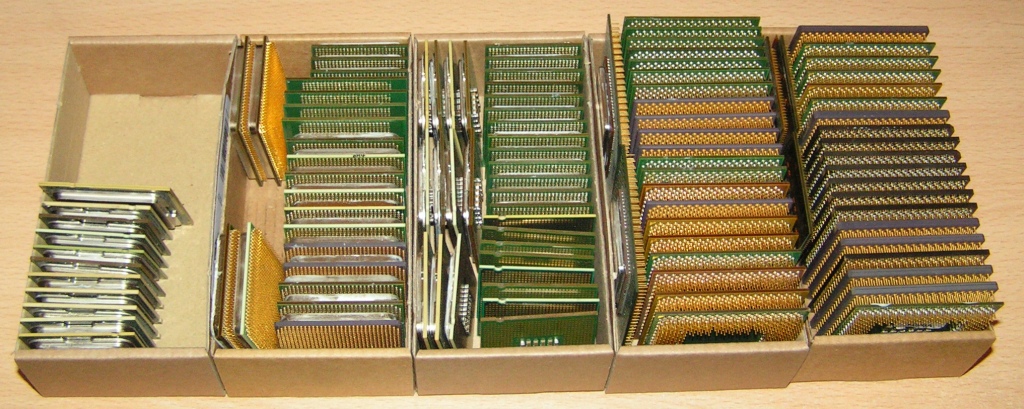
No need for some fancy storage... simple cardboard boxes are good enough. 😀

cpu1vcaof.jpg

vgaqlyy5.jpg

HW museum.cz - my collection of PC hardware

Reply 11 of 15, by computergeek92

User metadata
Rank Oldbie
Rank
Oldbie
havli wrote:
No need for some fancy storage... simple cardboard boxes are good enough. :happy: […]
Show full quote

No need for some fancy storage... simple cardboard boxes are good enough. 😀

cpu1vcaof.jpg

vgaqlyy5.jpg

I still believe they MUST all be stored in antistatic bags or computer cases. ESD failures can happen.

Dedicated Windows 95 Aficionado for good reasons:
http://toastytech.com/evil/setup.html

Reply 12 of 15, by dogchainx

User metadata
Rank Member
Rank
Member

I work in a pharmacy, so I come across a LOT of extra small silica gel desiccant canisters for free. I throw four or five of those in each of the cases and in each antistatic bag to keep humidity off of the electronics. I should start selling those things, since we throw away about 50 a day and they're about $0.50 each online or more.

http://www.ebay.com/itm/1-Gram-Silica-Gel-Cap … DL1rLNU2Te-HKMw

386DX-40MHz-8MB-540MB+428MB+Speedstar64@2MB+SoundBlaster Pro+MT-32/MKII
486DX2-66Mhz-16MB-4.3GB+SpeedStar64 VLB DRAM 2MB+AWE32/SB16+SCB-55
MY BLOG RETRO PC BLOG: https://bitbyted.wordpress.com/

Reply 13 of 15, by havli

User metadata
Rank Oldbie
Rank
Oldbie
computergeek92 wrote:

I still believe they MUST all be stored in antistatic bags or computer cases. ESD failures can happen.

Sure, it doesn't hurt to put your HW in antistatic bag... but it really isn't necessary. Risk of killing CPU or VGA by ESD is very slim. All my hardware is stored like this and maybe one or two components died over the years (out of hundreds). It is not worth the extra space occupied by antistatic bags and money to buy them.

HW museum.cz - my collection of PC hardware

Reply 14 of 15, by seob

User metadata
Rank Member
Rank
Member

I worked a lot with computers back in the day, and now with fire equipment. Stored a lot of items without any static bag, and handled them just as i would handle a phone. Never, ever did any kind of component die on me due to esd. If you just use common sence, not wearing a woolen sweater when handling components and discharge before picking them up, you will be fine.

Reply 15 of 15, by adalbert

User metadata
Rank Oldbie
Rank
Oldbie

I like to use anti-ESD bags anyway, because of their stiffness - they are pretty thick and I can stack the cards on top of each other or even just throw them inside a box or a bag and they will be protected from being scratched by each other and there won't be any broken-off components or capacitors. I am able to buy ESD bags in 3.5 inch HDD size very cheap, they aren't large enough for mounting brackets to fit so I just cut a notch in them and the mounting bracket stays partially outside.

Repair/electronic stuff videos: https://www.youtube.com/c/adalbertfix
ISA Wi-fi + USB in T3200SXC: https://www.youtube.com/watch?v=WX30t3lYezs
GUI programming for Windows 3.11 (the easy way): https://www.youtube.com/watch?v=d6L272OApVg