VOGONS


Question about non-Intel bus speeds

Topic actions

Reply 40 of 45, by Scali

User metadata
Rank l33t
Rank
l33t
oerk wrote:

Strange that the KT7A, which came out later and supports 133MHz FSB, wouldn't support anything over 1000MHz.

Actually, at least in this revision of the manual, they say ~1.2 GHz: http://www.motherboards.org/files/manuals/2/kt7a-raid.pdf
But yea, they don't say 1.4 GHz at least.
I guess you may get lucky, it's basically overclocking. If you happen to have a CPU that is > 1.2 GHz, but happens to be a very power-efficient one, then it may work. I apparently had a pretty crappy one, so having a properly designed motherboard made all the difference.
The MSI K7T Turbo specifically states it can run up to 1800+ (that is 1533 MHz, I later upgraded to one of those to get SSE): http://www.manualslib.com/manual/398372/Msi-K … l?page=9#manual
http://scalibq.wordpress.com/just-keeping-it- … ro-programming/

Reply 41 of 45, by Scali

User metadata
Rank l33t
Rank
l33t
Anonymous Coward wrote:

I believe PCI was originally specced to run between 25 and 33MHz. The only socket 7 type boards I remember using an asynchronous bus were those with VIA chipsets.

I'm pretty sure it's not, see also: http://www.xilinx.com/Attachment/PCI_SPEV_V3_0.pdf
I think a fundamental design decision in PCI was to have the clockspeed fixed, so that PCI cards could run synchronously with a 33 MHz bus, and not worry about any deviations from that speed (as was the problem with ISA and VBL before it).

Edit: Well, this book says otherwise: https://books.google.nl/books?id=tbIvDKSZbR0C … 0speeds&f=false
It states that 33 MHz is the top speed, but it may be implemented at lower speeds. I wonder how many chipsets did this though, vs running them at 33 MHz regardless of CPU-related timings (but, getting back to the original question, I doubt that any boards ran the bus at MORE than 33 MHz under normal conditions.. overclocking features not included).
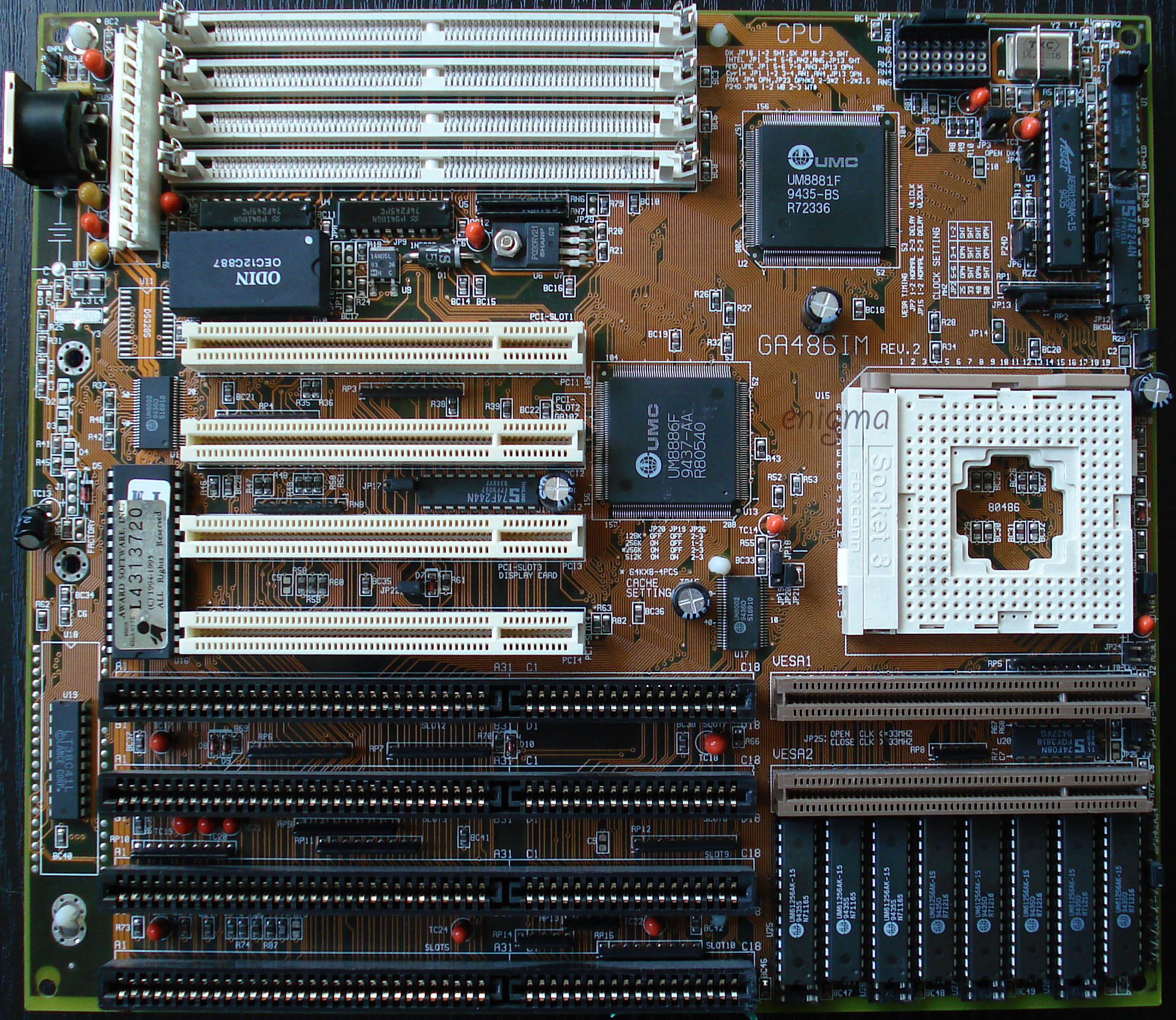
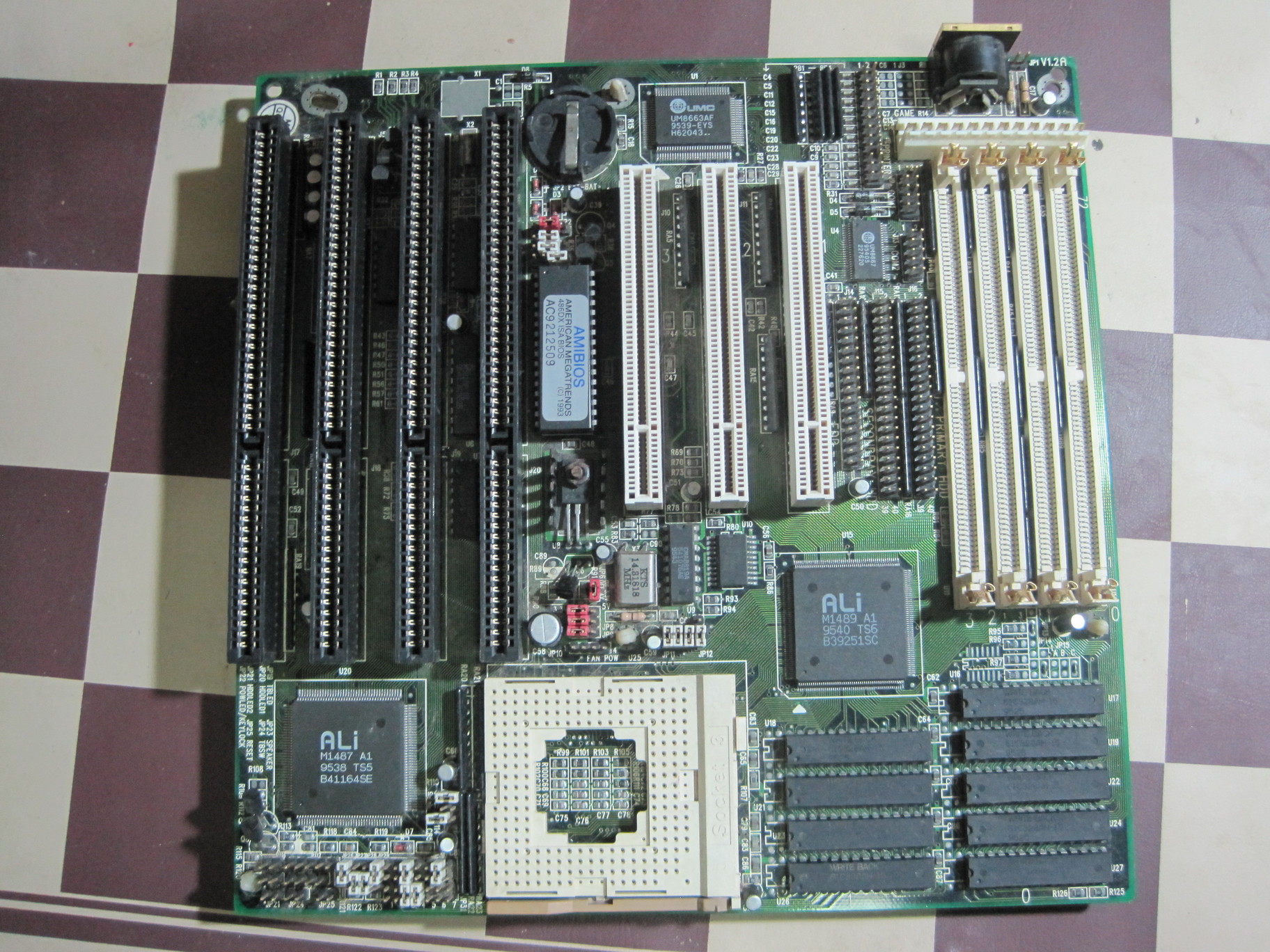
I know at least that in the 486 ISA/VLB age, there was usually a 14.318 MHz crystal somewhere (standard NTSC) to drive things like the PIT and ISA bus at the correct speed, even though none of the 486 CPU/bus speeds are derived from this at all.
See top-right here for example:
mainboard_ga486im.jpg

And here another one, just above the CPU socket:
img_2449.jpg

http://scalibq.wordpress.com/just-keeping-it- … ro-programming/

Reply 42 of 45, by elianda

User metadata
Rank l33t
Rank
l33t

Only late Super Socket 7 Boards added different dividers for FSB:PCI FSB:RAM and FSB:AGP.
For i430 TX the 75 and 83 MHz option was implemented by manufacturers on the boards but not officially supported by Intel. And PCI at 83 MHz was running at 42 MHz. Same applies e.g. for the SIS5591, where at least some manufacturers implemented various dividers. There is a nice photo here http://www.tomshardware.co.uk/review-of-socke … eview-49-5.html where the board implements dividers and for 75 MHz FSB you can have either 32/64 or 37.5/75 for PCI/AGP.
Also for the Gigabyte GA-586SG (SIS5591 based) 83 MHz operation is stated as optional. I had such board running at 42/83 for quite a while with selected components.

Late Boards with 100 MHz FSB option like the P5A-B have jumpers to set different dividers (manual page 16). If the board has no jumpers for this expect it to run as fixed dividers.

Retronn.de - Vintage Hardware Gallery, Drivers, Guides, Videos. Now with file search
Youtube Channel
FTP Server - Driver Archive and more
DVI2PCIe alignment and 2D image quality measurement tool

Reply 43 of 45, by Gamecollector

User metadata
Rank Oldbie
Rank
Oldbie

Yes, 83 MHz FSB was hit-or-miss until SS7 chipsets because of the standard 1:2 divider on S7 chipsets.

Asus P4P800 SE/Pentium4 3.2E/2 Gb DDR400B,
Radeon HD3850 Agp (Sapphire), Catalyst 14.4 (XpProSp3).
Voodoo2 12 MB SLI, Win2k drivers 1.02.00 (XpProSp3).

Reply 44 of 45, by computergeek92

User metadata
Rank Oldbie
Rank
Oldbie
Scali wrote:
My 1400 burnt through 2 of those (as I said, it's the board that is the problem. The PCB traces, voltage regulators and caps are […]
Show full quote
computergeek92 wrote:

Well I suppose if I had a good enough and loud enough cooler, (Like 80mm high rpm fan and copper base heatsink) Then I should be fine with a 1400C? Mobo is the Abit KT7A.

My 1400 burnt through 2 of those (as I said, it's the board that is the problem. The PCB traces, voltage regulators and caps aren't designed to deliver 70+W to the socket. No amount of cooling is going to fix that). Then I got an MSI K7T Turbo, which still survives today.
If you read the small print in the KT7A manual, it says it supports CPUs of 1000 MHz max. I found that out the hard way (sadly the shop didn't warn me about that either. I just bought one of the most popular boards at the time, and the fastest chip for that socket. Even after I returned the board for the second time, they didn't seem to think there was something wrong, but eventually they swapped it for the MSI instead of another Abit, which worked).

I bought a Silverado cooler btw, which was one of the best and most expensive coolers at the time (because I originally got one of those Dual Orb coolers, which was the best the store had to offer at the time. I had to specifically order a better cooler online somewhere, because decent coolers for high-end Athlons weren't readily available at most stores).

I didn't truly understand what "Intel Inside" meant, until I had this Athlon system with VIA chipset (don't get me started on the performance shortcomings and weird glitches of that chipset, or the bugs in the CPU itself, for that matter).

What about a Morgan Duron 1.3GHz? Well, maybe not due to the 1000MHz limit... It ran with 60W TDP. Would I have to worry about bad caps developing with using that cpu or an Athlon T-bird 1000C? BTW an Athlon 1000C (266FSB) runs at 54W so I might choose that. What do you guys think I should do? I want the motherboard configured with the most reliable cpu I can find, but not with one of the slowest models. Alas, I own only version 1.0 of the board and I don't have the manual.

Dedicated Windows 95 Aficionado for good reasons:
http://toastytech.com/evil/setup.html

Reply 45 of 45, by computergeek92

User metadata
Rank Oldbie
Rank
Oldbie

Well I suppose i'll make my own judgement and go with a Morgan Duron at 1GHz. (Only 46W) That should be good enough.

Dedicated Windows 95 Aficionado for good reasons:
http://toastytech.com/evil/setup.html