Here's my experience with MSI Pro266TD Master-LR (MS-9105) on a VIA VT865 chipset with DDR memory.
This is my first DUAL CPU motherboard designed with Tualatins in mind.

ATX Form Factor: 30.4cm x 25.4cm. Nice green PCB 😀
Specifications:
- 2 x 370 sockets with native Tualatin support (FC-PGA2)
- Apollo Pro266T chipset (VT8653+VT8233)
- 4 DDR memory slots!!! (supposedly suporting up to 4 GB of RAM)
- AGP 4x
- IDE RAID!
- LAN, PCI, USB and other standard crap
- No ISA 😜
More info here: https://theretroweb.com/motherboards/s/msi-pr … 266td-master-lr
My general thoughts:
- Runs fine with 1,4 GHz Tualatins(I bought it with two PIII-1133MHz tA1)
- It has a DDR support but it's very picky with RAM!
- BIOS should be more complex.
- Problematic with optimal configuration.
- Its performance is below my expectations.
- The placement of components on PCB is poor (hard to install big, solid radiators)
- It's nice that it works with just one CPU without unnecessary terminators.
BIOS Update:
Although I don't see any major differences between the available BIOSes, it's worth mentioning that the board has settings in the BIOS that block its update. You have to disable it in the BIOS in order to upload a new one.

Otherwise, you'll get an error:

Configuration, OC capabilities and performance:
A) Timing.
I like to push the hardware to the limit (sometime only to see how much it can go), but with this board, it's not that easy... All available BIOSes don't allow you to tighten some timings. The maximum you can set is 2-3-3-6 (CR2), which significantly limits the board's performance in games. Nevertheless, I figured out how to set timings to 2-2-2-5 (CR2) using WpcREDIT and this is what it looks like:

We have to edit offset 64 (set 00 01 10 10 = 2-2-2-5 CR2) where: (check the attached picture)
Bits 7 and 6 = 00 give x-x-2-5; 01 (x-x-2-6); 10 (x-x-3-5)
Bits 5 and 4 = 01 give 2-x-x-x; 00 (1.5-x-x-x supposedly...)
Bits 3 and 2 = 10 give x-2-x-x; 01 (x-3-x-x)
Bits 1 and 0 = better left unchanged, this is probably responsible for RAM Interleave
Unfortunately I couldn't figure out what is responsible for Command Rate and this is a big problem 🙁
B) Overclocking.
The advantage of this board is that you can adjust the FSB in 1MHZ increments from 133 to 166 MHz! Unfortunately, you can't raise the voltage for CPUs, so all we have left are Volt-MODs if necessary. I can assure you that the board reaches 166 MHz and is totally stable (even on CL-2-2-5). There is a high chance there is some more OC potential (similar platforms have OC options up to 200MHz), but it would require some modifications to go beyond 166 MHz options.
C) Performance (Windows XP SP3):
Performance is probably the biggest disappointment I've encountered while having fun with this board... For sure the makers of it had stability in mind in the first place, and even though the board has an AGP, I wouldn't expect a lot of frames in games. This platform has terribly low memory latency (107ns)!!!

This is what it looks like when you set the maximum timings in BIOS 2-3-3-6(CR2)
3DMARK 2001SE

A bit better with other memories (GEIL)
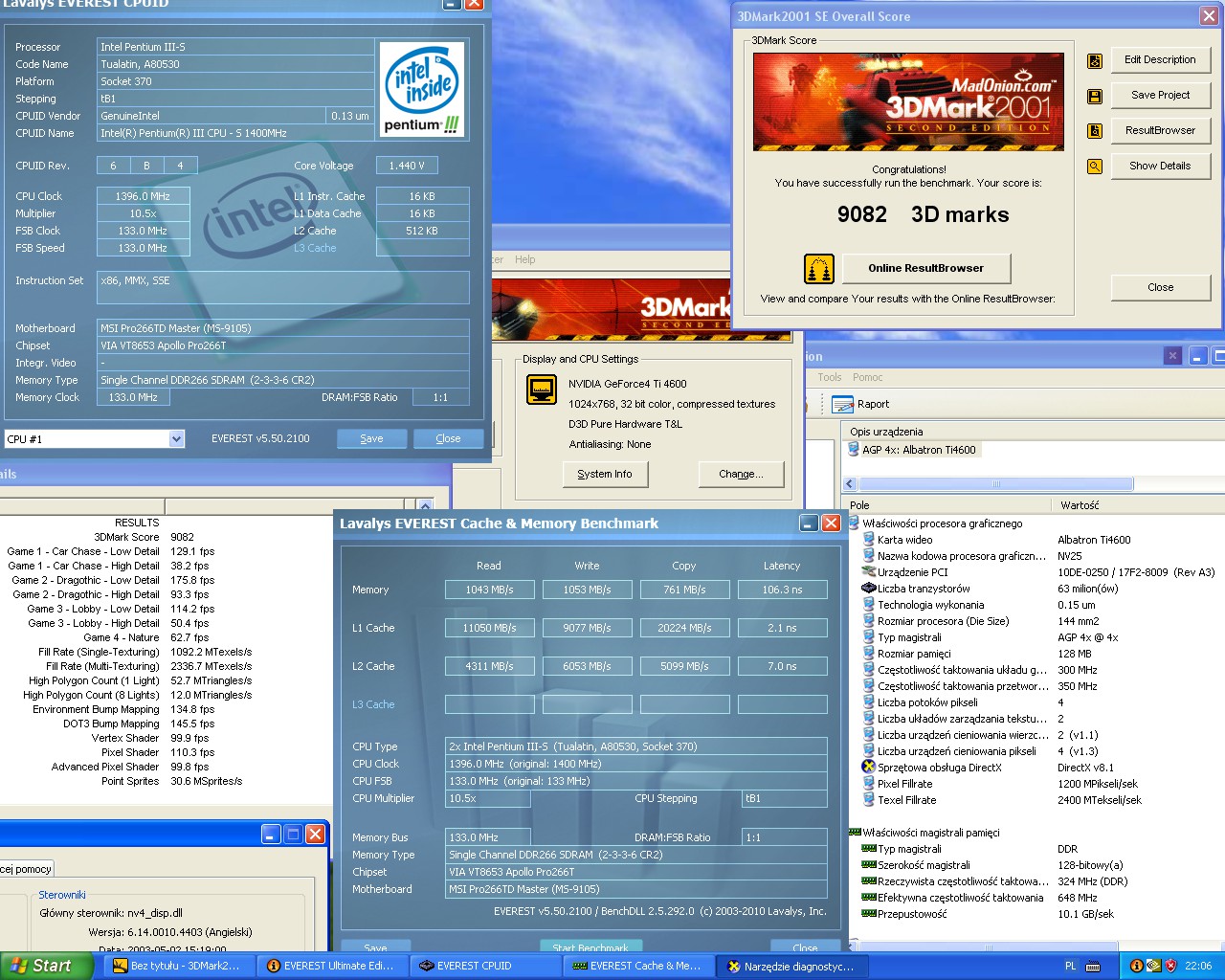
Note that these results are even worse than on an old VIA 693A chipset!
I expected at least 9500 points, but deep inside I was hoping for for some 9800 or even 10 thousand points (this is what you could get on SiS635T or Intel BX based boards) and here, even after overclocking the processor to 150 MHz, you don't get 10 thousand points!!

Anyway... there is still WPCREDIT where you can manually lower the timings 😉 Here are some improved results:
The timings are a bit better 102.4ns:

SiSoft Sandra:

3D Marks:


(as a reference take a look at those charts Project Tualatin 2018)
PERFORMANCE SUMMARY:
Cachemem Memory Latency - 102.4ns - 7th place (better than VIA 693A and worse than Intel 815)
SiSoft Sandra:
MEMORY CPU: 494 MB/s - 3rd/4th place (better than Intel BX - 468 and worse than VIA VT8633 - 526)
MEMORY FPU: 515 MB/s - 3rd/4th place (better than Intel BX - 473 and worse than VIA VT8633 - 528)
CPU DHRYSTONE: 4168 MIPS - 1st place (the best, then 3838)
FPU Whetstone: 2044 MFLOPS - 1st place the (best, then 2000)
PC MARK 2002:
4431 CPU - 2nd place (4438 - Intel BX and 4427 SiS 635T DDR)
2802 RAM - 2nd place (2839 - Intel BX and 2587 Intel I815)
3D Mark 2000 - 9685 points - 11th place (only Intel I820 was worse with 9371 points, still better than ALI M1651T with 10361 points)
3D Mark 2001SE - 9381 points - 8th place (better than ALI with DDR but worse than VIA 694T - 9481 points)
(CPU 1400 MHz WinXP, MAX settings NO SMP)
QUAKE III
1280x1024 = 184.8 FPS - 7th place (placed between 187.2 points on VIA 694T and intel I820; the first was SiS 635T with 197.2 FPS)
640x480 = 205.6 FPS - 8th place (placed between 205.9 points on IntelI820 and ALI DDR 194.6; the first was SiS 635T with 227.2 FPS)
SERIOUS SAM
OpenGL 1280x1024 = 59.3 FPS - 2nd place (after 57.4 FPS, the best was SiS 635T - 60.2)
Direct 3D 1280x1024 = 25.3 FPS - 12th place (the worst result, the next is 26.6 FPS - intel I820; the best was SiS 635T - 35.8 FPS)
D) Overclocking Performance:
You can expect a performance increase of around 20%
150MHz no problem:

166 MHz CL2-2-2-5(CR2)


GEFORCE 6800 GT:


I wanted to do a thorough comparison with the project TualGOD Project, however I don't have two SL6BY Tualatins with VOLTMODs...
The problem is that with Command Rate set to 2, the board slows down significantly. Such comparison wouldn't be truly fair and at the moment I have no idea how to lower it to CR1 🙁
To sum up:
- The board is definitely interesting (DDR1 sockets, 2x socket 370, there is IDE RAID!) and I think that every Tualatin fan should have at least one of those or a similar one!
- Bad performance caused by poorly developed BIOS and some problems with RAM support.
- Limited overclocking options.
- You can install up to 4 GB of RAM!
- IDE RAID support!
- Possible to reach 166 MHz FSB with CL2-2-2-6 timings - everything stable (no 1/5 divider though!)
- It will definitely perform much better in applications that utilize 2 CPUs 😉