VOGONS


Gigabyte GA-5AX AGP Voltage Mod

Topic actions

First post, by TELVM

User metadata
Rank Oldbie
Rank
Oldbie

Revision 5.2 of this board has a jumper (JP13) to switch AGP VCC3 from the onboard linear regulator to the PSU's +3.3V rail:

file.php?mode=view&id=246578

That sounds like a very good idea to me.

Unfortunately my GA-5AX is Rev. 4.1, and lacks said jumper:

file.php?mode=view&id=246579

I've read some allusions to a mod that bypasses the linear regulator by soldering a wire directly from a 3.3V pin in the ATX20 connector, to get the same effect that jumper JP13 does on Rev. 5.2 boards. But I can't find detailed info or pics.

Could some Vogoner with knowledge on this mod please shed some light on the subject?

Let the air flow!

Reply 1 of 22, by shevalier

User metadata
Rank Oldbie
Rank
Oldbie

Re: Gigabyte GA-6BA motherboard not good for voodoo3

Aopen MX3S, PIII-S Tualatin 1133, Radeon 9800Pro@XT BIOS, Audigy 4 SB0610
JetWay K8T8AS, Athlon DH-E6 3000+, Radeon HD2600Pro AGP, Audigy 2 Value SB0400
Gigabyte Ga-k8n51gmf, Turion64 ML-30@2.2GHz , Radeon X800GTO PL16, Diamond monster sound MX300

Reply 2 of 22, by TELVM

User metadata
Rank Oldbie
Rank
Oldbie

Thanks Shevalier! 👍

Let the air flow!

Reply 3 of 22, by TELVM

User metadata
Rank Oldbie
Rank
Oldbie

BTW, [SARCASM] as much as I loved those 10mm 25V 330uF they placed on the CPU VRM output bank, this is another circuit of the GA-5AX where Gigabyte really did a stellar job with their cap selection [/SARCASM].

Infinity guideline for the LX8383 linear voltage regulator:

file.php?mode=view&id=246621

Gigabyte's master OEM recipe for the application: Cheap lytic 8mm 25V 330uF Soyos (of who knows what ESR) ...

file.php?mode=view&id=246622

Let the air flow!

Reply 4 of 22, by majestyk

User metadata
Rank Oldbie
Rank
Oldbie

It´s a linear regulator, not a step down circuit so high frequency ripple isn´t the main concern. The data sheet shows an application as Vcore VRM for a Pentium CPU and it´s response to 7.5A transients.
AGP graphic adapters at that time might not have caused transients like this so "inferior" electrolytics could cope with it.
At the time of developement mainboard manufacturers also didn´t / couldn´t anticipate future graphics upgrades with heavily incresed power consumptions.
Epox boards had a linear VRM transistor for AGP supply soldered to the pcb without addtl. cooling that got boiling hot as soon as you used some Radeon 9xxx card. (The Radeon 9800 for example was released in 2003, TDP=37W)

Last edited by majestyk on 2026-08-01, 08:57. Edited 2 times in total.

Reply 5 of 22, by shevalier

User metadata
Rank Oldbie
Rank
Oldbie

The linear regulator on ATX motherboards is an artifact from the AT era, which lacks a 3.3V rail.
The stabilized 3.3V voltage only makes sense for early AGP cards whose core and memory are powered directly from this rail—like the ATI Rage. This slightly improves stability.
For any newer cards, it is only harmful.
The presence of a jumper does not solve the problem, and often exacerbates it.
This is because it is absolutely forbidden to connect two voltage sources in parallel.
The only viable option is to remove the regulator itself and create a direct connection between the ATX connector and the AGP slot.
There are simply no other viable options to solve this problem.

Aopen MX3S, PIII-S Tualatin 1133, Radeon 9800Pro@XT BIOS, Audigy 4 SB0610
JetWay K8T8AS, Athlon DH-E6 3000+, Radeon HD2600Pro AGP, Audigy 2 Value SB0400
Gigabyte Ga-k8n51gmf, Turion64 ML-30@2.2GHz , Radeon X800GTO PL16, Diamond monster sound MX300

Reply 6 of 22, by TELVM

User metadata
Rank Oldbie
Rank
Oldbie

Thanks for your contributions. 👍

shevalier wrote on 2026-08-01, 05:40:

The linear regulator on ATX motherboards is an artifact from the AT era, which lacks a 3.3V rail ...

^ That makes a bit of sense, however all GA-5AX versions I've seen have just one ATX power connector, no AT power connector is present.

shevalier wrote on 2026-08-01, 05:40:

... The stabilized 3.3V voltage only makes sense for early AGP cards whose core and memory are powered directly from this rail—like the ATI Rage. This slightly improves stability.
For any newer cards, it is only harmful ...

^ Interesting, could you please elaborate some more on this?

shevalier wrote on 2026-08-01, 05:40:

... The presence of a jumper does not solve the problem, and often exacerbates it.
This is because it is absolutely forbidden to connect two voltage sources in parallel ...

^ I bet that "brilliant" idea came from the same "genius" that made the "exquisite" selection of capacitors. 👎

Let the air flow!

Reply 7 of 22, by shevalier

User metadata
Rank Oldbie
Rank
Oldbie
TELVM wrote on 2026-08-01, 08:44:
shevalier wrote on 2026-08-01, 05:40:

... The stabilized 3.3V voltage only makes sense for early AGP cards whose core and memory are powered directly from this rail—like the ATI Rage. This slightly improves stability.
For any newer cards, it is only harmful ...

^ Interesting, could you please elaborate some more on this?

1719-front-large.jpg
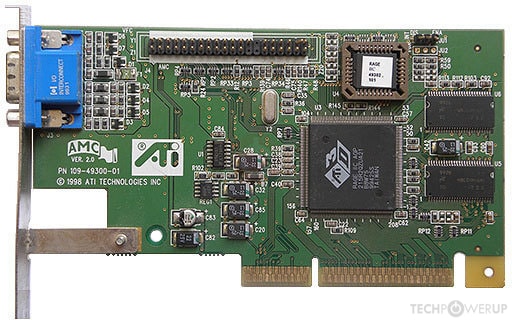
Just look at this graphics card yourself.There isn't a single voltage regulator on it.The GPU, memory, and flash ROM are all powered directly from the 3.3V rail.
Back then, the AGP slot (or the +3.3V local bus) was often cranked up to 3.5V (and higher) to improve stability.
Even the Riva TNT2 already had a dedicated voltage regulator for the GPU.And DDR-based graphics cards (which require 2.5V) had regulators for the memory as well, like the GeForce4 MX440.

So, there is absolutely no point to this linear AGP regulator.

Aopen MX3S, PIII-S Tualatin 1133, Radeon 9800Pro@XT BIOS, Audigy 4 SB0610
JetWay K8T8AS, Athlon DH-E6 3000+, Radeon HD2600Pro AGP, Audigy 2 Value SB0400
Gigabyte Ga-k8n51gmf, Turion64 ML-30@2.2GHz , Radeon X800GTO PL16, Diamond monster sound MX300

Reply 8 of 22, by TELVM

User metadata
Rank Oldbie
Rank
Oldbie
shevalier wrote on 2026-08-01, 16:29:

... Back then, the AGP slot (or the +3.3V local bus) was often cranked up to 3.5V (and higher) to improve stability ...

^ Ah I think I get it now, thanks.

So to summarize (please correct me if I'm wrong):

· With early AGP graphic cards (~ ATI Rage, Riva TNT) that ran everything on card from external 3.3V, and draw little current, at "VCC3=3.58" the LX8383 gives them a voltage boost that may improve stability.

· With later AGP graphic cards (~ from ATI Rage 128 / TNT2 / Voodoo 2 onwards) with integrated on card voltage regulators, and higher current draw, the LX8383 no longer brings anything to the table, and its 7.5A max rating becomes a problem => Extirpate & solder wire from PSU +3.3V rail.

Let the air flow!

Reply 9 of 22, by shevalier

User metadata
Rank Oldbie
Rank
Oldbie
TELVM wrote on 2026-08-02, 09:22:
^ Ah I think I get it now, thanks. […]
Show full quote
shevalier wrote on 2026-08-01, 16:29:

... Back then, the AGP slot (or the +3.3V local bus) was often cranked up to 3.5V (and higher) to improve stability ...

^ Ah I think I get it now, thanks.

So to summarize (please correct me if I'm wrong):

· With early AGP graphic cards (~ ATI Rage, Riva TNT) that ran everything on card from external 3.3V, and draw little current, at "VCC3=3.58" the LX8383 gives them a voltage boost that may improve stability.

· With later AGP graphic cards (~ from ATI Rage 128 / TNT2 / Voodoo 2 onwards) with integrated on card voltage regulators, and higher current draw, the LX8383 no longer brings anything to the table, and its 7.5A max rating becomes a problem => Extirpate & solder wire from PSU +3.3V rail.

Yes, that is completely correct.
It looks most hilarious with the 4MX440.
The reference design implies a switching regulator for the core. Cheap cards have a linear one. The core supply voltage is 1.5V.
Thus, if the motherboard also uses a linear regulator, then 70% of the power is wasted as pointless heat.
The GPU consumes 5 Watts, and 10 Watts is dissipated by the regulators

Aopen MX3S, PIII-S Tualatin 1133, Radeon 9800Pro@XT BIOS, Audigy 4 SB0610
JetWay K8T8AS, Athlon DH-E6 3000+, Radeon HD2600Pro AGP, Audigy 2 Value SB0400
Gigabyte Ga-k8n51gmf, Turion64 ML-30@2.2GHz , Radeon X800GTO PL16, Diamond monster sound MX300

Reply 10 of 22, by TELVM

User metadata
Rank Oldbie
Rank
Oldbie
shevalier wrote on 2026-08-02, 10:00:

... 70% of the power is wasted as pointless heat ...

^ That's bonkers! Intelligent design at its best. 😀 😀 😀

file.php?mode=view&id=246717

file.php?mode=view&id=246718

.

There is another extra benefit from this mod.

With the LX8383 in place, AGP / RAM / Chipset / PCI are in fact ultimately drawing their juice from the PSU +5V rail.

After eliminating the voltage regulator, they'll switch to truly drawing from the ATX PSU +3.3V rail.

In ATX group regulated PSUs, this unloading of the +5V rail will have a beneficial effect on voltage stability.

(The +3.3V rail is independently, mag-amp regulated In group-regulated ATX PSUs).

file.php?mode=view&id=246720

Let the air flow!

Reply 11 of 22, by TELVM

User metadata
Rank Oldbie
Rank
Oldbie

Is it me, or there are also many Slot 1 boards that sport this "feature"?

file.php?mode=view&id=247038

file.php?mode=view&id=247039

file.php?mode=view&id=247040

Does the same solution (remove linear regulator + direct wire from PSU +3.3V) apply here, or are there perhaps special considerations in the case of Slot 1 boards?

Let the air flow!

Reply 12 of 22, by shevalier

User metadata
Rank Oldbie
Rank
Oldbie

Yep, if this regulator used to powering agp/pci
As i speak earlier, its AT artifact
Intel reference design for 440bx chipset is not tell as about this pervertion - just direct connect to ATX connector

Aopen MX3S, PIII-S Tualatin 1133, Radeon 9800Pro@XT BIOS, Audigy 4 SB0610
JetWay K8T8AS, Athlon DH-E6 3000+, Radeon HD2600Pro AGP, Audigy 2 Value SB0400
Gigabyte Ga-k8n51gmf, Turion64 ML-30@2.2GHz , Radeon X800GTO PL16, Diamond monster sound MX300

Reply 13 of 22, by myne

User metadata
Rank l33t
Rank
l33t

So what's the solution?
Pull the chip and solder a wire from 3.3 direct to the big fat pad?

I built:
Convert old ASUS ASC boardviews to KICAD PCB!
Re: A comprehensive guide to install and play MechWarrior 2 on new versions on Windows.
Dos+Windows 3.11+tcp+vbe_svga auto-install iso template
Script to backup Win9x\ME drivers from a working install
Re: The thing no one asked for: KICAD 440bx reference schematic

Reply 14 of 22, by TELVM

User metadata
Rank Oldbie
Rank
Oldbie

On the Gigabyte GA-5AX, either the big fat pad or the hole where the central leg of the LX8383 linear voltage regulator goes in:

file.php?mode=view&id=247046

On the ATX power connector end, the wire has to be soldered to all three +3.3V pins:

file.php?mode=view&id=247047

file.php?mode=view&id=247048

It must be a thick wire.

Let the air flow!

Reply 15 of 22, by TELVM

User metadata
Rank Oldbie
Rank
Oldbie
shevalier wrote on Today, 08:32:

Yep, if this regulator used to powering agp/pci
As i speak earlier, its AT artifact
Intel reference design for 440bx chipset is not tell as about this pervertion - just direct connect to ATX connector

^ Thanks Shevalier. 👍

Let the air flow!

Reply 16 of 22, by myne

User metadata
Rank l33t
Rank
l33t

I'd use the bolt hole.
Much easier and fatter than the leg hole.

I built:
Convert old ASUS ASC boardviews to KICAD PCB!
Re: A comprehensive guide to install and play MechWarrior 2 on new versions on Windows.
Dos+Windows 3.11+tcp+vbe_svga auto-install iso template
Script to backup Win9x\ME drivers from a working install
Re: The thing no one asked for: KICAD 440bx reference schematic

Reply 17 of 22, by shevalier

User metadata
Rank Oldbie
Rank
Oldbie

Near the RAM slots, there is an unpopulated footprint for an electrolytic capacitor.
If it's on the +3.3V rail, I would try running a jumper wire to it.
That way the run will be much shorter, and you can use a thinner wire.
Plus, it will look much cleaner.

But again, I don't have this board.
I don't know where this pad goes.
This needs to be checked with a multimeter.

Last edited by shevalier on 2026-08-08, 11:34. Edited 1 time in total.

Aopen MX3S, PIII-S Tualatin 1133, Radeon 9800Pro@XT BIOS, Audigy 4 SB0610
JetWay K8T8AS, Athlon DH-E6 3000+, Radeon HD2600Pro AGP, Audigy 2 Value SB0400
Gigabyte Ga-k8n51gmf, Turion64 ML-30@2.2GHz , Radeon X800GTO PL16, Diamond monster sound MX300

Reply 18 of 22, by zami555

User metadata
Rank Member
Rank
Member
TELVM wrote on 2026-08-01, 08:44:

^ I bet that "brilliant" idea came from the same "genius" that made the "exquisite" selection of capacitors. 👎

I bet the decision was made by management and financial departments of Gigabyte. Engineers usually try to do their best with designing something... And then others come in and decide. It's just a few words from me to support the engineer who worked on this design 😉

Reply 19 of 22, by shevalier

User metadata
Rank Oldbie
Rank
Oldbie
zami555 wrote on Today, 11:32:
TELVM wrote on 2026-08-01, 08:44:

^ I bet that "brilliant" idea came from the same "genius" that made the "exquisite" selection of capacitors. 👎

I bet the decision was made by management and financial departments of Gigabyte. Engineers usually try to do their best with designing something... And then others come in and decide. It's just a few words from me to support the engineer who worked on this design 😉

You're not seriously telling me that a piece of wire (a PCB trace in this case) costs more than a regulator, are you? 😀
It's just brainless copy-pasting.
Asus S370/Slot 1 boards have a mindless copy-paste of 10+22µF caps, just because Intel specified 33µF for filtering. Even though Intel themselves always put a 47µF tantalum inside the socket.

Aopen MX3S, PIII-S Tualatin 1133, Radeon 9800Pro@XT BIOS, Audigy 4 SB0610
JetWay K8T8AS, Athlon DH-E6 3000+, Radeon HD2600Pro AGP, Audigy 2 Value SB0400
Gigabyte Ga-k8n51gmf, Turion64 ML-30@2.2GHz , Radeon X800GTO PL16, Diamond monster sound MX300