Reply 20 of 29, by Gmlb256
Yep, Intel Arc GPUs got a terrible start but at least they aren't based on the i740 architecture, and the drivers are improving over time.
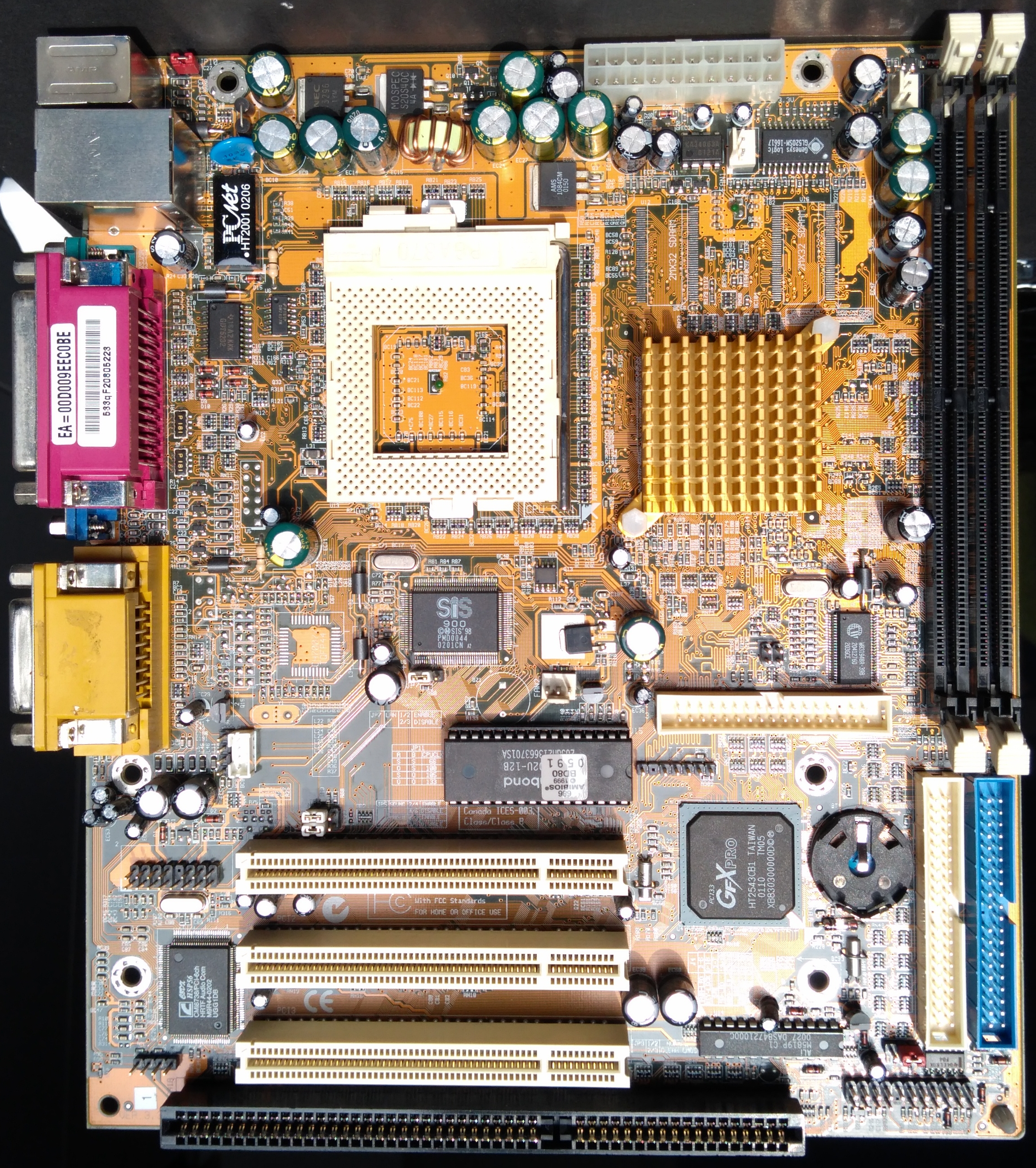
You have the PCChips M754LR+ with onboard TNT2, CMedia 8738 sound and also ISA slot for SB.
I've had the chance to get one of these recently and built a compact mATX retro-pc, still need to take some pics to show it on a new thread.

I lowkey wanna see a benchmark faceoff for win98 pre-2000 stuff, on duron 600 on boards with the various early socket A onboard graphics solutions, cyberblade vs savage vs SiS 315. ... though it got a bit better later on socket A with unichrome and NF2... I have heard tell that if you restrict comparisons to the only things you'd expect the NF2 to be any good on anyway, the unichrome doesn't do too bad on them either.
When I get into low level repairs on the trash thrash motherboard, that might be up for some onboard action, though I paired it with a radeon for a bit more oomph.
Earlier than socket A, there was the late P54 early P55 era when there were Rage and S3 onboard non integrated solutions that were sorta commonish. Intel did some on their first ATX boards, onboard SB16 was optional with those I think. For that time though when top end 3D was "nice to have" but you still had a chance of running things in lower res or software, the S3 etc weren't all that bad.... one could of course bolt on a V2 or PVR to help them out.
Back into the 486es it was more LPX style systems that had onboard, non integrated, ranging from ET4000, thru GD54xx to S3s of various sophistication. Usually you could override these with a VLB or PCI card, but for DOS performance the real gain was only a few percent so only much point for higher res and RAM in windows.
Unicorn herding operations are proceeding, but all the totes of hens teeth and barrels of rocking horse poop give them plenty of hiding spots.
DerBaum wrote on 2023-11-17, 15:46:Times never change :smirk: […]
Gmlb256 wrote on 2023-11-17, 15:30:...Intel ... obviously isn't ideal for 3D games.
Times never change 😏
Here I was relaxing in bed about to go to sleep when your post caught me so off guard I was left in tears. Thanks for that
That dude could also have been XGI when they were overhyping the Volari 🤣
Unicorn herding operations are proceeding, but all the totes of hens teeth and barrels of rocking horse poop give them plenty of hiding spots.
BitWrangler wrote on 2023-11-18, 05:16:I lowkey wanna see a benchmark faceoff for win98 pre-2000 stuff, on duron 600 on boards with the various early socket A onboard […]
I lowkey wanna see a benchmark faceoff for win98 pre-2000 stuff, on duron 600 on boards with the various early socket A onboard graphics solutions, cyberblade vs savage vs SiS 315. ... though it got a bit better later on socket A with unichrome and NF2... I have heard tell that if you restrict comparisons to the only things you'd expect the NF2 to be any good on anyway, the unichrome doesn't do too bad on them either.
When I get into low level repairs on the trash thrash motherboard, that might be up for some onboard action, though I paired it with a radeon for a bit more oomph.
Earlier than socket A, there was the late P54 early P55 era when there were Rage and S3 onboard non integrated solutions that were sorta commonish. Intel did some on their first ATX boards, onboard SB16 was optional with those I think. For that time though when top end 3D was "nice to have" but you still had a chance of running things in lower res or software, the S3 etc weren't all that bad.... one could of course bolt on a V2 or PVR to help them out.
Back into the 486es it was more LPX style systems that had onboard, non integrated, ranging from ET4000, thru GD54xx to S3s of various sophistication. Usually you could override these with a VLB or PCI card, but for DOS performance the real gain was only a few percent so only much point for higher res and RAM in windows.
I’m currently running Epox 8rga+ in my 2003 Socket A rig. I didn’t use the onboard graphics that much before installing 5900XT in it, but it sure was handy at the testing phase after I recapped the board.
I think nForce2 IGP was a great solution for the time and it really puts the dual channel of nF2 in a good use. That is actually the reason why nVidia made the dual channel support as vanilla socket A barely gets any performance uplift from it. I don’t know about other IGP boards, but 8rga+ has also MCP-T, which means Soundstorm. I didn’t bother installing a sound card on this machine, because I don’t have any complaints about the audio performance or noise so far.
I’d rate this nForce2 IGP the first fully integrated chipset which provides more than just simple and cheap desktop platform for system integrators. Sure, GF4MX isn’t exactly top end for ~2003 when these boards mostly came out, but with 100MHz AGP bus and dedicated memory channel (when you have memory in dual channel configuration) gives it a better performance than top end GF2 cards, so it isn’t completely useless for 3D either.
imi wrote on 2022-08-27, 16:40:also I think the cache modules might be proprietary?
hardware38_22.jpg
Sort of. Electrically, they are identical to regular COAS modules you can find on fleabay. Mechanically, the slot has a little pin/blocker thing at bottom edge that will block you from using a standard coast module.
I cut off the excess plastic, installed a regular 256k coast module in the board and it runs fine. It is a bit picky about L2 cache, it took 3 attempts to find a compatible module.
i like anonymous dull business desktop motherboards! well, i like the feature rich enthusiast boards more - but i like those budget ones too
i recently tested out a 'trigem cognac' with i810E and the glorious 3d power of i752 plus amazing CS54299 ac97 sound. It even came with a powerful celeron 900mhz!
it was very cheap and an impulse buy, actually its fine with win98se and once i find another 64mb ram (to double it) it will be fine with all kinds of 9x era applications and (2d) games
i'll build a small amateur slef-build case and have it as an experiment set up, with low wattage psu, ide to sdcard and no fdd/hdd or cd
and if it all goes wrong its ok - that's one of the advantages 😀
The most curious motherboard with everything integrated that I have is in an Intel DOT station 2300 (http://www.museohc.com/blog/paquito.html). The motherboard is an Intel MO810E (https://theretroweb.com/motherboards/s/intel- … al,-intel-dot-s).
With a Celeron 600Mhz and 256MB RAM it is an interesting computer with everything integrated for Windows 98 as long as it is limited to Directx 6 games, the integrated Intel 752 graphics (https://vintage3d.org/i752.php#sthash.aQKOJ54S.dpbs), is quite compatible for both Direct3D and OpenGL, I always take as a base the 25 FPS that I consider playable for games of the time, although that is just my opinion.
The 14" monitor is a good companion for this graphic since at 640x480, in my opinion, the image is very good.
The CT1373 Audio chip has nothing relevant, is a Creative Audio PCI 128, also quite suitable for Windows 98.
I also have a FSC-XS D1215 with AIMM module 4MB. It's a very nice machine but there is currently no amithlon support even if it has a linuxkernel-driver.
Retro-Gamer 😀 ...on different machines