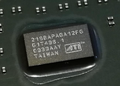
LunarG wrote on 2026-03-10, 13:24:Got an appropriate graphics card for my Pentium 60 today. […]
Show full quote
Got an appropriate graphics card for my Pentium 60 today.
I want to benchmark my Pentium 60 "like-for-like" against my Intel DX4 100. There have been so many debates over the years about which one was faster.
My impression back in the mid '90s, when my best friend had a Pentium 60, was that it was definitely faster than any 486. Granted, back then I didn't really know of people running AMD 5x86s clocked at 160+MHz, and I am absolutely certain they'd demolish a lowly 60MHz Pentium. But a mutual friend had a DX4, and it was definitely slower than my friend's Pentium 60... But I have no clue what hardware was in that DX4.
So in my own DX4 I have a VLB Diamond Stealth 64 DRAM (Vision 864 Chip) with 2MB, which should be basically identical to this PCI card, despite this one being the 868 (only means it's got added video playback acceleration). There is one major difference, the drive controller. My 486 uses a VLB IDE controller, while my Pentium uses a PCI SCSI controller, due to the onboard IDE controller being buggy. This was a common issue with Socket 4 motherboards, they seemed to favour a controller chip which unfortunately was highly buggy. This could explain why my friend's Pentium back in the day ALSO had SCSI.
Once I an certain both systems are running flawlessly, I'll run a bunch of different benchmarks, both MS-DOS and Windows 3.x to see how they compare.
The attachment Diamond Stealth 64 PCI.jpg is no longer available
Interesting project. I can recall a few snippets from that area of comparison from back in the day. This was around the turn of the millennium, and I was deciding which machine should have most/best RAM, case and soundcard to be 3rd best machine in the house for office/web to keep the family from continually bugging my wife and I for our machines. So it was a Socket 4, Pentium 60, vs a UMC board with an AMD DX4. I think it was an 8kb write through setup, the DX4s with 16kb write back may do better on some things. The P60 had i/o disadvantage, because of nothing onboard, and having to use ISA i/o card, while the DX4 had fast onboard and VLB. I don't think the P60 got very good graphics either, maybe a GD5430 PCI which was slower than GD5429 in the VLB slot.
Seemed that unless you were going to make things all about Quake, then you could "prove" it either way. Older stuff favored the DX4, think it did best on 386 and 16bit code, while the P60 beat the DX4 on anything more 486 specific, floating point and new stuff with pentium optimisations. But there is also stuff that will cache and optimise in the pentium pipeline and it will scream through. Subjectively, it was a bit of a wash in wfwg 3.11, testing because of familiarity, but it was losing browser support, but we had a lot of old windows software. DX4 and P60 felt about the same, if there was a gain in one app, there was a loss in another. Win95 was a different story, just ran way smoother on the P60, it felt built for a P60. Then the P60 could do things the DX4 could not do, like play mp3s from winamp while scrolling pages on netscape or using word. The DX4 would glitch and stutter, it could play mp3 OR do work. Forget what bitrate we were using then though, probably better than 56kbit but not as high as 192 or so. Also SWF, shockwave flash animations were the new thing and the P60 could play them, while the DX4 struggled badly.
So this was a system for use "going forward" the P60 thus "won" with whatever could be got working in win95 and tough luck about the old apps that wouldn't play nice. My Cyrix 5x86 which I had overclocked into close to P90 performance levels, which I was using at the time, was a bit faster, even on "pentium class" instructions but not "specifically intel pentium optimised" code. i.e. stuff like quake pretty much using timing hacks.
In theory though, a pentium can be brought to it's knees with some kinds of half word bit shifting operations which it takes twice the clocks to perform than a 486 does. Find code that does much of that and suddenly a P60 will look like a 486DX33.
In general though, the one thing you tend to notice on say 1995ish era games that are pentium recommended, 100mhz 486 can just about play it, is that it is a lot smoother on the P60, even if not technically giving higher frame rates, it just flows, where fast 486 might stumble and stutter a bit then gain speed for a moment, then drop back. I think the larger write back cache models improve things there too though.
From launch the P60 had some killer apps that were FPU intensive, but wasn't all that impressive on the installed code base of general 16/32bit DOS and Win3.x programs for a couple of years. Thus why people thought it was an overpriced dud, and also why a P75 was seen as "not worth it" vs a fast 486 in 1995 by a lot of people. However, by 1996 into 1997 there was a lot more pentium optimisation going on and a lot of discarding of old 16 bit stuff in Windows applications. So anyone on a 486 was starting to feel performance drop away on newer things while low end pentium users were feeling their systems gain. Of course this didn't last long as faster and faster pentium class sold and MMX and PII came on the market, thus software got more demanding and they had bottom end performance again.
Anyway, lot of avenues to explore there, have fun.
Unicorn herding operations are proceeding, but all the totes of hens teeth and barrels of rocking horse poop give them plenty of hiding spots.