VOGONS


First post, by willow

User metadata
Rank Member
Rank
Member

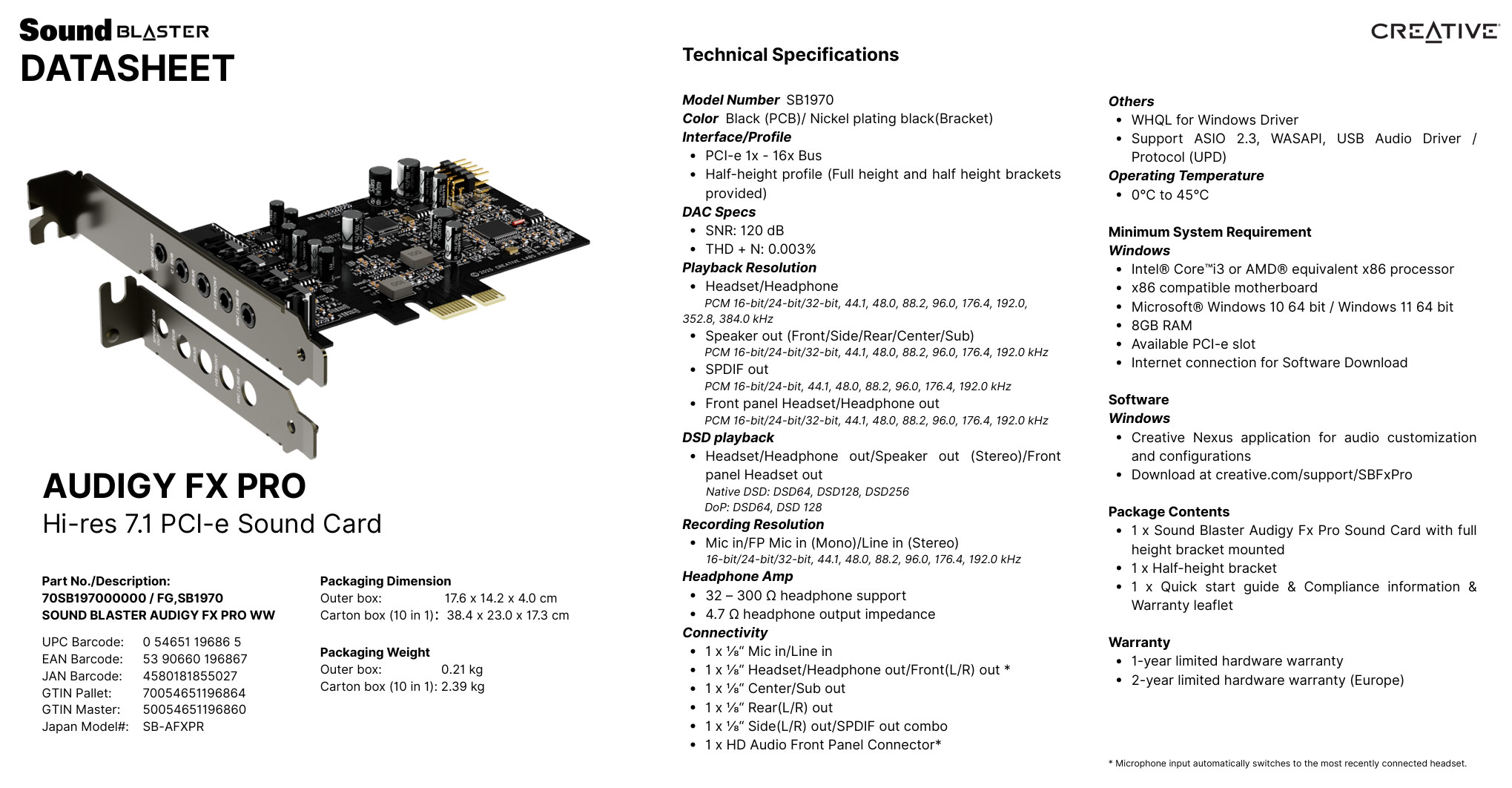
Creatve has announced Adugiy fx pro, the new creative sound card since 2019 (AE 9)
https://www.tomshardware.com/pc-components/so … d-onboard-audio

official site : https://fr.creative.com/p/sound-blaster/sound … gy-fx-pro#specs

spec : https://cdn.mos.cms.futurecdn.net/8JGKj9Z53vDySg5x2abCpb.jpg

I haven't seen alchemy support.

Reply 1 of 19, by UCyborg

User metadata
Rank Oldbie
Rank
Oldbie

I suspect old ALchemy would work in software mode.

Another one supporting high KHz output. Does anyone even hear the difference, assuming you can come across such content?

Arthur Schopenhauer wrote:

A man can be himself only so long as he is alone; and if he does not love solitude, he will not love freedom; for it is only when he is alone that he is really free.

Reply 2 of 19, by badmojo

User metadata
Rank l33t
Rank
l33t

I'm still more than happy with my X-Fi here in Win10.

Life? Don't talk to me about life.

Reply 3 of 19, by LSS10999

User metadata
Rank Oldbie
Rank
Oldbie

I think the Audigy Fx line uses the same Realtek audio codec ICs that most onboard audio use, so basically onboard audio on a discrete card with (perhaps) additional software perks.

From what I read about Audigy Fx2 specs it seems the system requirement was significantly increased compared to original Fx. Not sure how much this one would require. I never owned any Fx so I've no idea if those increased requirements actually matter, considering they are simply "onboard" audio under the hood.

Only Audigy Rx has actual Audigy hardware.

Reply 4 of 19, by shevalier

User metadata
Rank Oldbie
Rank
Oldbie
willow wrote on 2026-03-16, 15:54:

Creatve has announced Adugiy fx pro, the new creative sound card since 2019 (AE 9)
I haven't seen alchemy support.

The Audigi RX is equipped with a PCI-e – PCI bridge and a fully-featured 10KX DSP processor.
All FX versions consist of a PCI-e bridge connected to a onboard audio codec (the same as in the entire AE range) and the audio codec itself.
First there was one Realtek, then another.
And now — well, probably the next one.
And this is most likely due to the fact that Realtek is discontinuing production of previous generations. 😀

On the plus side, it features a "well cooked by Creative" audio codec that isn’t of the motherboard designer’s whims.
The rest is just free OpenAL Soft for $80

Aopen MX3S, PIII-S Tualatin 1133, Radeon 9800Pro@XT BIOS, Audigy 4 SB0610
JetWay K8T8AS, Athlon DH-E6 3000+, Radeon HD2600Pro AGP, Audigy 2 Value SB0400
Gigabyte Ga-k8n51gmf, Turion64 ML-30@2.2GHz , Radeon X800GTO PL16, Diamond monster sound MX300

Reply 5 of 19, by masterfaster

User metadata
Rank Newbie
Rank
Newbie

Probably it uses a Realtek ALC4082 (usb based, so it needs the necessary bridge chip).

Reply 6 of 19, by GL1zdA

User metadata
Rank Oldbie
Rank
Oldbie

I'm curious what chips they are using. The Fx serious were basically top motherboard codecs used on PCIe cards. The previous Audigy Fx V2 used the Creative's CA0113 chip with the Realtek ALC1220. I couldn't find any datasheet for the CA0113 chip, but the CA0111 was simply a PCIe HDA host controller to which the ALC1220 was connected. Looking at the specs, the Fx Pro is advertising 32-bit at 384 kHz playback and 32-bit at 192 kHz recording. This is more than HDA can handle, so it would suggest a change of both chips. As someone mentioned, the ALC4082 chips are USB Audio chips, so this could mean the Fx Pro is just an ALC4082 using a USB to PCIe bridge. The ALC4082 is used for the on-board audio on the most expensive motherboards.

If you need 5.1 or 7.1 output, the Fx Pro is a fine upgrade, cheaper than Creative's external USB devices like the Sound Blaster X4 or G8. For those, who just want stereo, there is a vast USB DAC market with any option (headphone amps, power amps, DSPs) one could desire, so you can tailor the output to whatever you need.

getquake.gif | InfoWorld/PC Magazine Indices

Reply 7 of 19, by shevalier

User metadata
Rank Oldbie
Rank
Oldbie
GL1zdA wrote on 2026-03-17, 10:48:

As someone mentioned, the ALC4082 chips are USB Audio chips, so this could mean the Fx Pro is just an ALC4082 using a USB to PCIe bridge.

For example, the ASUS Xonar AE was designed precisely on this principle—it is an external USB controller to which an audio controller is connected.
And then ASUS stopped producing sound cards.

Aopen MX3S, PIII-S Tualatin 1133, Radeon 9800Pro@XT BIOS, Audigy 4 SB0610
JetWay K8T8AS, Athlon DH-E6 3000+, Radeon HD2600Pro AGP, Audigy 2 Value SB0400
Gigabyte Ga-k8n51gmf, Turion64 ML-30@2.2GHz , Radeon X800GTO PL16, Diamond monster sound MX300

Reply 8 of 19, by LSS10999

User metadata
Rank Oldbie
Rank
Oldbie
shevalier wrote on 2026-03-17, 12:04:
GL1zdA wrote on 2026-03-17, 10:48:

As someone mentioned, the ALC4082 chips are USB Audio chips, so this could mean the Fx Pro is just an ALC4082 using a USB to PCIe bridge.

For example, the ASUS Xonar AE was designed precisely on this principle—it is an external USB controller to which an audio controller is connected.
And then ASUS stopped producing sound cards.

ASUS also made a few other cards like this, like the Strix series (Soar, RAID Pro/DLX). They use C-Media ICs instead of Realtek.

Though IMO this kind of idea feels odd in general, as such "discrete cards" can always be made into discrete USB audio devices, and that the PCIe XHCI controller chip itself can also become a point of problems, not too different from potential incompatibilities with XHCI controllers of various chipsets.

Reply 9 of 19, by GL1zdA

User metadata
Rank Oldbie
Rank
Oldbie
LSS10999 wrote on 2026-03-17, 12:33:

Though IMO this kind of idea feels odd in general, as such "discrete cards" can always be made into discrete USB audio devices, and that the PCIe XHCI controller chip itself can also become a point of problems, not too different from potential incompatibilities with XHCI controllers of various chipsets.

The price difference has to offset the compatibility problems. Here, in Poland the current Audigy Fx V2 is around $50. The external Sound Blaster X4 is $125. I haven't found an external USB Audio device with spec similar to the new Fx Pro except for the X4. Plenty stereo devices and audio interfaces, but nothing 5.1 or 7.1.

getquake.gif | InfoWorld/PC Magazine Indices

Reply 10 of 19, by RetroGamer4Ever

User metadata
Rank Oldbie
Rank
Oldbie

USB Audio is listed in the specs, so it likely is as you say. Most USB audio stuff is inexpensive - by design and intention - and built on older chips, so you won't find much that can go against the Fx Pro around that price, though there are some competitive 5.1/7.1 options out there, just not with the fancy digital audio fluff that the discrete card has.

Reply 11 of 19, by DracoNihil

User metadata
Rank Oldbie
Rank
Oldbie
UCyborg wrote on 2026-03-16, 20:59:

Another one supporting high KHz output. Does anyone even hear the difference, assuming you can come across such content?

Probably the only way to test 192000 Hz and such sampling rates is in the realm of audio synthesis. Especially when resampling algorithms come into play.

“I am the dragon without a name…”
― Κυνικός Δράκων

Reply 12 of 19, by UCyborg

User metadata
Rank Oldbie
Rank
Oldbie

Interesting that they came up with another internal card at all.

Guess the possibility of a refreshed X-Fi model (like they did for Audigy with Rx variant) is out of the picture at this point.

Arthur Schopenhauer wrote:

A man can be himself only so long as he is alone; and if he does not love solitude, he will not love freedom; for it is only when he is alone that he is really free.

Reply 13 of 19, by LSS10999

User metadata
Rank Oldbie
Rank
Oldbie
RetroGamer4Ever wrote on 2026-03-17, 15:06:

USB Audio is listed in the specs, so it likely is as you say. Most USB audio stuff is inexpensive - by design and intention - and built on older chips, so you won't find much that can go against the Fx Pro around that price, though there are some competitive 5.1/7.1 options out there, just not with the fancy digital audio fluff that the discrete card has.

Now I think the reason behind this kind of USB-audio-behind-PCIe-USB-controller "discrete" card is indeed cost. With whatever USB audio solutions on the market as well as a decent PCIe XHCI controller there's no need to invent a new native design. Most modern OSes already have class drivers for USB Audio, so these kind of devices, be it an external USB audio device, or an "internal sound card", would "just work" in these places for basic functionalities, with "drivers" that are simply software meant to control special features in the device.

PS: Turned out ALC4082 is actually being used on some very recent mobos for the onboard solution as well. I wonder what this would mean for those motherboards regarding toggling onboard USB (EHCI/XHCI) controllers, now that onboard audio is USB instead of HDA.

DracoNihil wrote on 2026-03-18, 08:45:
UCyborg wrote on 2026-03-16, 20:59:

Another one supporting high KHz output. Does anyone even hear the difference, assuming you can come across such content?

Probably the only way to test 192000 Hz and such sampling rates is in the realm of audio synthesis. Especially when resampling algorithms come into play.

Some audio stores do offer 96kHz FLAC option. As for 192kHz and higher, I haven't come by any.

UCyborg wrote on 2026-03-18, 12:26:

Interesting that they came up with another internal card at all.

Guess the possibility of a refreshed X-Fi model (like they did for Audigy with Rx variant) is out of the picture at this point.

EMU10K (Live!/Audigy) has excellent feature support across a wide range of OSes, with most if not all hardware features available. EMU20K (X-Fi) on the other hand has only basic support in Linux (without any hardware feature such as synths) and that's it.

And it doesn't have to be Creative themselves to refresh those models. Aside from the official Audigy Rx, EMU10K has already been unofficially refreshed via so-called "Sound Blessed" clones, even with PCIe options. These cards work just like the originals they're meant to imitate.

I'm still curious what exactly is EMU20K compared to EMU10K, and how does some of these cards' features, like the onboard X-RAM, actually work. Unless support for EMU20K hardware features across other OSes becomes possible, as well as getting a kX-like treatment for Windows, I doubt there would be enough interest for new EMU20K-based solutions like EMU10K.


Reply 14 of 19, by shevalier

User metadata
Rank Oldbie
Rank
Oldbie
UCyborg wrote on 2026-03-18, 12:26:

Interesting that they came up with another internal card at all.

Guess the possibility of a refreshed X-Fi model (like they did for Audigy with Rx variant) is out of the picture at this point.

What exactly do you not like about the X-Fi Titanium HD, the Auzen Forte or the Auzen X-Fi Forte 7.1, and the Onkyo se300 pci-e?

Aopen MX3S, PIII-S Tualatin 1133, Radeon 9800Pro@XT BIOS, Audigy 4 SB0610
JetWay K8T8AS, Athlon DH-E6 3000+, Radeon HD2600Pro AGP, Audigy 2 Value SB0400
Gigabyte Ga-k8n51gmf, Turion64 ML-30@2.2GHz , Radeon X800GTO PL16, Diamond monster sound MX300

Reply 15 of 19, by LSS10999

User metadata
Rank Oldbie
Rank
Oldbie
shevalier wrote on Yesterday, 05:29:
UCyborg wrote on 2026-03-18, 12:26:

Interesting that they came up with another internal card at all.

Guess the possibility of a refreshed X-Fi model (like they did for Audigy with Rx variant) is out of the picture at this point.

What exactly do you not like about the X-Fi Titanium HD, the Auzen Forte or the Auzen X-Fi Forte 7.1, and the Onkyo se300 pci-e?

I do own a X-Fi Titanium HD, and currently it's installed in a system that I mainly run modern Windows for gaming. It's not a bad card for such purposes. I don't have other X-Fi cards you mentioned so I'm not really sure about them.

The issue I don't like about X-Fi Titanium HD is that its Windows driver lacks the ability to freely toggle between RCA and headphone output. If I plug a headphone then the speaker/RCA out will be muted. Ironically, the "snd-ctxfi" Linux driver that provides only basic functionality to this card (without any hardware features) can do this correctly, so it is not really a hardware limitation.

Regardless... driver support outside of what Creative already provided is scarce for the EMU20K family. I think kX is a big enough driving factor for the renewed interests in EMU10K in the form of unofficial Live!/Audigy clones (PCI and PCIe), coupled with the well-established driver support (with hardware features) across a wide range of OSes (Linux, BSD/Haiku and even macOS).

Reply 16 of 19, by UCyborg

User metadata
Rank Oldbie
Rank
Oldbie

I don't have a frame of reference for any X-Fi card, it's just that they're not buyable in your typical computer shop.

Can you have hardware EAX with EMU10K cards on Linux?

Arthur Schopenhauer wrote:

A man can be himself only so long as he is alone; and if he does not love solitude, he will not love freedom; for it is only when he is alone that he is really free.

Reply 17 of 19, by DracoNihil

User metadata
Rank Oldbie
Rank
Oldbie
UCyborg wrote on Yesterday, 07:10:

Can you have hardware EAX with EMU10K cards on Linux?

No, because Creative doesn't want their "blackbox patented technology" on Linux whatsoever.

ALSA does support hardware accelerated mixing but only on older cards of the generation and that's mostly just for the purpose of serving multiple clients at once and not actually hardware mixed audio in a standalone video game or whatever.

“I am the dragon without a name…”
― Κυνικός Δράκων

Reply 18 of 19, by shevalier

User metadata
Rank Oldbie
Rank
Oldbie
LSS10999 wrote on Yesterday, 06:55:

The issue I don't like about X-Fi Titanium HD is that its Windows driver lacks the ability to freely toggle between RCA and headphone output. If I plug a headphone then the speaker/RCA out will be muted. Ironically, the "snd-ctxfi" Linux driver that provides only basic functionality to this card (without any hardware features) can do this correctly, so it is not really a hardware limitation.

/off
Well, I’m waiting for someone with a disassembler.
Someone who can tweak a couple of commands in the Creative Console.
Although, if they didn’t do it during the heyday of Titanium HD, there’s no point hoping for it now.

Aopen MX3S, PIII-S Tualatin 1133, Radeon 9800Pro@XT BIOS, Audigy 4 SB0610
JetWay K8T8AS, Athlon DH-E6 3000+, Radeon HD2600Pro AGP, Audigy 2 Value SB0400
Gigabyte Ga-k8n51gmf, Turion64 ML-30@2.2GHz , Radeon X800GTO PL16, Diamond monster sound MX300

Reply 19 of 19, by st31276a

User metadata
Rank Member
Rank
Member

High sampling rate is beneficial for recording, as it relaxes the requirements for the analogue anti aliasing filter on the input side significantly.

No human can hear the difference between a straight wire and a good 44.1kHz 16-bit AD/DA section in ABX testing, unless you set the gain insanely high and listen to the noise floor characteristics in the absence of signal.

Once sampled at 192kHz, a digital brickwall filter can be applied cutting everything above 20kHz, whereafter 3/4 samples can be discarded, resulting in a 48kHz stream. No difference will be measurable within the audible range of the spectrum.

16-bit sample precision is sufficient for storage and playback of normal audio signals too, as modern multibit delta sigma DA converters shape the quantization noise in a way that it can be filtered out, getting noise floors as good as -118dB, where running it straight would otherwise set the noise floor at the quantization level of -96dB.