VOGONS


Cyrix appreciation thread

Topic actions

Reply 540 of 561, by Dan386DX

User metadata
Rank Member
Rank
Member
marxveix wrote on 2025-11-02, 12:02:
I am new do this LFB and FastVid. Is it possible to have LFB performance boost to other CPU-s as well? […]
Show full quote
Dan386DX wrote on 2025-11-02, 00:29:

Used SET6X86 to modify a register with the aim of tweaking LFB performance on my motherboard's onboard GPU (ATI Rage Pro 3D) - a bit like a DIY FastVid because FastVid won't work on this system.

I am new do this LFB and FastVid. Is it possible to have LFB performance boost to other CPU-s as well?

FastVid is for Intel
K6INIT is for AMD
CYRIX has no tool?

What about other less known CPU-s, like Transmeta Crusoe?

Good question, I honestly don't know - I'd have thought in theory it's possible on any x86 processor, although IIRC, Transmeta Crusoe while able to emulate x86 microcode is architecturally wildly different. It's possible a tool exists somewhere but seems unlikely

90s PC: IBM 6x86 120Mhz. 128MB/6GB. ATI Rage Pro 3D.
Boring modern PC: R9 3900X, RX 7800XT. 32GB/1TB.
Fixer upper project: NEC Powermate 486SX/25. 16MB/400MB.

Reply 541 of 561, by Dan386DX

User metadata
Rank Member
Rank
Member

@feipoa

Well, this is embarassing.

It turns out, my SET6x86 tweak did *not* work.

You know what had triggered the VGA/LFB improvement? I'd switched the FSB/Multi jumpering from 83*1.5 to 100*1.5 and completely and utterly forgotten.

LFB scales with FSB (of course it does).

I'm going to take a little VOGONS break for shame. Thank you all for puting up with me 😁

90s PC: IBM 6x86 120Mhz. 128MB/6GB. ATI Rage Pro 3D.
Boring modern PC: R9 3900X, RX 7800XT. 32GB/1TB.
Fixer upper project: NEC Powermate 486SX/25. 16MB/400MB.

Reply 542 of 561, by DarthSun

User metadata
Rank Member
Rank
Member

FastVid is ok with all older configurations/video cards, and FVid gives good results on modern configurations and with today's video cards.
The latter, for example, gives about a 2x FPS increase with Q2DOS, with a relatively small GTX1650 card.

The 3 body problems cannot be solved, neither for future quantum computers, even for the remainder of the universe. The Proton 2D is circling a planet and stepping back to the quantum size in 11 dimensions.

Reply 543 of 561, by nickles rust

User metadata
Rank Newbie
Rank
Newbie

Socket 7 systems are so easy/fun to experiment with! I tried an IBM 6x86MX in mine and it looks like it has 4 options for the multiplier: 2x, 2.5, 3 and 3.5x. I tested at its extremes, and compared it with a K6-2 and K6-3. I timed how long it took to compile bash (in linux):

200MHz (2x100) 59:33
210MHz (3.5x60) 69:35
210MHz (3.5x60) 74:20 K6-2
210MHz (3.5x60) 56:10 K6-3

So it seems to be between the K6-2 and k6-3 in performance. The decent cache means it is not extremely sensitive to the bus speed.

Reply 545 of 561, by BitWrangler

User metadata
Rank l33t++
Rank
l33t++

Yeah preliminary testing was showing it to hand celeron it's own ass at same clockspeed, though they still had overoptimistic PR nonsense going on. The centaur replacement seemed like such a disappointment for the first couple of spins, worse. I guess maybe it couldn't develop for low power like that could in later iterations.

Unicorn herding operations are proceeding, but all the totes of hens teeth and barrels of rocking horse poop give them plenty of hiding spots.

Reply 546 of 561, by nickles rust

User metadata
Rank Newbie
Rank
Newbie

Which version of the 6x86 would have a good chance of working at 300MHz? I've been looking on ebay and "333" seems to be the highest rating available now for usa buyers. Is there a better source?

Reply 547 of 561, by BitWrangler

User metadata
Rank l33t++
Rank
l33t++

As far as the small selection i have tried over the years goes, 35, 30, 25 micron 233, 266, 333, 366 all seem to be hitting a wall at 290, even with massive coolers on them. Though I've never taken the core volts up from 2.9. So I guess it takes a 2.2V 18 micron to get over that hump comfortably, or a "golden sample" in the silicon lottery.

I was noticing the other day though how expensive everything over 233 is getting. 6x86 in general too, seems odd to me that they seem in general more expensive than most of the Winchips now, when the winchips were thought to be rarer a decade back.

Unicorn herding operations are proceeding, but all the totes of hens teeth and barrels of rocking horse poop give them plenty of hiding spots.

Reply 548 of 561, by DarthSun

User metadata
Rank Member
Rank
Member
BitWrangler wrote on 2026-02-07, 03:51:

As far as the small selection i have tried over the years goes, 35, 30, 25 micron 233, 266, 333, 366 all seem to be hitting a wall at 290, even with massive coolers on them. Though I've never taken the core volts up from 2.9. So I guess it takes a 2.2V 18 micron to get over that hump comfortably, or a "golden sample" in the silicon lottery.

I was noticing the other day though how expensive everything over 233 is getting. 6x86 in general too, seems odd to me that they seem in general more expensive than most of the Winchips now, when the winchips were thought to be rarer a decade back.

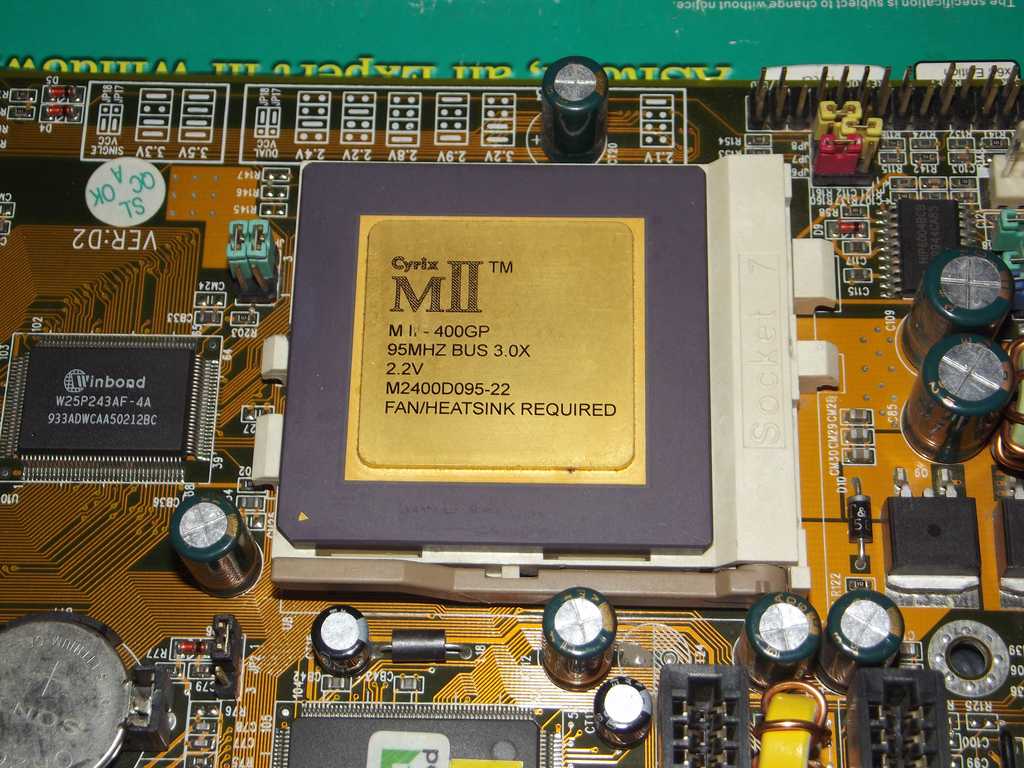
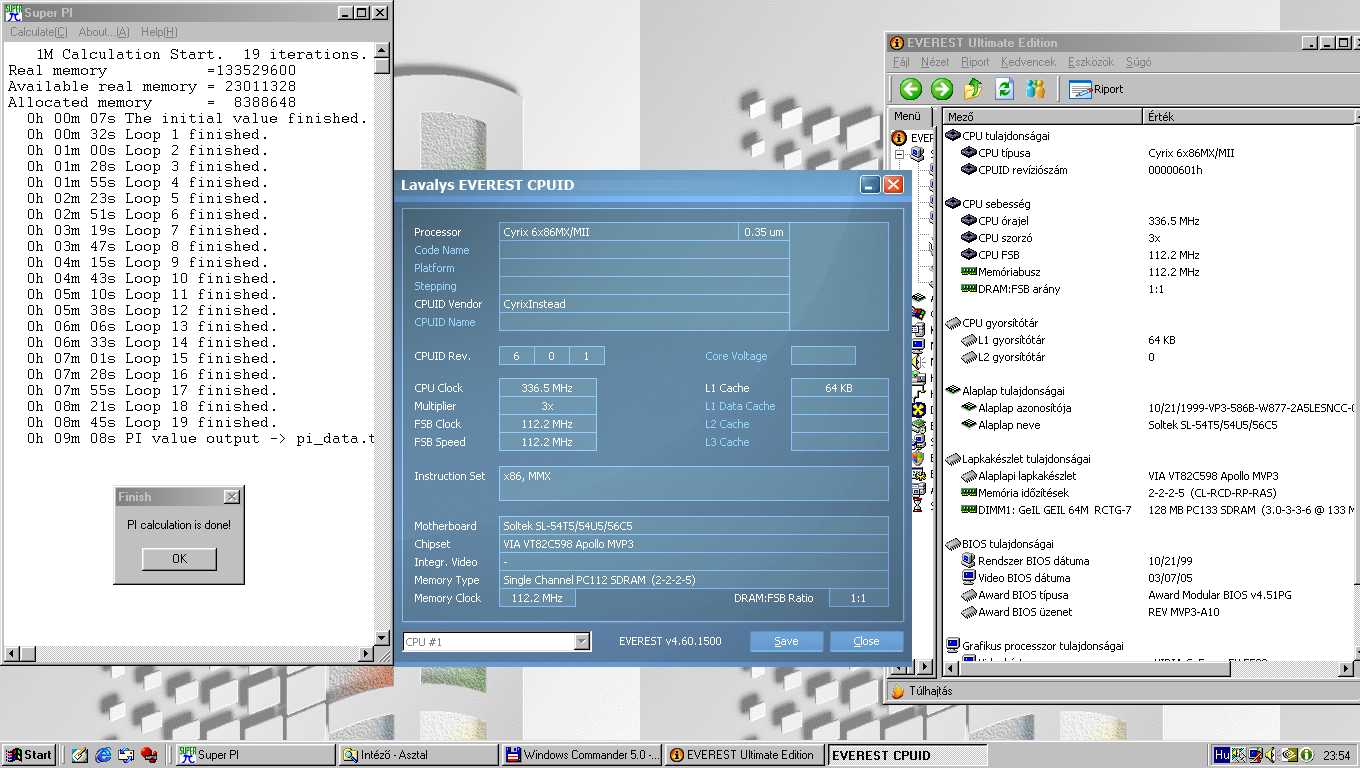
The 400 run for 336 MHz. Of course, it's very rare and expensive these days, and I don't know where to get it.
225621_wc1akexgng2fqgkh_mii-400.jpg
225621_xtaxifoqyuhujztr_spi_336_cl2.jpg

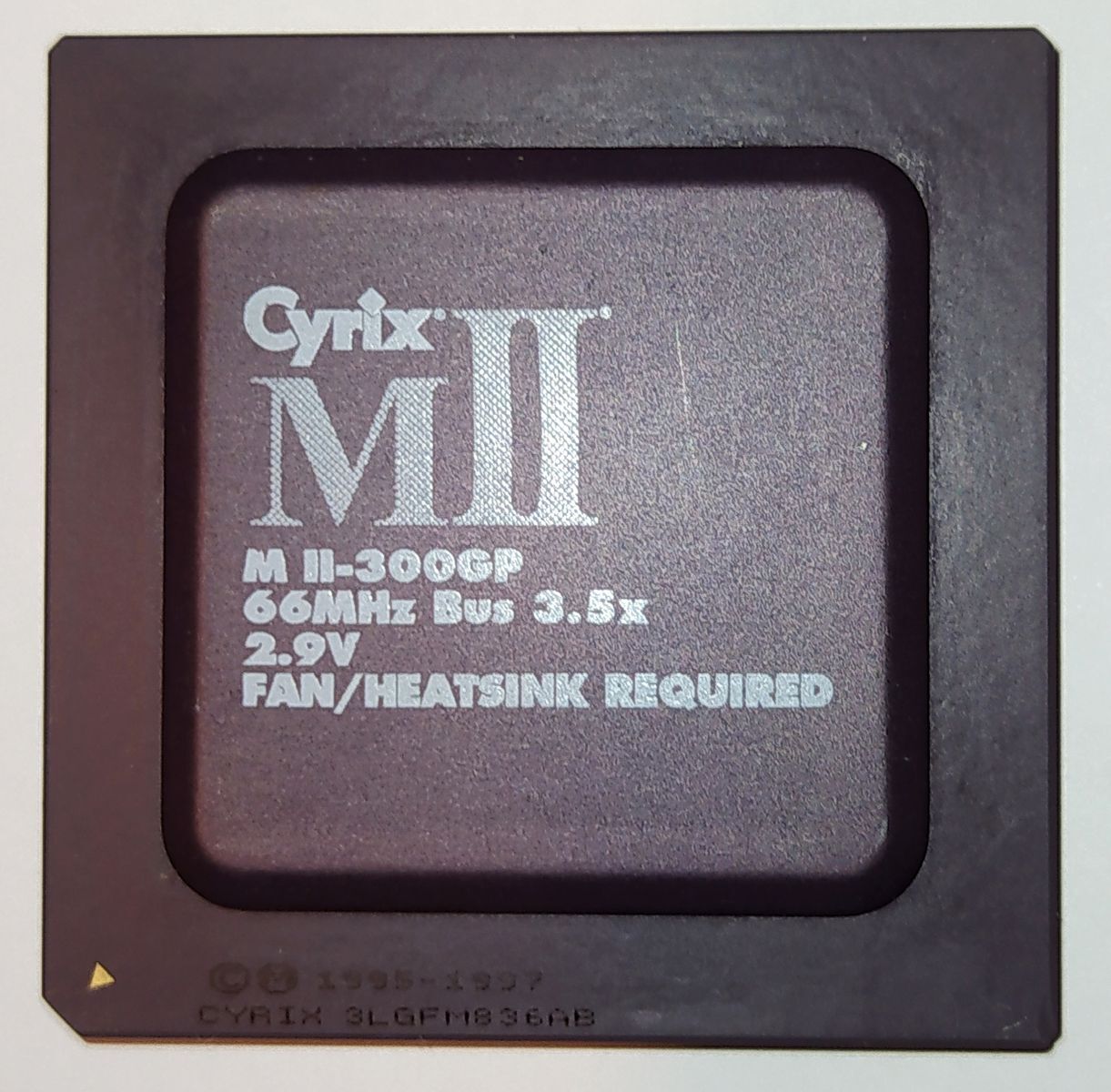
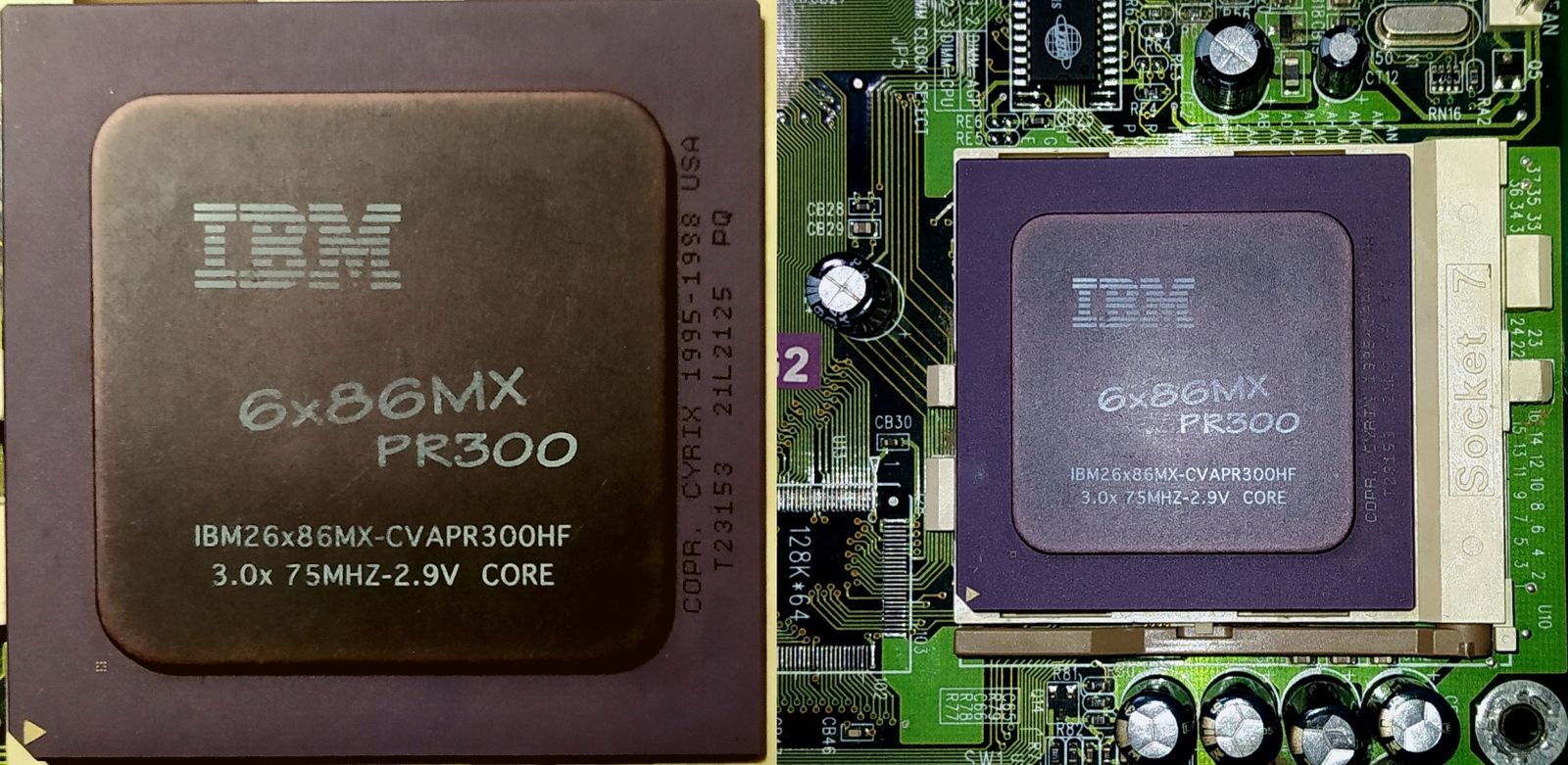
I've only driven the 300s on 250.
225621_uijrxq6ffchbdid1_1mii_300_black.jpg
225621_jb9i8tbxflvbbrgu_1ibm6x86mx300duo1.jpg

The 3 body problems cannot be solved, neither for future quantum computers, even for the remainder of the universe. The Proton 2D is circling a planet and stepping back to the quantum size in 11 dimensions.

Reply 549 of 561, by elmatero

User metadata
Rank Newbie
Rank
Newbie

Last night i was playing with my Cyrix 6x86MX PR-266 with FSB speed. From factory it comes with multiplier of 2,5 x 83 MHz which gives 208 MHz CPU Speed. While I was doing DOS benchmarks i saw rather low Doom FPS score of 66,21 which worried me.
After few tests with multipliers and FSB speeds i find out that when i configured the CPU as 3 x 66 Mhz (200 MHz of CPU Speed) Doom benchmark score jump to 95,51 FPS !

Here posted the other benchmark score comparation between this CPU (PR-266) set to 208 MHz and 200 MHz.
I have highlighted scores that go better on lower CPU and FSB frequency.

Anybody know what can couse it?
Every Windows benchmark (eg 3Dmark, PCPlayerD3D) goes better on 208 Mhz. It looks like it affect only DOS .
The only thing I had found are VESA throughput in SpeedSys .
On 208 MHz it shows:
VESA video memory : 8192 KB (31805 KB/s)
And on 200 MHz it shows:
VESA video memory : 8192 KB (82924 KB/s)

So it looks like 208 MHz CPU VESA throughput is somethig like divided by 2,5 of 82924 KB(66MHz FSB score) which gives 33169,6 KB (close to 31805 KB of 83HMz FSB score ).
My motherboard with chipset Via MVP3 use 2,5 divider for 83 MHz FSB to get 33 MHz on PCI bus , maybe this is correlated?

I wonder if someone else can try how his/her CPU performs in Doom and SpeedSys on 83 MHz FSB vs 66 MHz FSB.

ATX 1998 build: IBM 6x86MX-PR266@208MHz on Tekram P5MVP-A4, 128MB SDRAM, Ati Rage Pro Turbo AGP 2X 8 MB SGRAM, Yamaha YMF719e, Adaptec 1200A IDE 100, Windows 95b

Reply 550 of 561, by BitWrangler

User metadata
Rank l33t++
Rank
l33t++

How are you sure it's using the 2.5 divider? seems more like it's using 83/3.

Unicorn herding operations are proceeding, but all the totes of hens teeth and barrels of rocking horse poop give them plenty of hiding spots.

Reply 551 of 561, by elmatero

User metadata
Rank Newbie
Rank
Newbie
BitWrangler wrote on 2026-04-23, 12:36:

How are you sure it's using the 2.5 divider? seems more like it's using 83/3.

Actually I,m not sure of the divider, but that 2,5 for 83 MHz FSB I have found in Via MVP3 chipset documentation:
https://theretroweb.com/chip/documentation/vt … 2b474795183.pdf

But mayby it depends from the motherboard producer.

ATX 1998 build: IBM 6x86MX-PR266@208MHz on Tekram P5MVP-A4, 128MB SDRAM, Ati Rage Pro Turbo AGP 2X 8 MB SGRAM, Yamaha YMF719e, Adaptec 1200A IDE 100, Windows 95b

Reply 552 of 561, by BitWrangler

User metadata
Rank l33t++
Rank
l33t++
elmatero wrote on 2026-04-23, 13:34:
Actually I,m not sure of the divider, but that 2,5 for 83 MHz FSB I have found in Via MVP3 chipset documentation: https://theret […]
Show full quote
BitWrangler wrote on 2026-04-23, 12:36:

How are you sure it's using the 2.5 divider? seems more like it's using 83/3.

Actually I,m not sure of the divider, but that 2,5 for 83 MHz FSB I have found in Via MVP3 chipset documentation:
https://theretroweb.com/chip/documentation/vt … 2b474795183.pdf

But mayby it depends from the motherboard producer.

Yeah, could be lazy BIOS programming or only doing bit 1 or bit 2 saves a logic gate or something. So I would be wanting to find out what 75 does. If it beats 66 in those highlighted scores, then it's probably sticking with 2 for 37.5mhz, if it's same or a touch worse than 83Mhz then it's doing the same thing. I would then say that if they are seeming to use 2 for 75, then they maybe just implemented 2 and 3, no 2.5. IF however it does the same as 83, still a question whether it's actually on 2.5 with other issues pertaining to that, or 3.

Unicorn herding operations are proceeding, but all the totes of hens teeth and barrels of rocking horse poop give them plenty of hiding spots.

Reply 553 of 561, by elmatero

User metadata
Rank Newbie
Rank
Newbie

I have tested out 75 Mhz, and it's just a bit better then 83 MHz.
In SpeedSys VESA test shows:
On 188 MHz:
VESA video memory : 8192 KB (35796 KB/s)
On 225 MHz:
VESA video memory : 8192 KB (55454 KB/s)

So it's hard to tell how this VESA throughput is calculated. What i know for sure it affects DOOM, PCP benchmark at 640x480, Quake at 640x480 and Chris’s 3D Benchmark 640x480. Other benchmarks incremental scores together with raw CPU speed, and are not affected by this VESA or FSB thing.

ATX 1998 build: IBM 6x86MX-PR266@208MHz on Tekram P5MVP-A4, 128MB SDRAM, Ati Rage Pro Turbo AGP 2X 8 MB SGRAM, Yamaha YMF719e, Adaptec 1200A IDE 100, Windows 95b

Reply 554 of 561, by nickles rust

User metadata
Rank Newbie
Rank
Newbie

It looks like the PCI bus is the bottleneck in some tests. If it's automagical, 2x100 should give you the same 33MHz PCI bus as 3x67. I think I have a MVP motherboard where the PCI/FSB multiple is set with jumpers.

Reply 555 of 561, by elmatero

User metadata
Rank Newbie
Rank
Newbie
nickles rust wrote on 2026-04-23, 19:02:

It looks like the PCI bus is the bottleneck in some tests. If it's automagical, 2x100 should give you the same 33MHz PCI bus as 3x67. I think I have a MVP motherboard where the PCI/FSB multiple is set with jumpers.

Yeah 2x100 gives exacly the same result as 3x66 in VESA Test. Unfortunately my motherboard doesn't allow to manualy adjust PCI Bus speed.
My Cyrix CPU isn't stable at 100 FSB, so I have tested also 95 FSB which also crush. Only the third option was stable which was 100 MHz FSB with 66 MHz set for RAM memory. I had tested couple of SDRAM memory sticks (PC100 and PC133) but all crushed at Fixed setting to 100 Mhz.

With my bechmarks results, I bet that this mobo Tekram P5MVP-A4 set those dividers for FSB:
66/2 = 33
75/2,5 = 30
83/3 = 27
95/3 = 32
100/3 = 33

ATX 1998 build: IBM 6x86MX-PR266@208MHz on Tekram P5MVP-A4, 128MB SDRAM, Ati Rage Pro Turbo AGP 2X 8 MB SGRAM, Yamaha YMF719e, Adaptec 1200A IDE 100, Windows 95b

Reply 556 of 561, by BitWrangler

User metadata
Rank l33t++
Rank
l33t++

I don't know quite what to make of it, the FSB being ~20% down drops VESA results wayyy too much. Seems like it's triggering some huge waitstate or really slow timing settings. Also I had the thought that maybe the Cyrix cpu support in BIOS is only recognising certain speed grades, and leaving enhancements off for those it doesn't recognise.

Unicorn herding operations are proceeding, but all the totes of hens teeth and barrels of rocking horse poop give them plenty of hiding spots.

Reply 557 of 561, by elmatero

User metadata
Rank Newbie
Rank
Newbie

You are right it is something else, as this issue appears only in DOS VESA using softwere . In Windows every game goes better at 83 MHz then on 66 fsb (200MHz) or 100 fsb (200MHz) MHz. Which make sense because 83 fsb gives higher CPU clock -208MHz. CPU identify in Bios is correct on diffrent fsb-s. Only 190 MHz on 95 fsb show unknown variant of Cyrix. Funny thing is that 3x66 show PR-266 but 2x100, which is faster, identifies as PR-233 😀

ATX 1998 build: IBM 6x86MX-PR266@208MHz on Tekram P5MVP-A4, 128MB SDRAM, Ati Rage Pro Turbo AGP 2X 8 MB SGRAM, Yamaha YMF719e, Adaptec 1200A IDE 100, Windows 95b

Reply 558 of 561, by rmay635703

User metadata
Rank l33t
Rank
l33t
elmatero wrote on 2026-04-24, 19:14:

You are right it is something else, as this issue appears only in DOS VESA using softwere . In Windows every game goes better at 83 MHz then on 66 fsb (200MHz) or 100 fsb (200MHz) MHz. Which make sense because 83 fsb gives higher CPU clock -208MHz. CPU identify in Bios is correct on diffrent fsb-s. Only 190 MHz on 95 fsb show unknown variant of Cyrix. Funny thing is that 3x66 show PR-266 but 2x100, which is faster, identifies as PR-233 😀

A lot of manufacturers mixed up pr values or did wierd things if you used a bus multiplier combination the board didn’t recognize.
Thats why the real clock and bus are far more important than any mythical pr value.

Traditionally (using the most current m598 bios)
75x2 pr200
66x2.5 pr200
60x2.5 pr166
66x2 pr166
75x2.5 pr233
66x3 pr233
83x2.5 pr266
75x3 pr300
66x3.5 pr300
83x3 pr333 (ibm)
66x4 pr333 (ibm only)
90x3 pr350 (Cyrix)
100x2.5 pr366 (national/cyrix/via)
95x3 pr400
100x3 pr433

(My board also has settings for pr466, pr500 and pr533 which never existed)

Reminds me of circa 97/98 of the don’t worry Cyrix fans articles talking about the mythical Jalapeño and Cayenne cores for faster socket 7 that never materialized

Reply 559 of 561, by elmatero

User metadata
Rank Newbie
Rank
Newbie

There was also ultra rare 83x2 PR-233 produced by IBM .

ATX 1998 build: IBM 6x86MX-PR266@208MHz on Tekram P5MVP-A4, 128MB SDRAM, Ati Rage Pro Turbo AGP 2X 8 MB SGRAM, Yamaha YMF719e, Adaptec 1200A IDE 100, Windows 95b