VOGONS


First post, by veelstekel

User metadata
Rank Newbie
Rank
Newbie

I bought a P3 yesterday with some unknown cards to me:

1. Was an ISA UART Card
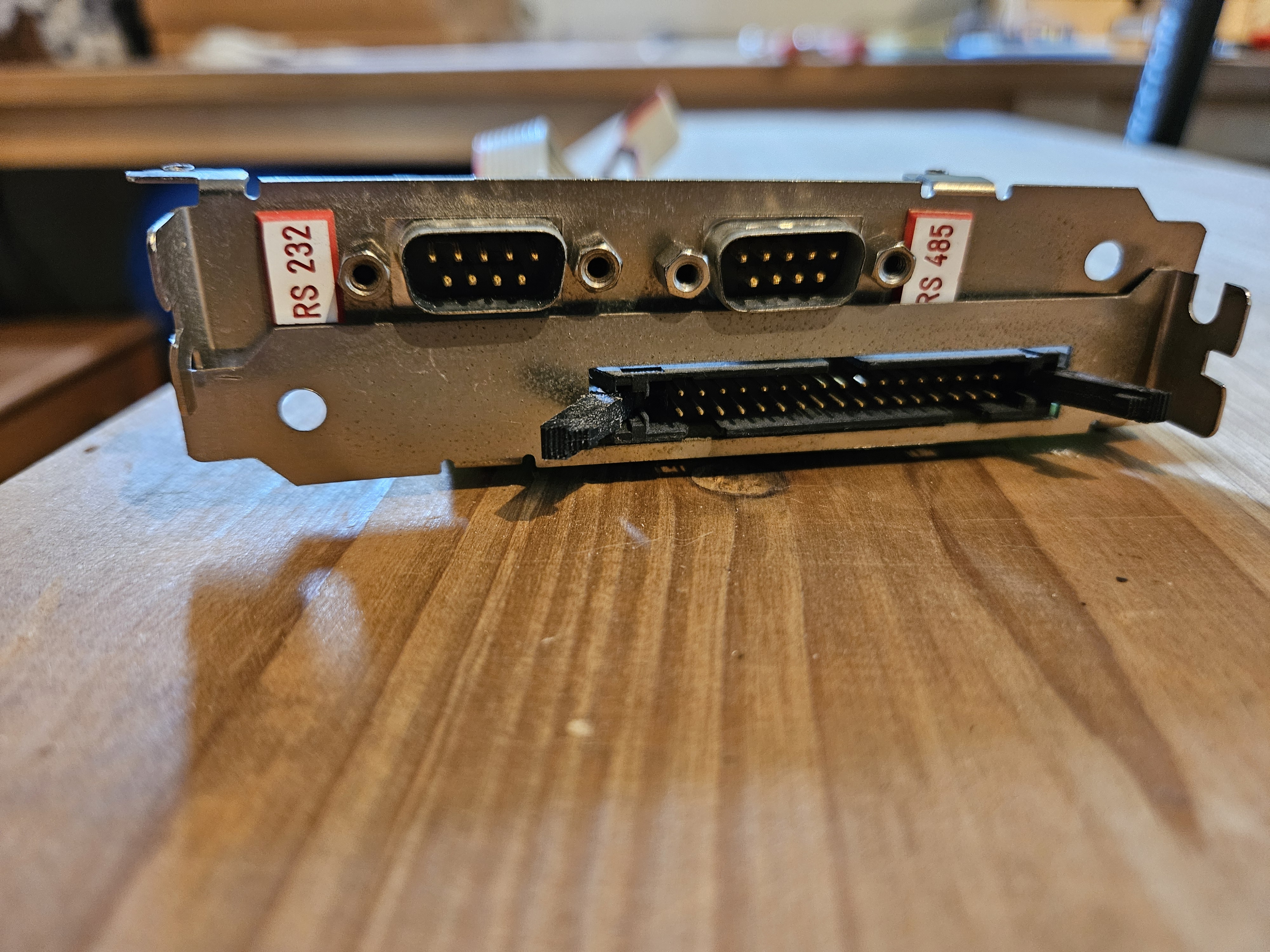
It featured an kinda IDE connector on the back as well as 2 DB9 ports;
1 was labelled RS232, the other RS-485, it seems to be centered around a Zilog Z85C3010PSC chip.
It also featured an eprom chip with UV lens for clearing.

2. Was an PCI UART Card
Seems to be a IC133C-R2 with also 2 DB9 ports which could be configured as either RS422 or RS485.
When googling, it seemed to have been expensive at some point. (https://www.barcodesinc.com/black-box/part-ic133c-r2.htm)

Question is... What am I going to do with it?
Throw it away? Put it on ebay? Can I use this as "normal" COM ports in DOS? What can I do with this "IDE" kind of connector?
Why were these cards so expensive?

Reply 1 of 8, by eisapc

User metadata
Rank Member
Rank
Member

Sure you can use these as RS232 if you find the right drivers for DOS.
RS485 is an industrial standard, so the boards might be expensive due to different qualification, low production count and because in industial measures they were not even expensive.
You might check if the EPROM is something to overcome any kind of BIOS limitation, but wondering why they used an ISA board for IDE in a PCI box?
Does the BIOS shows up something during boot or has any manufacturer information in its content?
Probably theprevious owner replaced some older hardware and kept the controller and the attached storage media?

Reply 2 of 8, by DaveDDS

User metadata
Rank Oldbie
Rank
Oldbie

Not families with these cards, just from your descriptions...

The Zilog Z85C3010 is am SCC (Serial Communications Controller) - a UART, which I'm pretty sure is NOT 8250 (PC) family compatible.

Not sure why there's be an EPROM.. is the a local microprocessor on the board?
If yes, could be a "serial" LAN.
If no, possible a BIOS extension to support the serial ports.

PC BIOS is terrible at any sort of high-speed serial I/O, and for this reason, most serious DOS software that does serial I/O has it's own internal interrupt-driven code to talk to 8250 family devices, and is much less likely to support the Zilog part. For this reason I wouldn't expect this card to be terribly useful in DOS. A newer OS could support it better, but you would have to have the right driver.

The link you posted for the second card says it's 16550 compatible, so it should work "as normal".
The only problem I see is it being a PCI card you might have trouble getting it to show up at the right hardware addresses for use under DOS.

As someone who uses serial ports a LOT ... I wouldn't toss either of them, you never know when you might need them,
especially the second one - Newer systems tend to not have serial ports at all, and only PCI card slots. Finding a decent PCI serial card can be a bit tricky.

- Dave ; https://dunfield.themindfactory.com ; "Daves Old Computers" ; SW dev addict best known:
ImageDisk: rd/wr ANY floppy PChardware can ; Micro-C: compiler for DOS+ManySmallCPU ; DDLINK: simple/small FileTrans(w/o netSW)via Lan/Lpt/Serial

Reply 3 of 8, by DaveDDS

User metadata
Rank Oldbie
Rank
Oldbie

BTW/FYI: RS422/485 are serial communication standards that use differential signalling over twisted pair.
This provides a fair bit of noise immunity which makes them suitable for longer runs and higher data rates.

RS232 is the more traditional serial interface which is the "standard" for PC COM ports. RS232 is +/- relative to ground based (not differential or twisted pair) which makes it more susceptible to induced noise but simpler for most people to understand and suitable for short runs (Desktop PC to printer/modem etc.)

Most peripherals that attach to a PC serial port expect RS-232 but it's not terribly difficult to adapt one type to the other.

- Dave ; https://dunfield.themindfactory.com ; "Daves Old Computers" ; SW dev addict best known:
ImageDisk: rd/wr ANY floppy PChardware can ; Micro-C: compiler for DOS+ManySmallCPU ; DDLINK: simple/small FileTrans(w/o netSW)via Lan/Lpt/Serial

Reply 4 of 8, by veelstekel

User metadata
Rank Newbie
Rank
Newbie

Thanks! These are images of the card;
http://www.harmjan.dds.nl/1.jpg
http://www.harmjan.dds.nl/2.jpg

When inserting them in the computer; it did not contain any additional BIOS messages.
Probably am going to store them in the attic 😉 (As the mainboard already has 2 com ports).

If there is someone in the NL I can make happy with these cards, let me know.

Reply 5 of 8, by HwAoRrDk

User metadata
Rank Newbie
Rank
Newbie

Looks like the RS-232 and RS-485 ports might be isolated. Those HP4539 parts are probably optocouplers, interfacing with dual MAX232 transceivers for the RS-232. Not sure what's going on with the RS-485 port with all those circular inductors, but possibly some kind of isolated power supply, and only one two-channel optocoupler for that (A&B channels).

The 34-pin (not 40-pin) rear connector is probably just general-purpose external I/O. Some of the pins appear to be connected to a 74HCT540 chip, which is an 8-channel buffer/line-driver. Probably some power pins there too, given the two circular fuses nearby.

The Intel D8751H is a microcontroller with 4KB EPROM. Maybe acting as a UART for the RS-485.

Reply 6 of 8, by DaveDDS

User metadata
Rank Oldbie
Rank
Oldbie

Ahhh ... that's not an EPROM - It's a UV erasable programmable microcontroller - an 8751 which is 8051 family.

8051 has 4K of mask ROM within, the 8751 makes this programmable and UV erasable. Most often used in development/debugging/design, but sometimes used in production when firmware may change frequently or quantities don't justify a full masked ROM run.

So it's very likely that card is a serial LAN or part of some other setup which uses specialty serial connected devices.
It would definitely need OS drivers (in order to use it for whatever it does), but first you have to find out what "whatever it does" actually is!

Is there any name visible anywhere on the card (not chips)? On the back perhaps.

I doubt that's a hard drive connector (8051 family isn't really capable enough to need a hard drive for any normal use cases), perhaps a connector to some other proprietary hardware, possible parallel. If you can trace where it's connected, and follow the circuit back to the 8751, I can tell what what the 8751 pins do (mostly parallel, some timers/gates etc)

Reading the 8751 is doable, but equipment to do that is far less common than EPROMS.

- Dave ; https://dunfield.themindfactory.com ; "Daves Old Computers" ; SW dev addict best known:
ImageDisk: rd/wr ANY floppy PChardware can ; Micro-C: compiler for DOS+ManySmallCPU ; DDLINK: simple/small FileTrans(w/o netSW)via Lan/Lpt/Serial

Reply 7 of 8, by DaveDDS

User metadata
Rank Oldbie
Rank
Oldbie
HwAoRrDk wrote on 2026-05-04, 16:19:

... The Intel D8751H is a microcontroller with 4KB EPROM. Maybe acting as a UART for the RS-485.

I think unlikely, the Zilog SCC is a dual-channel device, UARTs are plentiful, there are LOTS to choose from, and 8051 is a relative common/usable embedded microprocessor (in the day), and an 8751 would cost a lot more than pretty much any uart.

I can't see a reason to put one on just to be a UART - I'm pretty sure it's performing other functions.

- Dave ; https://dunfield.themindfactory.com ; "Daves Old Computers" ; SW dev addict best known:
ImageDisk: rd/wr ANY floppy PChardware can ; Micro-C: compiler for DOS+ManySmallCPU ; DDLINK: simple/small FileTrans(w/o netSW)via Lan/Lpt/Serial

Reply 8 of 8, by DaveDDS

User metadata
Rank Oldbie
Rank
Oldbie

Btw, from my "junk card" box - this is an example of a serial LAN card.

This one happens to be ISA, but no doubt PCI ones did exist.

It has a Z80 mcu, Zilog SCC (two serial ports), masked ROM as well as both male and female serial connectors on the back (in many serial LANs each system had an in and out port and were arranged in a "ring").

Considering your card, it's probably NOT a LAN, but for some other type serially connected devices, because:
- The ports are different
- 8051 is a but limited for operating a LAN

- Dave ; https://dunfield.themindfactory.com ; "Daves Old Computers" ; SW dev addict best known:
ImageDisk: rd/wr ANY floppy PChardware can ; Micro-C: compiler for DOS+ManySmallCPU ; DDLINK: simple/small FileTrans(w/o netSW)via Lan/Lpt/Serial