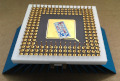
So I've been going back and forth with ChatGPT about why specifically this might not work, and if perhaps we could patch the BIOS to make it work. And after sending it a detailed 100 page spec sheet for the overdrive processors that I found online, here was the response.
The below text was AI generated, so while it might sound plausible (which it does to my somewhat inexperienced eyes), someone here might be able to say "yep that sounds right" or "nope the AI is full of it".
Here goes -
The key part is that the Pentium OverDrive is not just a 486-style internal cache. Intel’s datasheet says the POD has separate 16KB code and 16KB data caches, and the data cache is write-back capable with a MESI protocol.
More importantly, Intel says proper write-back support requires new signals:
WB/WT#, INV, HIT#, HITM#, CACHE#, EWBE#, BLEN#
plus INIT for warm reset behavior.
That is probably the smoking gun.
Why your GA-486VF fails
Your board has a BIOS option called Internal Cache WB/WT, but the Intel document shows that the POD’s cache mode is not merely a BIOS preference. The processor samples pins like CACHE#, KEN#, and WB/WT# during line fills; depending on those pin states, cache lines become write-back, write-through, shared, exclusive, or non-cacheable.
So if the GA-486VF Rev. 6 was designed for the earlier Intel engineering-sample P24D/T assumptions, but not the final retail POD83 pin/protocol requirements, then the BIOS can say “write-through” all day and the hardware may still not be presenting the right signals at the right times.
Your testing fits that exactly:
Test Meaning
Internal cache enabled + external cache disabled fails | The problem is not just motherboard L2 cache.
Internal cache write-through still fails | The BIOS setting is not enough to make the retail POD cache safe.
Internal cache disabled + external cache enabled boots | The rest of the board works; the POD internal cache protocol is the issue.
Newer BIOS behaves the same | The missing piece is probably board/chipset signal support, not setup strings.
Why BIOS patching probably won’t solve it
The Intel doc says systems designed for write-back cache support must account for Pentium OverDrive-specific cache consistency cycles, write-back cycles, and extra signals. Appendix B explicitly says the POD carries over the Pentium cache protocol and that system design considerations are required for it to operate properly in a system designed around write-back-enhanced DX2 compatibility.
That makes this much less like “patch one chipset register” and more like “the motherboard needs to route and drive the correct POD-specific cache pins.”
The GA-486VF manual’s own P24D note now looks even more important: it says P24D support requires PCB Rev. 8A and BIOS July 12, 1994 or later, and it lists a specific JP30 P24D WB/WT# jumper. Your Rev. 6 board does not appear to be that later hardware path.
My updated conclusion
This Intel datasheet supports the conclusion that the incompatibility is hardware-level cache protocol support, not simply BIOS CPU detection.
The likely failure is:
GA-486VF Rev. 6 does not correctly support the final retail POD83’s internal write-back/MESI/cache-control signal behavior.
A BIOS patch could maybe disable the POD cache, adjust chipset timing, or change defaults — but you already found that disabling internal cache is the only stable path. To make internal cache work, the board would likely need the correct WB/WT#, CACHE#, HIT#, HITM#, INV, EWBE#, BLEN#, and related behavior wired/handled correctly. That is not something the BIOS can invent after the fact.
So yes: this document helps, and it strongly explains why Gigabyte could honestly advertise early P24T/P24D/Pentium support in strings/manuals while later saying the released Intel Pentium OverDrive would not work.