VOGONS


Gigabyte GA-7ZXE recapping

Topic actions

First post, by Mike_

User metadata
Rank Member
Rank
Member

I got a Gigabyte GA-7ZXE as it was quite cheap compared to other KT133A boards with ISA slot. Or rather this board doesn't have ISA slot, but it does have footprint for one, and Retroweb has a picture of board that has it installed so I guess just soldering it in should work.

The board has already been partially recapped, original 3300µF and 1200µF 6,3V caps have been replaced with Rubycon parts. However, 330µF 25V Choyo caps (marked with red x:s) still remain, so is there need to recap those as well? Externally they seem to be fine, and based on quick testing the board seems to work. They seem to be general purpose caps rather than low ESR types.

I presume the tiny caps, such as 22µF and 100µF ones can be left alone.

The attachment ga-7zxe.jpg is no longer available
The attachment choyo1.jpg is no longer available
The attachment choyo2.jpg is no longer available
The attachment choyo3.jpg is no longer available

Reply 1 of 20, by PD2JK

User metadata
Rank Oldbie
Rank
Oldbie

If the system runs stable, leave them be if you don't have any testing equipment available. But inspect them once in a while.

has all kinds of stuff

Reply 3 of 20, by Mike_

User metadata
Rank Member
Rank
Member
PD2JK wrote on 2026-04-26, 15:58:

If the system runs stable, leave them be if you don't have any testing equipment available. But inspect them once in a while.

I was inclined to just leave them be as well unless the board starts to have problems.

But I actually do have an oscilloscope, so I could check out ripple voltages.

Reply 4 of 20, by andrea

User metadata
Rank Member
Rank
Member

On another AMD Gigabyte motherboard of the same vintage I replaced those Choyos with reclaimed capacitors from broken modern boards.
I used Chemicon KZE 820uf 6.3V on the 5V and 3V3 rails and Panasonic FJ 470uf 16V on the 12V rail. Which is pretty much what every manufacturer uses in those areas.

I also populated the unstuffed capacitors for the CPU VRM.

Reply 5 of 20, by Mike_

User metadata
Rank Member
Rank
Member
andrea wrote on 2026-04-26, 19:50:

On another AMD Gigabyte motherboard of the same vintage I replaced those Choyos with reclaimed capacitors from broken modern boards.
I used Chemicon KZE 820uf 6.3V on the 5V and 3V3 rails and Panasonic FJ 470uf 16V on the 12V rail. Which is pretty much what every manufacturer uses in those areas.

I also populated the unstuffed capacitors for the CPU VRM.

Why bother recycling capacitors when you can buy new ones for just a couple of euros? That sounds like a lot of effort for saving not much.

Anyways, it looks like those 330µF 25V caps are general purpose caps just used for filtering 3,3V and 5V rails. Plus there's a linear regulator generating ~3.4V for something, maybe RAM?

Reply 6 of 20, by PcBytes

User metadata
Rank l33t
Rank
l33t
Mike_ wrote on 2026-04-27, 16:14:
andrea wrote on 2026-04-26, 19:50:

On another AMD Gigabyte motherboard of the same vintage I replaced those Choyos with reclaimed capacitors from broken modern boards.
I used Chemicon KZE 820uf 6.3V on the 5V and 3V3 rails and Panasonic FJ 470uf 16V on the 12V rail. Which is pretty much what every manufacturer uses in those areas.

I also populated the unstuffed capacitors for the CPU VRM.

Why bother recycling capacitors when you can buy new ones for just a couple of euros? That sounds like a lot of effort for saving not much.

Anyways, it looks like those 330µF 25V caps are general purpose caps just used for filtering 3,3V and 5V rails. Plus there's a linear regulator generating ~3.4V for something, maybe RAM?

I actually do this too and it's much more effective than having to place orders and waiting for new caps. Another trick is using polymers if the board can allow it - I've done this to a recent Vinted purchase, an ABIT BH6 - the CPU caps are nearly all polymers now, save for 4x1000uF where I harvested a few SAMXON caps from a ASRock K10N78M Pro.

There's no harm in doing it - a lot of the modern boards tax the caps MUCH less than the older pre-P4 era boards do.

"Enter at your own peril, past the bolted door..."
Main PC: i5 3470, GB B75M-D3H, 16GB RAM, 2x1TB
98SE : P3 650, Soyo SY-6BA+IV, 384MB RAM, 80GB

Reply 7 of 20, by Mike_

User metadata
Rank Member
Rank
Member

So I was checking the board with a multimeter, and it appears that capacitors TC6 and TC7 are simply filtering caps for 5V rail. But TC6 is a 1200µF 6,3V cap while TC7 is 330µF 25V... I wonder what's the point here? It's an odd choice to put caps like that in parallel.

TC6 is not an original cap, while TC7 is. However, based on this post it appears that the board originally had a similar cap in place so it's not a matter of somebody having used random caps in the recapping process.

Re: Bought these (retro) hardware today

The attachment caps.jpg is no longer available

Reply 8 of 20, by shevalier

User metadata
Rank Oldbie
Rank
Oldbie
Mike_ wrote on 2026-04-29, 16:31:

So I was checking the board with a multimeter, and it appears that capacitors TC6 and TC7 are simply filtering caps for 5V rail. But TC6 is a 1200µF 6,3V cap while TC7 is 330µF 25V... I wonder what's the point here? It's an odd choice to put caps like that in parallel.

It’s not entirely pointless.
For measuring equipment or in audio engineering.
Beyond its resonance frequency, a capacitor exhibits inductive impedance. In other words, it behaves like a coil and loses its capacitive properties.
These frequencies vary depending on the capacitance, voltage, and size of the electrolytic capacitors.
On SuperSocket 7 motherboards, they also tried to achieve something similar by connecting a 10–100 μF electrolytic capacitor in parallel with a 1000 μF capacitor.
Before affordable, low-cost VNA (vector network analyzers) became available, everyone did their best, to the best of their knowledge and despite their misconceptions

And yes, someone very skillfully replaced the low-ESR capacitor with a General use capacitor, increasing its voltage to reduce the ESR while maintaining the same size.

Aopen MX3S, PIII-S Tualatin 1133, Radeon 9800Pro@XT BIOS, Audigy 4 SB0610
JetWay K8T8AS, Athlon DH-E6 3000+, Radeon HD2600Pro AGP, Audigy 2 Value SB0400
Gigabyte Ga-k8n51gmf, Turion64 ML-30@2.2GHz , Radeon X800GTO PL16, Diamond monster sound MX300

Reply 9 of 20, by Mike_

User metadata
Rank Member
Rank
Member

I see, that makes sense.

Reply 10 of 20, by momaka

User metadata
Rank Oldbie
Rank
Oldbie
Mike_ wrote on 2026-04-29, 16:31:

So I was checking the board with a multimeter, and it appears that capacitors TC6 and TC7 are simply filtering caps for 5V rail. But TC6 is a 1200µF 6,3V cap while TC7 is 330µF 25V... I wonder what's the point here? It's an odd choice to put caps like that in parallel.

TC6 is not an original cap, while TC7 is. However, based on this post it appears that the board originally had a similar cap in place so it's not a matter of somebody having used random caps in the recapping process.

Re: Bought these (retro) hardware today

Probably it was a cost-saving measure at the production floor.
My guess would be Gigabyte intended those cap spots (TC6, TC7, TC8, and TC9) to all be filled up with cheaper 25V 330 uF caps. Then someone on the production floor saw the design and probably figured there's a further opportunity to save more on costs by removing a few more caps from the BOM... until someone looked at this decision over and suddenly realized that only two 330 uF caps at spots TC6 and TC7 perhaps ain't going to cut it for the noise filtering. So instead of populating all of those cap spots again, perhaps they found it would be just cheaper to use one larger capacity cap at spot TC6 while still leaving TC7 with the original 330 uF cap. So they did that and called it done. (I know there is a lot of speculation here, but stories/decisions like this aren't actually uncommon.)

Worth noting here is that while all of these capacitor spots (TC6, 7, 8, and 9) appear to be in parallel (and on the 5V rail), they aren't actually so when it comes to high frequency AC noise filtering. If you look a little closer, toroidal inductor L14 is doing some separation there. To me, it appears that TC7 and TC8 are in parallel
"after" L14 and TC6 and TC9 are in parallel "before" L14. What I mean by this is that the "before" set should be connected with traces directly to the 5V pins on the ATX connector. The "after" group is also connected to the 5V rail on the PSU, but only after inductor L14. So what this arrangement does is it creates an C-L-C type filter (i.e. capacitor-inductor-capacitor filter.) Such filter is effective at filtering high frequency noise going back into the PSU and on the rest of the 5V rail going elsewhere to the motherboard.

IME, it's important that the "after" cap filter is done with proper low-ESR caps, since that is also technically the supply to the CPU VRM's upper MOSFETs.
So if this was my motherboard, I'd probably use 1200-2200 uF very low ESR caps in both spots, just to be consistent (or just 330-470 uF caps if going with polymers.) And no need to go with 25V -rated caps either (at least not if you used good low ESR caps.)

As for the rest of the 25V 330 uF Choyo caps on the board...
Except for the one between the PCI slots (which is likely filtering either a 3.3v or 5V rail from the PSU going into the PCI slots), the rest appear to be connected to linear regulators. In particular, the one in the upper-right corner by the RAM is probably for the RAM V_dd rail (i.e. 3.3V for SDRAM). Meanwhile, the 4 below the Northbridge are probably for either the Northbridge Vcc supply or the AGP slot communication voltage (3.3V or 1.5V switcheable for these "universal"/4x boards) - likely two before the linear regulator and two after it.
The 5th Choyo to the left of the RAM slots is probably also for the RAM V_dd, but not 100% sure.

PD2JK wrote on 2026-04-26, 15:58:

If the system runs stable, leave them be if you don't have any testing equipment available. But inspect them once in a while.

+1
For people who don't have the means to easily remove/replace caps (e.g. a good soldering iron and skills to use it comfortably on a motherboard) or test equipment to test them (cap meter), then this is probably indeed the more sound strategy to follow.

Otherwise, I'd pull at least one or two of these Choyo's and check their condition. If their ESR is "OK" and their capacitance is well within the 20% tolerance (more particularly, not getting close to the upper end of +20%), then they might be just fine to leave as is.

Shponglefan wrote on 2026-04-26, 16:16:

No reason to replace them if they look fine and everything is working.

Maybe.

I've had caps that appeared fine externally and the motherboard they were in was also working fine. But I pulled a few to check their condition, and they were actually starting to fail with abnormally high capacitance, which is indicative of the electrolyte inside the capacitor reacting with the foil plates and breaking it down. When that happens, it's just a matter of time before the capacitor becomes too failed and things stop working.

That said, I don't always pull capacitors to check them. If they are from a known good Japanese brand and not from a series that is known to be affected by issues (e.g. United Chemicon KZG, Sanyo WF, Nichicon HM and HN from 2001-2004, and etc.), then I leave them alone. If they are anything else, I use my knowledge/experience about how often I have seen that particular brand and series failed before to decide if I should remove any for a test.

andrea wrote on 2026-04-26, 19:50:

I also populated the unstuffed capacitors for the CPU VRM.

I tend to do that as well.
It's good insurance that you will have even better filtering.

Also, sometimes I do this when I'm too lazy to do a proper recap on a motherboard I don't care as much about. In such case, adding a few known good/reliable caps in the unpopulated empty spots that are in parallel basically allows the good caps to "hold over" the board even if the other original parallel caps fail.

Mike_ wrote on 2026-04-27, 16:14:

Why bother recycling capacitors when you can buy new ones for just a couple of euros? That sounds like a lot of effort for saving not much.

It's all relative to each person's situation.
Here, for a few euro, I can typically get a whole motherboard for scrap from the flea market or the metal recycling centers with all kinds of caps on it (and I usually do when they have good quality capacitors on them are cheap enough - e.g. under 1-2 Euro per board). This does two things for me: it guarantees I have a variety of motherboard-grade capacitors in stock and it IS much cheaper. With online retailers, some of the bigger caps can cost almost 1 euro per cap (which can add up fast if you need a lot of them.) In contrast, if I have a whole motherboard full of these, it brings the repair costs down considerably. Also, when buying stuff online, not only do I have to wait for the shipping, but I also have to walk all the way to the post office to collect it (and often pay either VAT or customs tax... or both.)

So yes, reusing caps can indeed be much more cost-effective. But again, it all depends on where you live an what you have available near you.
As for the effort part - it takes me maybe 10-20 seconds to remove a cap from a board, another 10 to pop it in my cap tester... and from there, it's ready to go back to use if it's good. In other words, it's hardly that much effort if you have all of the equipment to do it and at the ready.


Reply 11 of 20, by Mike_

User metadata
Rank Member
Rank
Member
momaka wrote on 2026-05-07, 22:12:
Worth noting here is that while all of these capacitor spots (TC6, 7, 8, and 9) appear to be in parallel (and on the 5V rail), t […]
Show full quote

Worth noting here is that while all of these capacitor spots (TC6, 7, 8, and 9) appear to be in parallel (and on the 5V rail), they aren't actually so when it comes to high frequency AC noise filtering. If you look a little closer, toroidal inductor L14 is doing some separation there. To me, it appears that TC7 and TC8 are in parallel
"after" L14 and TC6 and TC9 are in parallel "before" L14. What I mean by this is that the "before" set should be connected with traces directly to the 5V pins on the ATX connector. The "after" group is also connected to the 5V rail on the PSU, but only after inductor L14. So what this arrangement does is it creates an C-L-C type filter (i.e. capacitor-inductor-capacitor filter.) Such filter is effective at filtering high frequency noise going back into the PSU and on the rest of the 5V rail going elsewhere to the motherboard.

IME, it's important that the "after" cap filter is done with proper low-ESR caps, since that is also technically the supply to the CPU VRM's upper MOSFETs.
So if this was my motherboard, I'd probably use 1200-2200 uF very low ESR caps in both spots, just to be consistent (or just 330-470 uF caps if going with polymers.) And no need to go with 25V -rated caps either (at least not if you used good low ESR caps.)

Actually it looks like they really are all in parallel, it's more obvious from bottom side. Maybe it just relies on PSU caps to do filtering before the inductor?

The attachment vrm_bottom.jpg is no longer available

Here's also a better close-up photo of the top side.

The attachment vrm_top.jpg is no longer available

In these pics I have replaced the Choyo cap with a Panasonic FM 1500µF 6,3V cap. Unfortunately I don't have an ESR meter, so I guess I'll give the cap to a friend whose workplace does have one.

momaka wrote on 2026-05-07, 22:12:

As for the rest of the 25V 330 uF Choyo caps on the board...
Except for the one between the PCI slots (which is likely filtering either a 3.3v or 5V rail from the PSU going into the PCI slots), the rest appear to be connected to linear regulators. In particular, the one in the upper-right corner by the RAM is probably for the RAM V_dd rail (i.e. 3.3V for SDRAM). Meanwhile, the 4 below the Northbridge are probably for either the Northbridge Vcc supply or the AGP slot communication voltage (3.3V or 1.5V switcheable for these "universal"/4x boards) - likely two before the linear regulator and two after it.
The 5th Choyo to the left of the RAM slots is probably also for the RAM V_dd, but not 100% sure.

One of them is indeed connected to a LX8384 linear regulator, as can be seen from last pic of my opening post. But the semiconductor near the caps in middle of the board is a 15N03GH MOSFET rather than a regulator. It appears that it's just used as a switch, and the top caps are directly connected to 3,3V rail and the bottom one is after the MOSFET.

The attachment mosfet.jpg is no longer available
momaka wrote on 2026-05-07, 22:12:

It's all relative to each person's situation.
Here, for a few euro, I can typically get a whole motherboard for scrap from the flea market or the metal recycling centers with all kinds of caps on it (and I usually do when they have good quality capacitors on them are cheap enough - e.g. under 1-2 Euro per board). This does two things for me: it guarantees I have a variety of motherboard-grade capacitors in stock and it IS much cheaper. With online retailers, some of the bigger caps can cost almost 1 euro per cap (which can add up fast if you need a lot of them.) In contrast, if I have a whole motherboard full of these, it brings the repair costs down considerably. Also, when buying stuff online, not only do I have to wait for the shipping, but I also have to walk all the way to the post office to collect it (and often pay either VAT or customs tax... or both.)

Some vendors like Digikey are really expensive for purchasing small quantities of capacitors, but LCSC is much cheaper (and it should be a reputable vendor unlike say, Aliexpress). For example, Panasonic FR 3300µF 6,3V cap costs around 1 euro for small quantities in Digikey (if you buy them by the thousands, it's under 40 cents per piece) but it's around 30 cents in LCSC (there price drops very little if you buy lots of them).

Reply 12 of 20, by shevalier

User metadata
Rank Oldbie
Rank
Oldbie
Mike_ wrote on 2026-05-18, 16:36:

Actually it looks like they really are all in parallel, it's more obvious from bottom side. Maybe it just relies on PSU caps to do filtering before the inductor?

In fact, this is the CPU`s VRM input, which is separated from the rest of the board by an inductor.
And the presence of just a single capacitor there seems rather odd.
Even for a Pentium 3 with a power consumption of 30 W, three such capacitors are usually fitted; the 462 socket has twice the power consumption.

Moreover, a Panasonic FM capacitor with an ESR of 20 mΩ is more suitable for a power supply unit.

Aopen MX3S, PIII-S Tualatin 1133, Radeon 9800Pro@XT BIOS, Audigy 4 SB0610
JetWay K8T8AS, Athlon DH-E6 3000+, Radeon HD2600Pro AGP, Audigy 2 Value SB0400
Gigabyte Ga-k8n51gmf, Turion64 ML-30@2.2GHz , Radeon X800GTO PL16, Diamond monster sound MX300

Reply 13 of 20, by Mike_

User metadata
Rank Member
Rank
Member
shevalier wrote on 2026-05-18, 17:59:
In fact, this is the CPU`s VRM input, which is separated from the rest of the board by an inductor. And the presence of just a […]
Show full quote
Mike_ wrote on 2026-05-18, 16:36:

Actually it looks like they really are all in parallel, it's more obvious from bottom side. Maybe it just relies on PSU caps to do filtering before the inductor?

In fact, this is the CPU`s VRM input, which is separated from the rest of the board by an inductor.
And the presence of just a single capacitor there seems rather odd.
Even for a Pentium 3 with a power consumption of 30 W, three such capacitors are usually fitted; the 462 socket has twice the power consumption.

Moreover, a Panasonic FM capacitor with an ESR of 20 mΩ is more suitable for a power supply unit.

It wasn't a single capacitor, there were two caps in parallel, a Rubycon ZL 1200µF 6.3V cap (original Choyo one had already been replaced with this) and a Choyo 330µF 25V general purpose cap. I replaced the latter with Panasonic FM, it should definitely be better than the original one. There are two more empty footprints, so I could plop in more caps there if needed.

Reply 14 of 20, by shevalier

User metadata
Rank Oldbie
Rank
Oldbie
Mike_ wrote on 2026-05-18, 18:11:
shevalier wrote on 2026-05-18, 17:59:
In fact, this is the CPU`s VRM input, which is separated from the rest of the board by an inductor. And the presence of just a […]
Show full quote
Mike_ wrote on 2026-05-18, 16:36:

Actually it looks like they really are all in parallel, it's more obvious from bottom side. Maybe it just relies on PSU caps to do filtering before the inductor?

In fact, this is the CPU`s VRM input, which is separated from the rest of the board by an inductor.
And the presence of just a single capacitor there seems rather odd.
Even for a Pentium 3 with a power consumption of 30 W, three such capacitors are usually fitted; the 462 socket has twice the power consumption.

Moreover, a Panasonic FM capacitor with an ESR of 20 mΩ is more suitable for a power supply unit.

It wasn't a single capacitor, there were two caps in parallel, a Rubycon ZL 1200µF 6.3V cap (original Choyo one had already been replaced with this) and a Choyo 330µF 25V general purpose cap. I replaced the latter with Panasonic FM, it should definitely be better than the original one. There are two more empty footprints, so I could plop in more caps there if needed.

Google’s AI (Artifical Idiot) suggests that for a 50 kHz two-phase DC-DC converter stepping down the voltage from 5 V to 1.5 V (60 W), a capacitance of 1000 μF is sufficient.
With an average ripple current of 10 A and an ESR of 2.5 mΩ.
I’m inclined to believe them, because I don’t want to calculate this by hand. 😀
And it sounds quite plausible.

Aopen MX3S, PIII-S Tualatin 1133, Radeon 9800Pro@XT BIOS, Audigy 4 SB0610
JetWay K8T8AS, Athlon DH-E6 3000+, Radeon HD2600Pro AGP, Audigy 2 Value SB0400
Gigabyte Ga-k8n51gmf, Turion64 ML-30@2.2GHz , Radeon X800GTO PL16, Diamond monster sound MX300

Reply 15 of 20, by Mike_

User metadata
Rank Member
Rank
Member
shevalier wrote on 2026-05-18, 18:44:
Google’s AI (Artifical Idiot) suggests that for a 50 kHz two-phase DC-DC converter stepping down the voltage from 5 V to 1.5 V ( […]
Show full quote

Google’s AI (Artifical Idiot) suggests that for a 50 kHz two-phase DC-DC converter stepping down the voltage from 5 V to 1.5 V (60 W), a capacitance of 1000 μF is sufficient.
With an average ripple current of 10 A and an ESR of 2.5 mΩ.
I’m inclined to believe them, because I don’t want to calculate this by hand. 😀
And it sounds quite plausible.

So how did it ever work if Gigabyte massively underbuilt it like that? 😁 I haven't tested it yet after changing the cap, but it did work when I got the board as well...

Reply 16 of 20, by shevalier

User metadata
Rank Oldbie
Rank
Oldbie
Mike_ wrote on 2026-05-19, 05:16:
shevalier wrote on 2026-05-18, 18:44:
Google’s AI (Artifical Idiot) suggests that for a 50 kHz two-phase DC-DC converter stepping down the voltage from 5 V to 1.5 V ( […]
Show full quote

Google’s AI (Artifical Idiot) suggests that for a 50 kHz two-phase DC-DC converter stepping down the voltage from 5 V to 1.5 V (60 W), a capacitance of 1000 μF is sufficient.
With an average ripple current of 10 A and an ESR of 2.5 mΩ.
I’m inclined to believe them, because I don’t want to calculate this by hand. 😀
And it sounds quite plausible.

So how did it ever work if Gigabyte massively underbuilt it like that? 😁 I haven't tested it yet after changing the cap, but it did work when I got the board as well...

It won’t last long, it’ll be very hot, and it’ll last right up until the end of the warranty period.

something like that

Gigabyte's senior management
- We need to pull off a minor miracle. We need an S754 motherboard that supports the Athlon 64 3700+ Newcastle 130nm and comes with a useless (but not free) FireWire chip. And overclocking capable, of course.
- Here you go
- It needs to be cheaper.
- OK. We won’t solder 2 out of 5 capacitors in the CPU VRM and 1of 3 for chipset. But we’re definitely keeping Fire Wire.
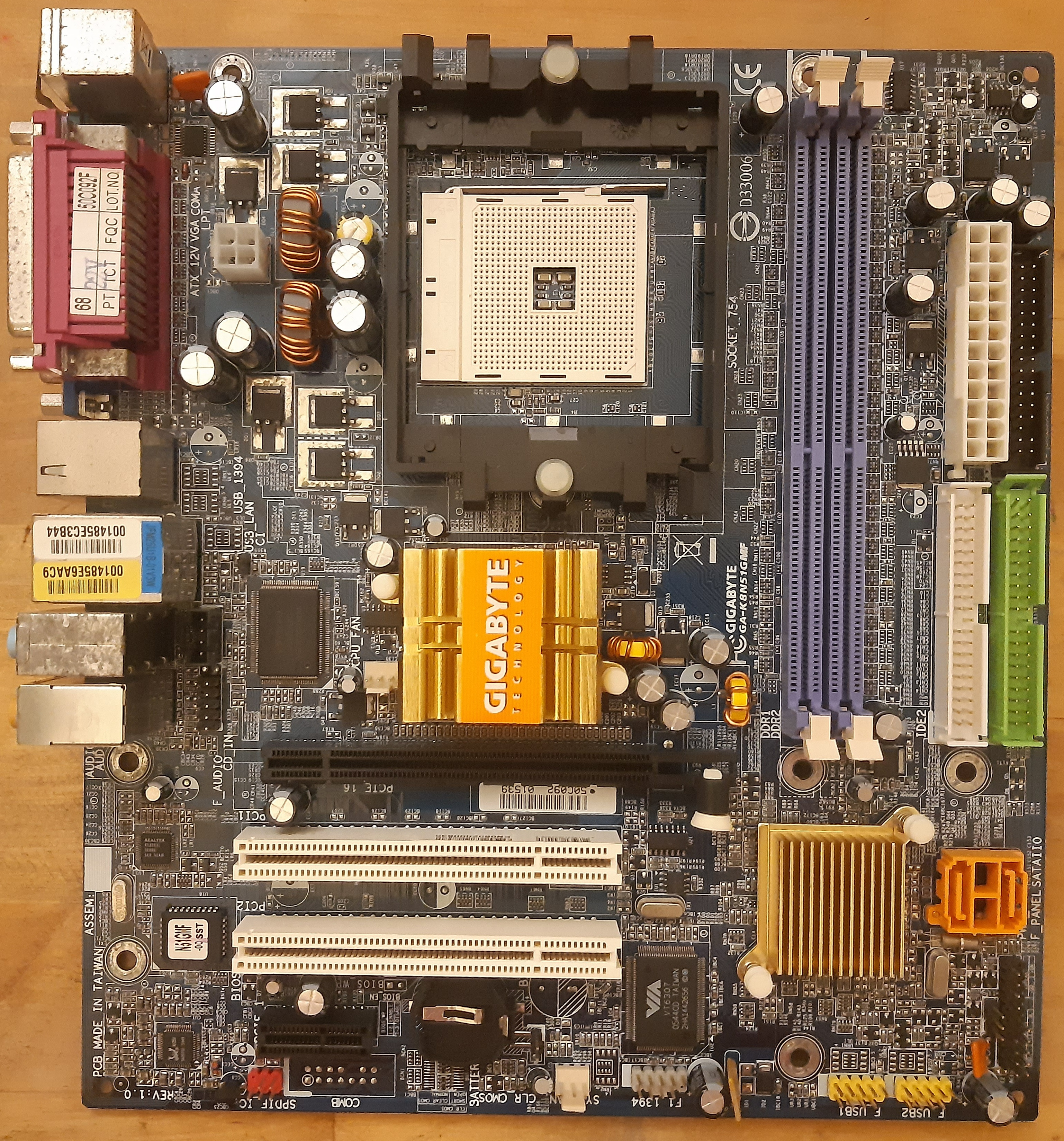
k8n51gmf-rev10-754-photo-6482f20ad969b645083145.jpg
After recap 😀
file.php?id=159601&mode=view

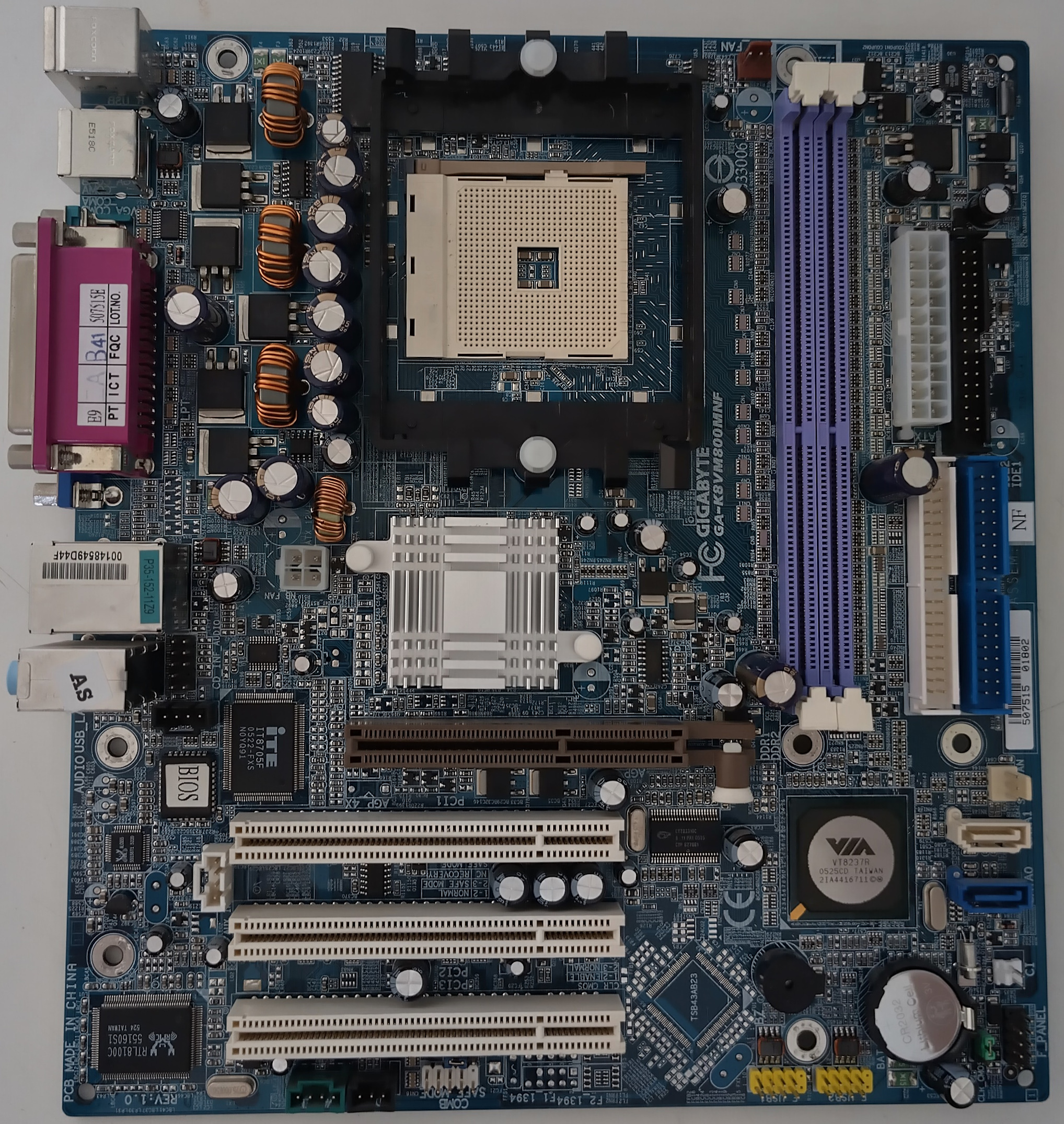
At the same time, Gigabyte OEM for Packard Bell.
It feels a bit dodgy to not solder the capacitors, so let’s remove the Fire Ware.
ga-k8vm800mnf-packard-bell-bali-photo1-64de9dab76455620088234.jpg

Aopen MX3S, PIII-S Tualatin 1133, Radeon 9800Pro@XT BIOS, Audigy 4 SB0610
JetWay K8T8AS, Athlon DH-E6 3000+, Radeon HD2600Pro AGP, Audigy 2 Value SB0400
Gigabyte Ga-k8n51gmf, Turion64 ML-30@2.2GHz , Radeon X800GTO PL16, Diamond monster sound MX300

Reply 17 of 20, by Mike_

User metadata
Rank Member
Rank
Member
shevalier wrote on 2026-05-19, 13:51:

It won’t last long, it’ll be very hot, and it’ll last right up until the end of the warranty period.

something like that

Gigabyte's senior management
- We need to pull off a minor miracle. We need an S754 motherboard that supports the Athlon 64 3700+ Newcastle 130nm and comes with a useless (but not free) FireWire chip. And overclocking capable, of course.
- Here you go
- It needs to be cheaper.
- OK. We won’t solder 2 out of 5 capacitors in the CPU VRM and 1of 3 for chipset. But we’re definitely keeping Fire Wire.
k8n51gmf-rev10-754-photo-6482f20ad969b645083145.jpg
After recap 😀
file.php?id=159601&mode=view

At the same time, Gigabyte OEM for Packard Bell.
It feels a bit dodgy to not solder the capacitors, so let’s remove the Fire Ware.
ga-k8vm800mnf-packard-bell-bali-photo1-64de9dab76455620088234.jpg

I mean, rated ripple current for the current Rubycon 1200µF cap is 1.43A and it's probably less than an amp for the 25V Choyo general purpose cap. So I'm wondering that how did this thing even last past its warranty or past a couple of months of use for that matter if it exceeded the ratings by more than four times? 😁

I guess I'll put two more of those Panasonics into empty TC8 and TC9 footprints... then it'll have twice the number of caps and better ones at that, so it should last quite a while. I'm intending to undervolt this by modding CPU bridges, as well.

Reply 18 of 20, by shevalier

User metadata
Rank Oldbie
Rank
Oldbie
Mike_ wrote on 2026-05-19, 18:22:

I mean, rated ripple current for the current Rubycon 1200µF cap is 1.43A and it's probably less than an amp for the 25V Choyo general purpose cap. So I'm wondering that how did this thing even last past its warranty or past a couple of months of use for that matter if it exceeded the ratings by more than four times? 😁

I guess I'll put two more of those Panasonics into empty TC8 and TC9 footprints... then it'll have twice the number of caps and better ones at that, so it should last quite a while. I'm intending to undervolt this by modding CPU bridges, as well.

With a Duron Spitfire processor (TDP around 30 W) and Word in the office? It worked absolutely perfectly.

When I can’t be bothered to do the calculations (which is always the case), I resort to the scientific method of ‘studying previous solutions’—I just look at the pictures.
ASUS A7N8X
The best of the worst (yep, ASUS still hasn’t switched the CPU power supply to +12V) motherboards based on the very latest chipset. By this point, motherboard manufacturers have studied all the platform’s nuances and analysed the RMA.
And all the fastest processors have been released.
fetch?id=2136973
3300u*6.3V nichicon HM
2.8A rated current, ESR 12 mOhm
https://www.nichicon.co.jp/english/products/pdf/e-hm.pdf
3 at the entrance to the VRM and 5 at the exit.
But that didn’t save them 😀

Aopen MX3S, PIII-S Tualatin 1133, Radeon 9800Pro@XT BIOS, Audigy 4 SB0610
JetWay K8T8AS, Athlon DH-E6 3000+, Radeon HD2600Pro AGP, Audigy 2 Value SB0400
Gigabyte Ga-k8n51gmf, Turion64 ML-30@2.2GHz , Radeon X800GTO PL16, Diamond monster sound MX300

Reply 19 of 20, by Mike_

User metadata
Rank Member
Rank
Member
shevalier wrote on 2026-05-20, 04:14:
With a Duron Spitfire processor (TDP around 30 W) and Word in the office? It worked absolutely perfectly. […]
Show full quote

With a Duron Spitfire processor (TDP around 30 W) and Word in the office? It worked absolutely perfectly.

When I can’t be bothered to do the calculations (which is always the case), I resort to the scientific method of ‘studying previous solutions’—I just look at the pictures.
ASUS A7N8X
The best of the worst (yep, ASUS still hasn’t switched the CPU power supply to +12V) motherboards based on the very latest chipset. By this point, motherboard manufacturers have studied all the platform’s nuances and analysed the RMA.
And all the fastest processors have been released.
fetch?id=2136973
3300u*6.3V nichicon HM
2.8A rated current, ESR 12 mOhm
https://www.nichicon.co.jp/english/products/pdf/e-hm.pdf
3 at the entrance to the VRM and 5 at the exit.
But that didn’t save them 😀

Nichicon HMs were a defective series, though. 😀

Anyways, I put in two more similar Panasonic caps at the empty spots. They are rated at 2.18A ripple current, so in total the caps should be able to deal with about 8A, quite close to that Asus board. I guess it somewhat reduced ripple voltage in the input stage.

The attachment before.jpg is no longer available
The attachment after.jpg is no longer available