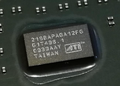
This isn't the 9800 circuit, but it's very similar to that implementation.
Page 4.
The oscillator is powered by 3.3V, so the peak-to-peak voltage cannot exceed 3.3 V.
Apart from narrow spikes on the fronts, which may exceed the 0–3.3 V range due to inductance.
The fact that the waveform doesn’t match the “textbook” is because that’s how it always looks in reality, especially if it isn’t tested with a ground spring and probe isn’t tuned.
If you’re absolutely certain about the measurements, then you’ve got a donor.
Just swap the oscillator.
P.S. It’s possible that the 9800 model uses a 5 V generator, but this is easy to check using a multimeter on its terminals.
But I have serious doubts about that.
The oscillator on the Radeon 9800 (9700, PCB-style) is definitely connected to the +3.3V supply; I’ve checked.
PPS Try using the same oscilloscope settings to measure either a CR2032 battery or the +3.3V power supply voltage.
Aopen MX3S, PIII-S Tualatin 1133, Radeon 9800Pro@XT BIOS, Audigy 4 SB0610
JetWay K8T8AS, Athlon DH-E6 3000+, Radeon HD2600Pro AGP, Audigy 2 Value SB0400
Gigabyte Ga-k8n51gmf, Turion64 ML-30@2.2GHz , Radeon X800GTO PL16, Diamond monster sound MX300