First post, by DCFly
DCFly
Offline
Rank
Newbie
- Rank
- Newbie
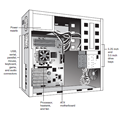
My Pentium III system.
My Pentium III system.
The CPU fan is installed upside down, so it's drawing air out of the heatsink instead of blowing air onto it.
Ydee wrote on 2026-06-29, 10:02:The CPU fan is installed upside down, so it's drawing air out of the heatsink instead of blowing air onto it.
Which in some cases, dependent on the airflow of the rest of the system, is not necessarily a bad thing. On some builds, I've dont that deliberately.
If it's dual it's kind of cool ... 😎
--- GA586DX --- P2B-DS --- BP6 ---
Please use the "quote" option if asking questions to what I write - it will really up the chances of me noticing 😀
Nice rig. Feels like peak Single 370 Pentium 3!! Have you got any more pictures?
I too am curious about the reverse airflow - do you find it helps with temps?
Got any 3DMark01 scores?
geordiepingu wrote on 2026-07-05, 17:19:All for the benchmarks!
Petrol head and serial PC tweaker
Nice,
I have the same motherboard with 1ghz cpu
But I want to put a 1.4 ghz CPU in it.
What version bios are you using ?
The manual only shows support up to 1ghz CPU.
What jumper settings are you using ?
Do you have any photos of your bios cpu post speed ?
Please change that fan to the correct way... Just looking at is makes me itchy and disturbes my adhd...
It s like putting the toilet roll in the holder the wrong way (paper close to wall)....
There's a shroud over the top of the heatsink so the fan should work in this setup, as it draws cool air into the space between the heatsink fins and expels it away from the CPU.
I would install a rear case fan though.
I like the system. The GPU is a little overpowered but... Why not? I am currently building a P3-1000 with a V5-5500. It already passed some LAN session but some cooling/lighting is still missing.
bitzu101 wrote on 2026-06-29, 14:14:Please change that fan to the correct way... Just looking at is makes me itchy and disturbes my adhd...
It s like putting the toilet roll in the holder the wrong way (paper close to wall)....
No way, you can't compare using a fan drawing air away from the cooler with toilet paper turned the wrong way around 🤣
If it's dual it's kind of cool ... 😎
--- GA586DX --- P2B-DS --- BP6 ---
Please use the "quote" option if asking questions to what I write - it will really up the chances of me noticing 😀
It can work this way, too, but the fan that blows air onto the heat sink fins also cools the MOSFETs and capacitors around the socket.
Ydee wrote on 2026-06-29, 10:02:The CPU fan is installed upside down, so it's drawing air out of the heatsink instead of blowing air onto it.
Because of the thermal nature of the 1400S and the airflow setup of my case (I have two front 92mm intake fans and no exhaust), I decided to go with the setup I have (with the fan pulling air up and away from the heatsink).
Intel486dx33 wrote on 2026-06-29, 12:29:Nice, I have the same motherboard with 1ghz cpu But I want to put a 1.4 ghz CPU in it. […]
Nice,
I have the same motherboard with 1ghz cpu
But I want to put a 1.4 ghz CPU in it.What version bios are you using ?
The manual only shows support up to 1ghz CPU.
What jumper settings are you using ?
Do you have any photos of your bios cpu post speed ?
Let me get back to you on this; give me a couple days and I'll get this information for you.
DCFly wrote on 2026-07-01, 21:49:Ydee wrote on 2026-06-29, 10:02:The CPU fan is installed upside down, so it's drawing air out of the heatsink instead of blowing air onto it.
Because of the thermal nature of the 1400S and the airflow setup of my case (I have two front 92mm intake fans and no exhaust), I decided to go with the setup I have (with the fan pulling air up and away from the heatsink).
Unless the CPU fan is ducted to the outside of the case where it can functionally serve as an exhaust, it's always better to have the airflow down onto the heatsink IMO
98/DOS Rig: BabyAT AladdinV, K6-2+/550, V3 2000, 128MB PC100, 20GB HDD, 128GB SD2IDE, SB Live!, SB16-SCSI, PicoGUS, WP32 McCake, iNFRA CD, ZIP100
XP Rig: Lian Li PC-10 ATX, Gigabyte X38-DQ6, Core2Duo E6850, ATi HD5870, 2GB DDR2, 2TB HDD, X-Fi XtremeGamer
NeoG_ wrote on 2026-07-02, 00:30:DCFly wrote on 2026-07-01, 21:49:Ydee wrote on 2026-06-29, 10:02:The CPU fan is installed upside down, so it's drawing air out of the heatsink instead of blowing air onto it.
Because of the thermal nature of the 1400S and the airflow setup of my case (I have two front 92mm intake fans and no exhaust), I decided to go with the setup I have (with the fan pulling air up and away from the heatsink).
Unless the CPU fan is ducted to the outside of the case where it can functionally serve as an exhaust, it's always better to have the airflow down onto the heatsink IMO
Hi,
I agree with @NeoG_ in this, if not ducted it is almost always better to have the airflow down.
In regards of this case instead of an exhaust duct, installing a high CFM exhaust fan to the grille (left to the CPU in the first image), might produce a similar effect to a duct as it seems to be close enough to the CPU socket to exhaust the heated air above the CPU heat-sink.
Anyway even the S variant of P3 1.4 Ghz has only a 32.2W TDP(Unlike Intel's P4 Netburst processors which tend to have at least around double of that) , so having it not in the most efficient configuration is not that big of a problem most likely.
"A process cannot be understood by stopping it. Understanding must move with the flow of the process, must join it and flow with it." - Dune
I have a Northwood 3.2 ghz with a akasa cooler (nothing special) , works just fine.
as long as it s not Prescott , than no problem
Irinikus wrote on 2026-06-29, 15:56:... I would install a rear case fan though.
^ Me too. Not so much for the Tualatin (that looks well served with that CPU heatsink, regardless of CPU fan pulling or pushing air thru it), but to help cooling the heat sensitive mobo VRM components (FETs lacking heatsinks, VRM output caps, toroid choke).
Speaking of which, I noticed several empty spots for VRM output caps in DCFly's system.
Never fiddled with one of these ASUS TUSL2-C boards, so did a cursory inspection at the superb The Retro Web site.
Looks like the TUSL2-C was designed with 7 spots for VRM output caps, which was good practice at the time for PIIIs.
However it also looks like ASUS systematically cheaped out on populating said spots:
( ESR of each individual cap in parallel / Number of caps ) = Combined ESR.
The lower the VRM output caps' combined ESR, the better.
The lesser the number of VRM output caps, the higher the combined ESR. Not good.
.
Interestingly, it looks like they didn't cheap out on populating the CUSL2-C:
Let the air flow!