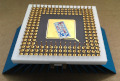
OK I have some additional details to share around testing and an open question I'm aiming to answer, but first here's the end-to-end documentation of my hardware platform and some of what I have tried so far.
Hardware / Test Platform
Motherboard
- Gigabyte GA-486VF Rev. 6
- Chipset: SiS 85C471
- BIOS: Award Modular BIOS v4.50G, dated 04/27/94
- BIOS has been edited with MODBIN only to expose additional setup-menu options. No underlying register patches are currently being used, and the previous write-back register change is not active.
- 3x VESA Local Bus slots:
Memory
- 64MB RAM, installed entirely in bank 0, using 60ns 30-pin SIMMs (I have an extra 64mb but removed it so the external cache covers it all.)
External Cache
- 512KB external L2 cache
- Data SRAM:
- 4x ISSI IS61C1024-15N
- 128Kx8, DIP-32, 15ns
- TAG SRAM:
- W24257AK-12
- 32Kx8, DIP-28, 12ns
Video
- Diamond Stealth64 VLB
- S3 Vision868 chipset
- 2MB video memory
- Installed in VESA2
Storage / I/O
- Adaptec AHA-2842A VLB SCSI controller
- Installed in VESA1
- Also provides the floppy controller
- ZuluSCSI Blaster Rev. 2025f
Additional Hardware Available
- BusLogic BT-445S VLB SCSI controller
- Promise EIDE2300 Plus VLB IDE controller
CPUs Tested
- AMD Am5x86-P75 / Am486 DX5-133V16BGC (with large heatsink + Noctua fan on top)
- AMD Am5x86-P75 / AMD-X5-133ADZ (with large heatsink + Noctua fan on top)
- Intel Pentium OverDrive POD83 / P24T
CPU Tests to Date
Three Socket 3 CPUs have been tested so far. Both AMD Am5x86-P75 parts, the Am486 DX5-133V16BGC and the AMD-X5-133ADZ, work correctly at the stock 33MHz bus / 4x multiplier configuration, for 133MHz operation.
When attempting 40MHz bus / 4x multiplier operation, the DX5-133V16BGC fails to run Windows reliably. The X5-133ADZ gets farther and will boot into Windows 95, but still shows instability under load and during file-copy testing.
The Intel Pentium OverDrive POD83 / P24T also POSTs in this board, but only boots with its internal cache disabled. With the POD83 internal cache enabled, the system fails to boot from the Adaptec-controlled hard disk or floppy path. It throws a disk error as if the hard drive wasn't there (even though the SCSI banner shows and detects the disk.)
Important BIOS / Cache Stability Finding
At 33MHz with external cache enabled, setting Cache Burst Read to 0W caused immediate Windows 95 registry/disk-corruption-type symptoms. Returning Cache Burst Read to 1W made the 512KB cache configuration stable.
This was true across testing and was critical to getting the system reliable even at the normal 33MHz bus / 133MHz CPU configuration.
Current Question: Can the ADZ Run Reliably at 40MHz FSB?
I have mostly given up on the POD83 for now. After hours of changing jumper and BIOS settings one at a time, I admit defeat there. At this point I am focused on trying to get a modest overclock of the ADZ working at 40MHz bus / 4x multiplier, for an effective 160MHz CPU clock.
The ADZ appears to be the better candidate of the two AMD 5x86 chips. It boots farther than the DX5-133V16BGC at 160MHz and has reached the Windows 95 desktop, but it is not yet stable. I have seen hangs, blue screens, and file-copy instability under Windows 95, although I did get one successful SpeedSys result.
The challenge is determining whether the instability is caused by the CPU itself at 160MHz, the GA-486VF / SiS 471 chipset at 40MHz bus, the 30-pin SIMM memory subsystem, the 512KB external cache path, or the VLB I/O path with the Adaptec AHA-2842A.
So far, disabling the external cache did not make the 40MHz configuration stable, which suggests the 512KB L2 cache is probably not the only limiting factor. That leaves the CPU core at stock voltage, the 40MHz VLB environment, DRAM/chipset timing, or the Adaptec VLB controller path as the remaining suspects.
I don't think it will help much, but I also have 10ns SRAM chips and a 10ns TAG SRAM chip on order. But right now my 15ns chips paired with a 12ns TAG should be more than OK.
Happy to take questions or input, otherwise I'm going to keep testing and will report back when I have more.