VOGONS


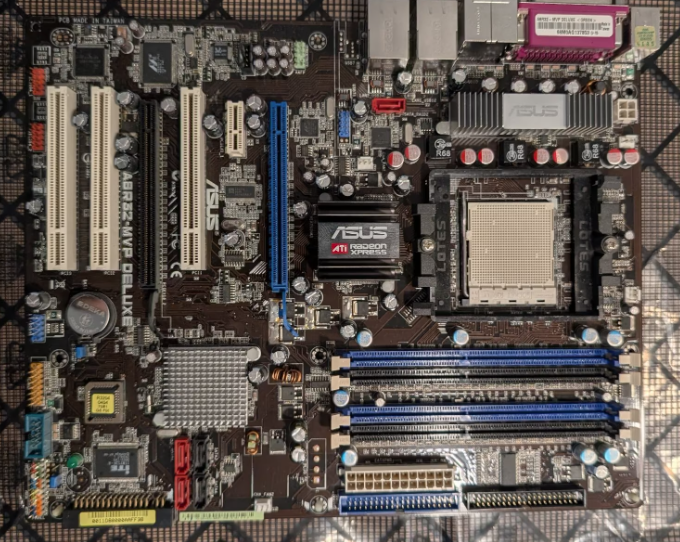
Bought these (retro) hardware today

Topic actions

Reply 59360 of 59369, by dionb

User metadata
Rank l33t++
Rank
l33t++
H3nrik V! wrote on 2026-07-01, 05:39:
[...] […]
Show full quote

[...]

Yes, that's a funny note - but you wrote it yourself: "I guess they did the whole "move the northbridge on-die" in steps."

If I look at it, it seems like the 1156 launched close to a year later than 1366 did. I guess the 1366 was the first "flagship" on-die memory controller chip, where they only put the memory controller on-board, rather than everything all at once. The thing is that the on-board PCIe on 1156 was on the expense of "only" dual channel memory. (not that it really made any practical difference - but data sheets are data sheets 🤣 )

I guess the fact that the QPI link was scalable (4.8GT/s to 6.4 GT/s) made it possible to also scale the number of PCIe channels from the northbridge side, whereas the 1156 had one x16 interface. That was probably not enough for the HEDT platform in Intel's mind back then. Also, if I understand correctly, the QPI is also used on Xeons for inter-socket communications?

Not so strange at all if you look at the context.

LGA1366 was originally designed for the Xeon server platform, but - as several times before and since - Intel decided to introduce it in November 2008 as a high-end desktop platform as well. As with other platforms primarily intended for the server market, features were more geared towards bandwidth than latency. So big wide QPI path to an extermal chipset, where you could basically deploy as many PCIe lanes as you want. Sure, latency would be higher than if using a dedicated PCIe controller in the CPU, but for the workloads it was designed for, that was hardly an issue.

LGA1156 was a dedicated desktop platform with some nods and winks to laptop development. It not only moved the memory controller to the CPU like in LGA1366, but also included the northbridge and so the PCIe controller. The remaining chipset component - the PCH - was essentially a southbridge in all but name, and the DMI link between CPU and PCH was basically just PCIe as well.

The end result of the LGA1156 and later integration was a more modest bandwidth than LGA1366 offered and no sensible way to implement SMP, but with significantly reduced latency, so ideal for desktop use. These very different characteristics led to a divergence in benchmarks: things that thrived on raw CPU power and memory and PCIe bandwidth did a lot better on LGA1366 platforms, but things more sensitive to latency performed better on LGA1156. That meant that when it came to gaming, with a single GPU the LGA1156 scored better, but add a second GPU and LGA1366 came on top.

You saw similar things with later server->desktop platforms like the LGA2011.

Reply 59361 of 59369, by H3nrik V!

User metadata
Rank l33t
Rank
l33t
dionb wrote on 2026-07-01, 18:33:
Not so strange at all if you look at the context. […]
Show full quote
H3nrik V! wrote on 2026-07-01, 05:39:
[...] […]
Show full quote

[...]

Yes, that's a funny note - but you wrote it yourself: "I guess they did the whole "move the northbridge on-die" in steps."

If I look at it, it seems like the 1156 launched close to a year later than 1366 did. I guess the 1366 was the first "flagship" on-die memory controller chip, where they only put the memory controller on-board, rather than everything all at once. The thing is that the on-board PCIe on 1156 was on the expense of "only" dual channel memory. (not that it really made any practical difference - but data sheets are data sheets 🤣 )

I guess the fact that the QPI link was scalable (4.8GT/s to 6.4 GT/s) made it possible to also scale the number of PCIe channels from the northbridge side, whereas the 1156 had one x16 interface. That was probably not enough for the HEDT platform in Intel's mind back then. Also, if I understand correctly, the QPI is also used on Xeons for inter-socket communications?

Not so strange at all if you look at the context.

LGA1366 was originally designed for the Xeon server platform, but - as several times before and since - Intel decided to introduce it in November 2008 as a high-end desktop platform as well. As with other platforms primarily intended for the server market, features were more geared towards bandwidth than latency. So big wide QPI path to an extermal chipset, where you could basically deploy as many PCIe lanes as you want. Sure, latency would be higher than if using a dedicated PCIe controller in the CPU, but for the workloads it was designed for, that was hardly an issue.

LGA1156 was a dedicated desktop platform with some nods and winks to laptop development. It not only moved the memory controller to the CPU like in LGA1366, but also included the northbridge and so the PCIe controller. The remaining chipset component - the PCH - was essentially a southbridge in all but name, and the DMI link between CPU and PCH was basically just PCIe as well.

The end result of the LGA1156 and later integration was a more modest bandwidth than LGA1366 offered and no sensible way to implement SMP, but with significantly reduced latency, so ideal for desktop use. These very different characteristics led to a divergence in benchmarks: things that thrived on raw CPU power and memory and PCIe bandwidth did a lot better on LGA1366 platforms, but things more sensitive to latency performed better on LGA1156. That meant that when it came to gaming, with a single GPU the LGA1156 scored better, but add a second GPU and LGA1366 came on top.

You saw similar things with later server->desktop platforms like the LGA2011.

I can't really disagree with your analysis here, it's 2 totally different platforms. However, the i7 for 1366 released something like close to a year before 1156, so for early adopters, that was the way - using the HEDT platform.

If it's dual it's kind of cool ... 😎

--- GA586DX --- P2B-DS --- BP6 ---

Please use the "quote" option if asking questions to what I write - it will really up the chances of me noticing 😀

Reply 59362 of 59369, by myne

User metadata
Rank l33t
Rank
l33t
H3nrik V! wrote on 2026-07-01, 05:39:
Yes, that's a funny note - but you wrote it yourself: "I guess they did the whole "move the northbridge on-die" in steps." […]
Show full quote
myne wrote on 2026-07-01, 03:19:
You know what's confusing? 1156 has PCIE on-chip. 1366 doesn't. […]
Show full quote
H3nrik V! wrote on 2026-06-26, 12:17:

Interesting document. Thanks!

You know what's confusing?
1156 has PCIE on-chip. 1366 doesn't.

I do know that QPI is basically a variant of PCIE, so perhaps they figured a MUX on the chipset would be 'better'

Yes, that's a funny note - but you wrote it yourself: "I guess they did the whole "move the northbridge on-die" in steps."

If I look at it, it seems like the 1156 launched close to a year later than 1366 did. I guess the 1366 was the first "flagship" on-die memory controller chip, where they only put the memory controller on-board, rather than everything all at once. The thing is that the on-board PCIe on 1156 was on the expense of "only" dual channel memory. (not that it really made any practical difference - but data sheets are data sheets 🤣 )

I guess the fact that the QPI link was scalable (4.8GT/s to 6.4 GT/s) made it possible to also scale the number of PCIe channels from the northbridge side, whereas the 1156 had one x16 interface. That was probably not enough for the HEDT platform in Intel's mind back then. Also, if I understand correctly, the QPI is also used on Xeons for inter-socket communications?

If you do the math, pcie2 has 16x5gbit so it's faster than qpi. You might be on to something with the memory controller. Intel like to double up pin functions so maybe that explains it. -32 pcie pins +32 memory pins.

I built:
Convert old ASUS ASC boardviews to KICAD PCB!
Re: A comprehensive guide to install and play MechWarrior 2 on new versions on Windows.
Dos+Windows 3.11+tcp+vbe_svga auto-install iso template
Script to backup Win9x\ME drivers from a working install
Re: The thing no one asked for: KICAD 440bx reference schematic

Reply 59363 of 59369, by Shader_BiH

User metadata
Rank Newbie
Rank
Newbie
PcBytes wrote on 2026-07-01, 16:00:
X1950 Pro 256MB came in yesterday. Managed to undo its unnecessary overkill Rialto cooling. […]
Show full quote

X1950 Pro 256MB came in yesterday. Managed to undo its unnecessary overkill Rialto cooling.

We went from this absolute UNIT of a ghetto Rialto cooling (which would be enough for a Pentium MMX!!!!!!)

The attachment rialto_ovrkill_cool.png is no longer available

To something more within normal ranges, recycled from a broken RS481 motherboard's southbridge, although I had to clip off the old pushpin holes (they wouldn't reach the screw next to the Rialto anyways) before pasting it on.

The attachment after_rialto.jpg is no longer available

For the concerned, the heatsink is NOT touching anything with its corners, and I've filed the corners to the fullest extent possible.

Great card! It just might be the best AGP solution for non top-tier CPU combinations. Something like Pentium 4 3.4 or Athlon 3200+ would work great with it I think.

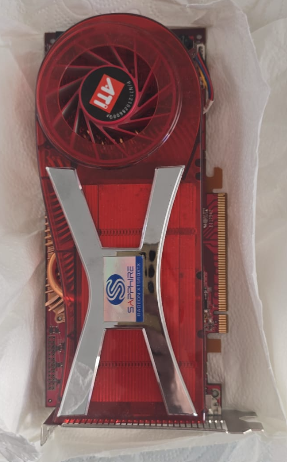
Today one of my GPU hunts finally gave results. As I'm heavily into ATI red PCB hardware I was trying to find the Sapphire 3850 red card with that cool sticker on it. At first, it was mission impossible, as it appears there were a lot of different models of this card in different specs and PCB and cooler solutions. After quite a while I managed to identify it as early version of Sapphire 3850 256 MB PCIEx. That one went to reviewers back in the day. The second challenge was finding that card with sticker on it. I was searching for months.... There were some card available on e-bay, but apparently, due to high temperatures, those stickers came off, and there is not a single one left with sticker intact.... By some luck I managed to track down a card on Croatian "Njuškalo" market site, and managed to obtain the card from my contact in Croatia for just 25 euros....

1782994702721.jpg 1782994702685.jpg

It's just a beautiful card... Great condition, and it even came with original CD and cables... Very happy ^^

Last edited by Shader_BiH on 2026-07-02, 14:27. Edited 1 time in total.

Reply 59364 of 59369, by nuno14272

User metadata
Rank Member
Rank
Member

The gravis is a clone one ! form Primax.. (yes the manufacrer of mouses).
Primax SoundStorm Wave Review
https://www.karlsitretro.com/primax-soundstorm-wave-review/

-but the gavis only emulates, and badly, the sound blaster.. so no option for mainstream.

The board is a QDI p4u880a/io. with a DX4-120.
https://theretroweb.com/motherboards/s/qdi-p4u880a-io

1| 386DX40
2| P200mmx, Voodoo 1
3| PIII-450, Voodoo 3 3000

Reply 59365 of 59369, by Nunoalex

User metadata
Rank Member
Rank
Member

Hi all

This just arrived today the Chips&Technologies F64300 VLB Card AKA Wingine GDX AKA expertcolor dsp64300

It is supposed to be on the high side of the VLB cards performance
It even has some slots for some suposed "cache" in windows accelelretion I would imagine

I already have a few Cirrus Logic, Trident and S3 805 VLB cards so I wanted to add this one to the collection

I payed 42 euros for it

What you guys think ?

Reply 59366 of 59369, by BitWrangler

User metadata
Rank l33t++
Rank
l33t++

Cool, be interesting to see if utilities for scaling etc for Chips laptop parts do anything on it.

Unicorn herding operations are proceeding, but all the totes of hens teeth and barrels of rocking horse poop give them plenty of hiding spots.

Reply 59367 of 59369, by Shader_BiH

User metadata
Rank Newbie
Rank
Newbie
Nunoalex wrote on 2026-07-02, 21:03:
Hi all […]
Show full quote

Hi all

This just arrived today the Chips&Technologies F64300 VLB Card AKA Wingine GDX AKA expertcolor dsp64300

It is supposed to be on the high side of the VLB cards performance
It even has some slots for some suposed "cache" in windows accelelretion I would imagine

I already have a few Cirrus Logic, Trident and S3 805 VLB cards so I wanted to add this one to the collection

I payed 42 euros for it

What you guys think ?

It's in lovely condition... By the state of slot contacts it doesn't appear to be used much. It would be interesting to see performance scaling with different cache configs.

Reply 59368 of 59369, by Nunoalex

User metadata
Rank Member
Rank
Member
Shader_BiH wrote on Today, 08:35:
Nunoalex wrote on 2026-07-02, 21:03:
Hi all […]
Show full quote

Hi all

This just arrived today the Chips&Technologies F64300 VLB Card AKA Wingine GDX AKA expertcolor dsp64300

It is supposed to be on the high side of the VLB cards performance
It even has some slots for some suposed "cache" in windows accelelretion I would imagine

I already have a few Cirrus Logic, Trident and S3 805 VLB cards so I wanted to add this one to the collection

I payed 42 euros for it

What you guys think ?

It's in lovely condition... By the state of slot contacts it doesn't appear to be used much. It would be interesting to see performance scaling with different cache configs.

As soon as I track down some compatible chips (the board has marking MT4c4256 ) I will post some results

But I think I read here on the forum that this is only affecting windows performance and has no effect in DOS

Reply 59369 of 59369, by SlowA

User metadata
Rank Newbie
Rank
Newbie
Shader_BiH wrote on 2026-07-02, 12:29:
Great card! It just might be the best AGP solution for non top-tier CPU combinations. Something like Pentium 4 3.4 or Athlon 320 […]
Show full quote
PcBytes wrote on 2026-07-01, 16:00:
X1950 Pro 256MB came in yesterday. Managed to undo its unnecessary overkill Rialto cooling. […]
Show full quote

X1950 Pro 256MB came in yesterday. Managed to undo its unnecessary overkill Rialto cooling.

We went from this absolute UNIT of a ghetto Rialto cooling (which would be enough for a Pentium MMX!!!!!!)

The attachment rialto_ovrkill_cool.png is no longer available

To something more within normal ranges, recycled from a broken RS481 motherboard's southbridge, although I had to clip off the old pushpin holes (they wouldn't reach the screw next to the Rialto anyways) before pasting it on.

The attachment after_rialto.jpg is no longer available

For the concerned, the heatsink is NOT touching anything with its corners, and I've filed the corners to the fullest extent possible.

Great card! It just might be the best AGP solution for non top-tier CPU combinations. Something like Pentium 4 3.4 or Athlon 3200+ would work great with it I think.

Today one of my GPU hunts finally gave results. As I'm heavily into ATI red PCB hardware I was trying to find the Sapphire 3850 red card with that cool sticker on it. At first, it was mission impossible, as it appears there were a lot of different models of this card in different specs and PCB and cooler solutions. After quite a while I managed to identify it as early version of Sapphire 3850 256 MB PCIEx. That one went to reviewers back in the day. The second challenge was finding that card with sticker on it. I was searching for months.... There were some card available on e-bay, but apparently, due to high temperatures, those stickers came off, and there is not a single one left with sticker intact.... By some luck I managed to track down a card on Croatian "Njuškalo" market site, and managed to obtain the card from my contact in Croatia for just 25 euros....

1782994702721.jpg 1782994702685.jpg

It's just a beautiful card... Great condition, and it even came with original CD and cables... Very happy ^^

Good find.
If you need anything from Njuškalo, feel free to be in touch.