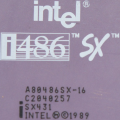
as indicated in the Canon Netejet post, I came into possession of this computer which is indicated on Wikipedia as having a 486DX4, to my surprise it is a DX4 75... a CPU that is almost never talked about on Vogons... would you like to have your say? about? I know perfectly well that the frequency is obtained from the slower bus compared to its more famous brother, the DX4 100, I really intended a debate between us precisely to stimulate some exchange of opinions on a very little represented CPU.
Which version of the DX4-75 are we talking about here .. the ceramic normal version or the even more rare overdrive model with 16kb of L1 cache ?
And yeah the extra cache makes a fair bit of difference.
As for interesting ...the 486 DX-50 (Note its not a DX2) is a more interesting CPU to discuss, its the only 486 with a 50Mhz FSB, the DX4-75 is only interesting because its rare but other than that the DX4-100 is a better CPU and far easier to obtain.
Last edited by Trashbytes on 2024-02-03, 21:44. Edited 1 time in total.
Besides being an overdrive for obsolete 25mhz 486’s I’ve never understood the point of this chip in “new desktop “ computers
Slower cache, ram, video and hard drive performance meaning the venerable DX2-66 could run side by side .
Marketing? The DX4 was never intended to be a flagship (the Pentium was already out), so if you can advertise 9 extra MHz and if the large OEMs can perhaps use slower (read: cheaper) parts in the rest of the system than in a DX2/66 system, that sounds like a win...
And actually, I would go one step further - if they already had motherboard designs that were optimized for a 25MHz bus that they could stick a DX4 onto with minimal adjustments, while that design couldn't handle a 33MHz bus, that means they get an extra year of life out of that design...
Large OEMs have always, always wanted to cut costs (and deliver the most-MHz and the most megabytes with the least everything-else they can get away with), whether at that time, at the turn of the millennium (just how many i810 systems were shipped with high-MHz CPUs at top dollar?), or today...
Dx4-75’s were marketed to death in laptops. They seemed to be common.
Besides being an overdrive for obsolete 25mhz 486’s I’ve never understood the point of this chip in “new desktop “ computers
Slower cache, ram, video and hard drive performance meaning the venerable DX2-66 could run side by side .
I’ve never tested it but have to guess these were easy to overclock.
Now if you want to talk rarer, the DX4-90’s were a thing
Also originally Intel itself included DX3 CPUs in the roadmap, a DX3-75 would have made more sense but Intel skipped it
AFAIK DX3 was planned to have the multiplier of 2.5. So DX2 multiplier 2. DX3 multiplier 2.5. DX4 multiplier 3.
Not really straight forward, nobody understands the logic behind. And then a DX3 was never produced. Except one: the PODP 63 and 83, those had a multiplier of 2.5, but anyway the multiplier was hardcoded.
Are you sure a DX3-75 was in the roadmap? So bus = 30MHz. So even more exotic than a DX4-90?
EDIT:
Funny that wikichip.org also mentions 2.5 multiplier. It never existed
VivienMwrote on 2024-02-03, 23:34:Marketing? The DX4 was never intended to be a flagship (the Pentium was already out), so if you can advertise 9 extra MHz and if […] Show full quote
Besides being an overdrive for obsolete 25mhz 486’s I’ve never understood the point of this chip in “new desktop “ computers
Slower cache, ram, video and hard drive performance meaning the venerable DX2-66 could run side by side .
Marketing? The DX4 was never intended to be a flagship (the Pentium was already out), so if you can advertise 9 extra MHz and if the large OEMs can perhaps use slower (read: cheaper) parts in the rest of the system than in a DX2/66 system, that sounds like a win...
And actually, I would go one step further - if they already had motherboard designs that were optimized for a 25MHz bus that they could stick a DX4 onto with minimal adjustments, while that design couldn't handle a 33MHz bus, that means they get an extra year of life out of that design...
Large OEMs have always, always wanted to cut costs (and deliver the most-MHz and the most megabytes with the least everything-else they can get away with), whether at that time, at the turn of the millennium (just how many i810 systems were shipped with high-MHz CPUs at top dollar?), or today...
I think the DX4-100 from Intel was a flagship.
But they delayed the release date on purpose, so Pentium 90 and 100 were simultaneously released with Intel DX4-100. Of course Pentium 90 is always faster than the Intel DX4-100.
The reason for delaying it's availabilty is clear, Intel wanted customers to buy their Pentium 60 and 66 systems. Except floating point intensive application, the Pentium 60 would have had a hard live against the DX4-100.
But yes, all what I wrote it is about DX4-100, DX4-75 was released together with the 100. It never made much sense from the very beginning, because of the low FSB, 25MHz is just not good for a 486.
Off-topic:
On a desktop PC, one could set it to 40MHz bus and multiplier 2, that will be a lot faster. I think it can handle the 40MHz internally. For sure it will beat then all Cyrix and AMDs DX2-80, because of the 16kb L1 cache.
the idea I got is that the DX4 75 only makes sense as an overdrive of very slow 486 sx25s. Building a system from scratch that is designed for this CPU means saving a few dollars to build it but giving the buyer a much slower system. It is where we glimpse the desire to earn money at the expense of everything and everyone. Anyway, returning to the topic, this is the photo of the CPU, it is mounted on a strange board that also includes (not present) memory chips...
It's close to the monitor connectors but I think it's the CPU because that thermal pad makes contact with the cover that has been disassembled which in turn is metal and seems to act as a large passive heat sink, why dissipate a graphics chip instead of the CPU? so I assumed it was the CPU
Played with two of those, both worked fine at 33MHz fsb with same small laptop non cooling solutions.
Intel didnt want to sell cheaper Pentiums, but market needed cheap CPU thus DX4 in both desktops and laptops took over the role of 386SX.
Imo it was never a good idea to buy into those Intel low end alternatives until Mendocino Celeron, skipping P4 Celerons and again with great value Core2 Celerons and Haswell Pentiums. Used server market took over as the best source of cheap base components around 2017. Why buy i7-4770 or whatever 4Core Intel CPU of the day when decommissioned (3 year cycle) 1150 Xeons E3-1286v3 flooded the market at a fraction of cost killing it at value/$. Thankfully now with once again viable AMD Intel is no longer selling turd sandwiches for the most part, and even a lowly ~$100 i3-14100F is solid entry level.
as indicated in the Canon Netejet post, I came into possession of this computer which is indicated on Wikipedia as having a 486DX4, to my surprise it is a DX4 75... a CPU that is almost never talked about on Vogons... would you like to have your say? about? I know perfectly well that the frequency is obtained from the slower bus compared to its more famous brother, the DX4 100, I really intended a debate between us precisely to stimulate some exchange of opinions on a very little represented CPU.
I know it is an old post, but I wanted to say that I had successfully installed Windows 95 on a system with that CPU, SVGA graphics and SoundBlaster compatible sound card. I don't remember the RAM amount, probably 16MB. It wasn't very fast, for better performance you need at least an Intel Pentium CPU, but we could play some games back in the 90's. We had even connected the sound card to a Hi-Fi for better sound.
CoffeeOnewrote on 2024-02-04, 00:01:I think the DX4-100 from Intel was a flagship.
But they delayed the release date on purpose, so Pentium 90 and 100 were simultan […] Show full quote
VivienMwrote on 2024-02-03, 23:34:Marketing? The DX4 was never intended to be a flagship (the Pentium was already out), so if you can advertise 9 extra MHz and if […] Show full quote
Besides being an overdrive for obsolete 25mhz 486’s I’ve never understood the point of this chip in “new desktop “ computers
Slower cache, ram, video and hard drive performance meaning the venerable DX2-66 could run side by side .
Marketing? The DX4 was never intended to be a flagship (the Pentium was already out), so if you can advertise 9 extra MHz and if the large OEMs can perhaps use slower (read: cheaper) parts in the rest of the system than in a DX2/66 system, that sounds like a win...
And actually, I would go one step further - if they already had motherboard designs that were optimized for a 25MHz bus that they could stick a DX4 onto with minimal adjustments, while that design couldn't handle a 33MHz bus, that means they get an extra year of life out of that design...
Large OEMs have always, always wanted to cut costs (and deliver the most-MHz and the most megabytes with the least everything-else they can get away with), whether at that time, at the turn of the millennium (just how many i810 systems were shipped with high-MHz CPUs at top dollar?), or today...
I think the DX4-100 from Intel was a flagship.
But they delayed the release date on purpose, so Pentium 90 and 100 were simultaneously released with Intel DX4-100. Of course Pentium 90 is always faster than the Intel DX4-100.
The reason for delaying it's availabilty is clear, Intel wanted customers to buy their Pentium 60 and 66 systems. Except floating point intensive application, the Pentium 60 would have had a hard live against the DX4-100.
This reminds of the forgotten P60 pricing scandal that occurred before the p75 released.
They priced the p60 a smidge below the dx2-66 while keeping the dx4-100 rather expensive and placing a lawsuit against amd to prevent their dx4 release.
Strange times, but they sold lots of p60’s for the few months until the p75 release
This reminds of the forgotten P60 pricing scandal that occurred before the p75 released.
They priced the p60 a smidge below the dx2-66 while keeping the dx4-100 rather expensive and placing a lawsuit against amd to prevent their dx4 release.
Strange times, but they sold lots of p60’s for the few months until the p75 release
I think they knew that they had to sell out the processors for the dead Socket 4.
This reminds of the forgotten P60 pricing scandal that occurred before the p75 released.
They priced the p60 a smidge below the dx2-66 while keeping the dx4-100 rather expensive and placing a lawsuit against amd to prevent their dx4 release.
Strange times, but they sold lots of p60’s for the few months until the p75 release
I think they knew that they had to sell out the processors for the dead Socket 4.
Intel has a long history of undercutting the previous generation of CPUs about a year after release to try to force alternative brands off the market.
The 386sx started the trend of dirty tricks with Intel marketing, pricing and school alliances.
The big one that was rarely talked about is that Intel provided immense above and beyond technical support to ensure DOS/4GW and 32bit coding resources were provided free to students and schools, whereas the 16bit extended memory equivalent could be thousands per seat and not fully fleshed out, as opposed to free. This meant it was reasonable to include a memory extender in the shareware model.
Intel moved further with cheap 486sx chips pricing them below typical 386 chips to squeeze them out.
The p60 continued the trend of undercutting other manufacturers to force them out. Considering per 1000 prices for p60’s continued into late 95 and new p60’s were still listed through 96 somebody was trying to fence the things.
The 386sx started the trend of dirty tricks with Intel ... pricing
In one of Computer History Museum interviews some Intel engineer revealed it cost Intel $5 to manufacture _and_ package 386sx at introduction in 1988. Chip was small and dead easy to make. It was MEGA printing money at Intel initial price of $219. i386SX-25 went from Q1 1990 $184 to Q4 1992 $59 due to Intel losing AMD Am386 microcode lawsuit. This move relegated Am386DX-40 Q2 1991 $231 flagship to the title of Q1 1993 $51 bottom feeder.
Even at $59 Intel was making over $55 of pure profit on those chips at the end of 1992, cant even call that dumping.
and new p60’s were still listed through 96 somebody was trying to fence the things.
More like dumping leftover stock of outdated merchandise. 5V Pentiums were very brief, super expensive, had problems with stability and heat. Not to mention there would be problems with chipset availability.
The conversation has trended toward Intel dumping leftover parts on different market segments, but the DX4-75 in laptops is still a decent decision.
A fraction lower heat and battery usage over time has value, a slightly cheaper bin of the DX4-100 making the overall cost of the laptop cheaper has value, the full speed 16KB L1 cache has value, faster floating point ops has value.
Not sure they were faster than a desktop DX2-66 overall, but it's a fair CPU in a laptop.
rasz_plwrote on 2026-07-20, 03:34:In one of Computer History Museum interviews some Intel engineer revealed it cost Intel $5 to manufacture _and_ package 386sx at […] Show full quote
The 386sx started the trend of dirty tricks with Intel ... pricing
In one of Computer History Museum interviews some Intel engineer revealed it cost Intel $5 to manufacture _and_ package 386sx at introduction in 1988. Chip was small and dead easy to make. It was MEGA printing money at Intel initial price of $219. i386SX-25 went from Q1 1990 $184 to Q4 1992 $59 due to Intel losing AMD Am386 microcode lawsuit. This move relegated Am386DX-40 Q2 1991 $231 flagship to the title of Q1 1993 $51 bottom feeder.
Even at $59 Intel was making over $55 of pure profit on those chips at the end of 1992, cant even call that dumping.
and new p60’s were still listed through 96 somebody was trying to fence the things.
More like dumping leftover stock of outdated merchandise. 5V Pentiums were very brief, super expensive, had problems with stability and heat. Not to mention there would be problems with chipset availability.
I have long quoted REAL prices for raw materials in a chip as you did to deflate certain fanboy discussions even around semi modern chip arguments .
You will get every excuse in the world why it’s justified. With the kind of money 386sx were making Intel could justify providing Wacom the resources to ensure coding 386 software was as close to free and license free as possible.
I would have to grab the per $1000 prices at various times
The 486sx25 eventually landed around $89 per chip which was similar to the list 386 prices which pushed them down and forced motherboard simplification to stay relevant.
The conversation has trended toward Intel dumping leftover parts on different market segments, but the DX4-75 in laptops is still a decent decision.
A fraction lower heat and battery usage over time has value, a slightly cheaper bin of the DX4-100 making the overall cost of the laptop cheaper has value, the full speed 16KB L1 cache has value, faster floating point ops has value.
Not sure they were faster than a desktop DX2-66 overall, but it's a fair CPU in a laptop.
486sx, sx2 and later the 486-75 were PROLIFIC IN laptops.
Computer shopper was filled with dx4-75 laptops for several years until Pentium 75 laptops started becoming more common.
It was a different time in that last gen laptop CPUs were just the norm and everybody accepted it as a necessity to keep power low.
"April 1991, Intel launched the 486SX...
At the time of launch, the 486SX-20 was priced aggressively – cheaper ($258) than Am386DX-40 CPU ($390)"
I dont know where that dependency-injection April 1991 AMD $390 price comes from, its MUCH higher than what I found (Am386DX-40 Q2 1991 $231). Afair I got my prices from "Semiconductor procurement worldwide" 1991-1993 by Dataquest. Somehow I cant find AMD 1991 386DX press release, google returns my own posts with prices I researched instead of looking into its own vast archive of scanned books and magazines, idiots 😐
"In 1000-unit quantities for OEMs, the i486SX costs $258, compared to $214 for the 33-MHz 386 (and $671 for the 25-MHz 486)"
page 109 Microcom A386/40C bare system $1,899. Their 486/25C is $2,649 and judging by $750 difference that would be a DX 25MHz system.
page 7 Cheapest bare ARL 486SX system in the ads $1995
Funnily enough it looks like Intel quickly bumped 486SX-20 price with introduction of mythical brief 16MHz model!
"Proliferation of 386/486-Compatible Microprocessors to Accelerate in ’92: 1/22/92" JANUARY 22, 1992 https://www.cecs.uci.edu/~papers/mpr/MPR/ARTICLES/060101.PDF
Probably a classic case of list price for thee but not for me coupled with chipset packaging deals.
Anyway, I have never seen your narrative but I have always seen the narrative here (and variations on it) having lived it, right or wrong the accepted narrative was that the sx25 was around to kill the 386 market.
That is what the media fed us and what local shops would say.
The attachment IMG_9057.png is no longer available
Commentary similar to this one can be found everywhere mid/late 92 and early 93
Your price if accurate was a very brief flash in the pan to subsidize future cheaper silicon.
————————-/-/—-
On the original topic Intel dx4-75’s were extremely popular far beyond what they should have been, Intel seemed to prefer selling them over the 100 for some reason.