Reply 240 of 263, by wierd_w
I was just being cheeky, and sardonically parroting the corporate rationale.
Unironically, in the increasingly expensive home computing ecosystem, being a miser like this becomes more and more important.
I was just being cheeky, and sardonically parroting the corporate rationale.
Unironically, in the increasingly expensive home computing ecosystem, being a miser like this becomes more and more important.
shevalier wrote on 2026-09-16, 18:11:The fact is that it’s already difficult to buy a standard power supply fan, and soon it will become impossible altogether. 🙁 Fan […]
ldeveraux wrote on 2026-09-16, 15:29:I mean no disrespect: What is the point?
The fact is that it’s already difficult to buy a standard power supply fan, and soon it will become impossible altogether. 🙁
Fans are now optimised for airflow (which is not the same as static pressure) and have almost entirely switched to PWM control.
However, PWM fans are reluctant to start at low voltages – they require a voltage of at least 5V. The Yate Loon D14BH-12, for which the fan control system was developed, starts at 3.5V.
The control system outputs constant 4 V for low loads, at which point the Be-Quiet simply stands still; it then starts to jerk and only spins up once the PSU is already noticeably warm.So we end up having to reverse-engineer the circuit just to, for goodness’ sake, change a simple fan in PSU.
I could see this being an issue on an older PSU, but why does it matter on a modern one? Despite their already pretty lofty claims of 8, 10, maybe more years of reliability, I've never had a modern PSU go south. I'm talking like the last 15 years, never had a bad one. I guess I don't see the draw here.
Fans fail from *Dirty Environments*, which is not always something that can be controlled.
Being able to replace a failed fan, in an otherwise perfectly healthy PSU, is a very valuable thing, IMO. A lack of suitable replacement parts, means the market for those parts is easily upset by supply or greed.
wierd_w wrote on 2026-09-16, 18:55:Fans fail from *Dirty Environments*, which is not always something that can be controlled.
Being able to replace a failed fan, in an otherwise perfectly healthy PSU, is a very valuable thing, IMO. A lack of suitable replacement parts, means the market for those parts is easily upset by supply or greed.
If you're using your precious retro computer in whatever you consider a dirty environment, it's time to upgrade to something more reliable. This is supposed to be a niche hobby discussion, not a workplace enhancement one.
I like repairing my old gear as much as anyone, I'm not about to use it to fly to the moon.
Says the guy who does not understand "Legacy Systems" 😁
Our hobby is not the only market for old hardware.
*edit
Besides, what is good for this goose, is good for the modern gander as well. Why replace an expensive Corsair Gold rated PSU, just because the fan got all full of gunk, and the bearings failed? Shouldn't you just, y'know.... replace the fan?
Few random things from my experience, w/o any particular reference to other posts.
1) AT PSU were usually good. and the specs were usually very conservative (I used a 160W AT PSU, modded by me to do SW power off, for most of 90s and 2010, while constantly upgrading the MB/CPU/GPU until the multicore Athlon 64s and GPU like the HD 3850 and alike)
So if you have one, working correctly on your old setup, there isn't any need to burn your credit card in pointless new units with pompous specs
2) The same is applicable for early ATX units. Then especially on early 2000s the market was flooded by cheap, no brand, units that were awful, albeit the supposed specs exploded, often a 400W unit from 2005 wasn't worth a 160W one from the late 90s.
3) Most of machines spend their time in idle drawing 1/10 or less of the peak power, while practically all PSU have awfully efficiency in that condition.
In short the more overspecced your PSU is, the more energy you're wasting for most part of your day. Platinum and alike certifications means that the problem is mitigated, not solved.
4) Given the above, for many setups from the 90s/ early 2005 a picopsu and a notebook like brik is likely all you need, even better if you use a modern brick based on GaN (Gallium Nitride) transistors.
No fans is a precise indicator of good efficiency, because no fans means low heat to dissipate, which in turn, means less energy wasted (and better reliability).
5) Unless they are extreme, ripple and worry about few % variation over the specs are mostly mental masturbations, a good part of electronics doesn't use the provided voltages as they are, but have further power stages that derive the real voltage needed by the final user, and even when the provided voltages are used directly MB and other electronics are plenty of electrolytics and decoupling ceramic capacitors for a reason.
Obviously your kilometrage may vary depending the specific case.
6) A general rule applicable to PSU and most tech is:
Weight matters, unless we are talking of something where lightness is the main selling point (a titanium wristwatch, a carbon fiber bike or alike, the GaN bricks mentioned above, ...) more weight is almost always a good indicator of better quality.
It may sound like a farmer's rule, but it isn't, more weight = larger caps, transformers, heatspreader, chokes, gears, bearings and so on.
In the early 2000s our supplier sold PSUs, meant for low end office machines, that cost less than 15€, they were so light that you wondered if there was really something inside them 😁
The Solutor wrote on 2026-09-16, 19:33:... more weight is almost always a good indicator of better quality ...
Counterfeiters adding metal weights to fake Apple power adapters to dupe consumers
Fake Samsung charger with steel weight
Cheap Computer PSU Puts On Weight With Box Of Iron
Fake and dangerous USB-C power supply with an iron heart
.
And finally my kind of fake weight 😀 :

Hidden Safe Fake Power Supply with Secret Compartment for Cash
Let the air flow!
I wrote "almost" for a reason, and for sure I wasn't talking about something sealed permanently, even non scam things may be filled with resin, that make the rule not fully applicable.
Not fully applicable, because insulating resin, as hideous as it is for people like me, is still an indication of quality, it protects the device from vibrations, humidity, liquids, helps heat dissipation (v.s. non resin submerged but sealed devices) and protects curios kids from getting zapped...
TELVM wrote on 2026-09-16, 21:50:And finally my kind of fake weight 😀 :
Oh if you mind to send that device to me, I believe I can gladly "fix" it, making it lighter 😜
ldeveraux wrote on 2026-09-16, 18:53:I could see this being an issue on an older PSU, but why does it matter on a modern one? Despite their already pretty lofty claims of 8, 10, maybe more years of reliability, I've never had a modern PSU go south. I'm talking like the last 15 years, never had a bad one. I guess I don't see the draw here.
I’ve very rarely come across a fan that’s seized up (those were just the simplest sleeve-type fans), and never one with two ball bearings like this Yate Loon.
But listening to that grinding and friction is enough to get on my nerves.
The problem is the noise, not the performance.
The Solutor wrote on 2026-09-16, 19:33:Weight matters, unless we are talking of something where lightness is the main selling point (a titanium wristwatch, a carbon fiber bike or alike, the GaN bricks mentioned above, ...) more weight is almost always a good indicator of better quality.
It may sound like a farmer's rule, but it isn't, more weight = larger caps, transformers, heatspreader, chokes, gears, bearings and so on.
Not quite.
The weight may be due to outdated circuit design.
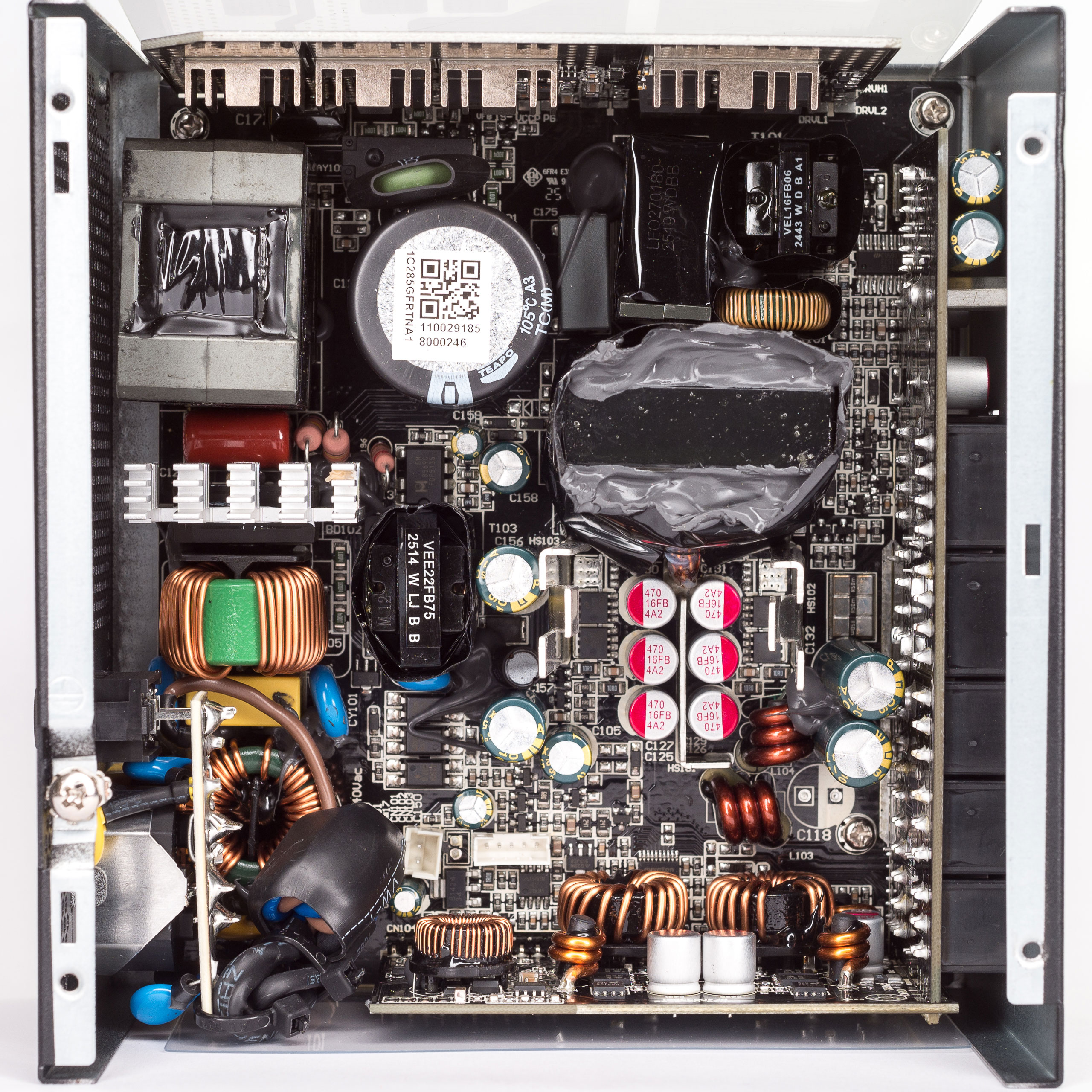
Seasonic CORE GX-850 ATX 3.1 850W

Gigabyte UD850GM 850 W

Hollow on the inside and lightweight, the Seasonic remains the Seasonic .
Aopen MX3S, PIII-S Tualatin 1133, Radeon 9800Pro@XT BIOS, Audigy 4 SB0610
JetWay K8T8AS, Athlon DH-E6 3000+, Radeon HD2600Pro AGP, Audigy 2 Value SB0400
Gigabyte Ga-k8n51gmf, Turion64 ML-30@2.2GHz , Radeon X800GTO PL16, Diamond monster sound MX300
shevalier wrote on 2026-09-17, 03:24:Not quite.
The weight may be due to outdated circuit design.
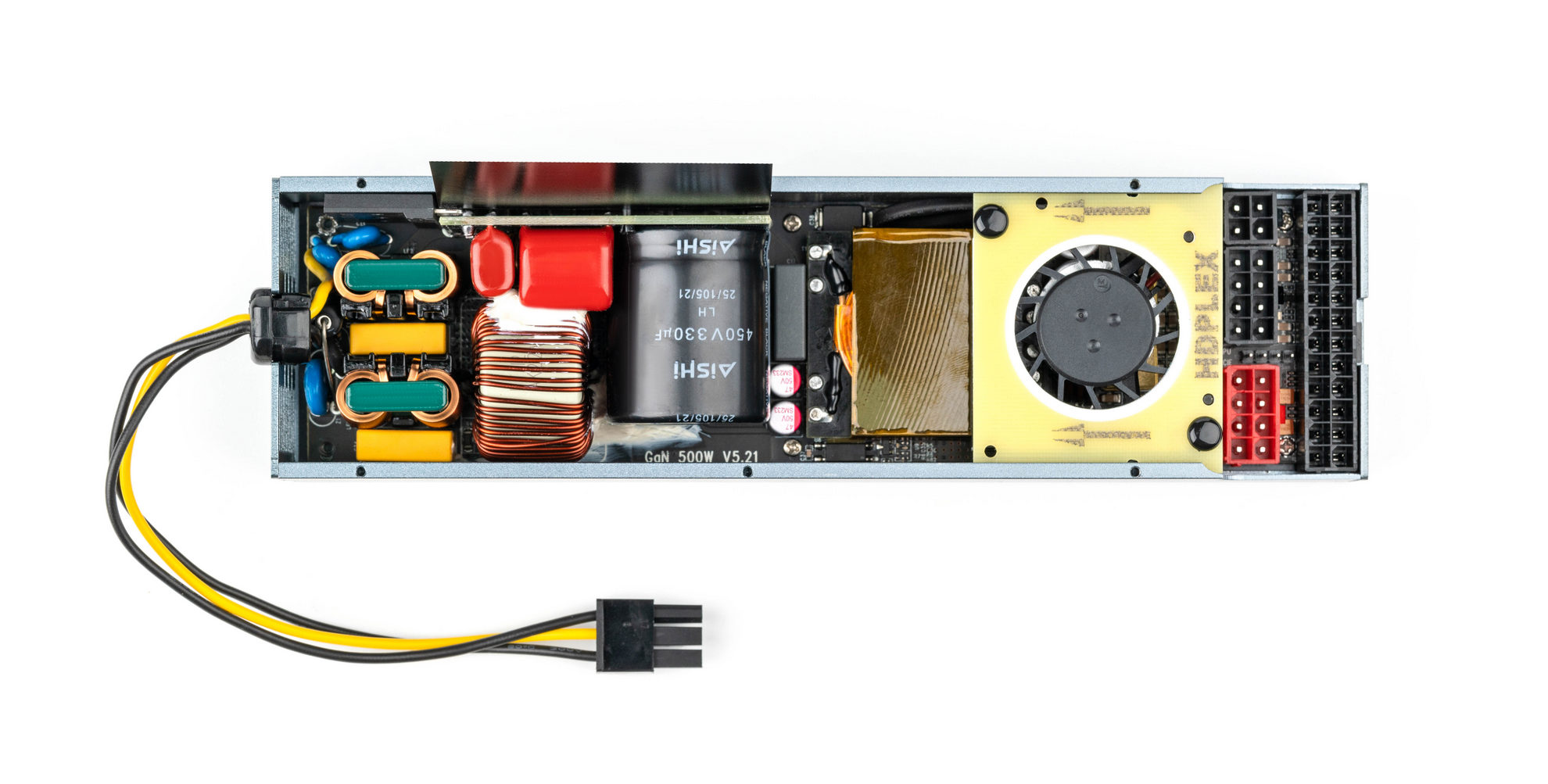
Better to compare apples with apples, obviously a recent PSU can be lighter than one similarly specced released 20 years ago, way lighter if a jump in technology is taken in account (like GaN transistors), just like a SSD is lighter than a HDD and a NVME is lighter than a SATA.
This is how a GaN 500W PSU looks like

My (superb) Fanless Seasonic X400 is relatively hollow but definitely not light.

The 400W specs are relative, it's a conservative value because the thermals, 400W limit is intended @50 °C of external temperature. In fresh environment it can do 600W, add a fan to it and likely it can output 700/800W w/o a blink. Also the internal heatsinks are oversized compared to the 400W specs, which add weight.
But that's a value, being fanless is an immense value, especially considering that it is about 15 years old. A value that made it heavier than competing units of the same era.
The Solutor wrote on 2026-09-17, 04:07:shevalier wrote on 2026-09-17, 03:24:Not quite.
The weight may be due to outdated circuit design.Better to compare apples with apples, obviously a recent PSU can be lighter than one similarly specced released 20 years ago, way lighter if a jump in technology is taken in account (like GaN transistors), just like a SSD is lighter than a HDD and a NVME is lighter than a SATA.
So, the Gigabyte and Seasonic PSU shown in the pictures were developed and released after 2023y.
Both feature a 12VHPWR connector.
However, Seasonic invested in the cost of the power components, whilst Gigabyte’s OEM invested in marketing in the cost of the heatsinks. 😀
Aopen MX3S, PIII-S Tualatin 1133, Radeon 9800Pro@XT BIOS, Audigy 4 SB0610
JetWay K8T8AS, Athlon DH-E6 3000+, Radeon HD2600Pro AGP, Audigy 2 Value SB0400
Gigabyte Ga-k8n51gmf, Turion64 ML-30@2.2GHz , Radeon X800GTO PL16, Diamond monster sound MX300
Here your seasonic cost almost 300 euros, the gigabyte half that price. So, no it's not seasonic that invested, it's the final user that invest, if thinks the difference is justified.
Perhaps the GaN PSU i linked above cost 173$, which makes both the old schools ones overpriced.
shevalier wrote on 2026-09-16, 12:35:We’ve come to this… […]
We’ve come to this…
There are exactly two 140mm fans on the market, 25mm thick and with high static pressure, that can be used in a PSU.
These are the SILENT WINGS PRO 4 140mm PWM from Be-Quiet and another ‘industrial’ Noctua.
But they both have a starting voltage of 5 volts.
And they cost 1.5 to 2 times more than their equivalents.So here I am, having to deal with this nonsense.
The CWT PSH (without any numbers) was sold under the Corsair, Thermaltake and Chiftec CFT brands.
Seems to workPS Perhaps Google will index this page and stop showing me its ‘smart search’ suggestions, which have been driving me mad for two days running. 😀
I thought most PWM fans can be voltage-controlled as well. Arctic's P14 doesn't fit the "25mm" part, but you don't need to go for Noctua's industrial lineup, a regular NF-P14s should work fine. And I would assume there are cheaper alternatives, but I can't say for sure.
Mike_ wrote on 2026-09-17, 06:02:shevalier wrote on 2026-09-16, 12:35:We’ve come to this… […]
We’ve come to this…
There are exactly two 140mm fans on the market, 25mm thick and with high static pressure, that can be used in a PSU.
These are the SILENT WINGS PRO 4 140mm PWM from Be-Quiet and another ‘industrial’ Noctua.
But they both have a starting voltage of 5 volts.
And they cost 1.5 to 2 times more than their equivalents.So here I am, having to deal with this nonsense.
The CWT PSH (without any numbers) was sold under the Corsair, Thermaltake and Chiftec CFT brands.
Seems to workPS Perhaps Google will index this page and stop showing me its ‘smart search’ suggestions, which have been driving me mad for two days running. 😀
I thought most PWM fans can be voltage-controlled as well. Arctic's P14 doesn't fit the "25mm" part, but you don't need to go for Noctua's industrial lineup, a regular NF-P14s should work fine. And I would assume there are cheaper alternatives, but I can't say for sure.
Noctua NF-P14s — 2 mm H₂O, original Yate Loon D14BH-12 — 5 mm H₂O.
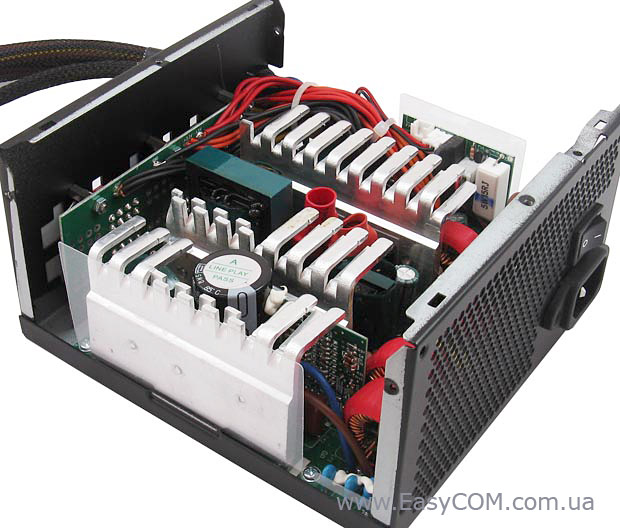
The heat sinks look like this

This is an old topology with independent regulation, but it still uses Schottky diodes.
And, unfortunately, they get very hot.
I’m afraid a case fan with a high CFM rating, but with blades designed for open-air cooling, won’t be able to cool such heat sinks properly.
Aopen MX3S, PIII-S Tualatin 1133, Radeon 9800Pro@XT BIOS, Audigy 4 SB0610
JetWay K8T8AS, Athlon DH-E6 3000+, Radeon HD2600Pro AGP, Audigy 2 Value SB0400
Gigabyte Ga-k8n51gmf, Turion64 ML-30@2.2GHz , Radeon X800GTO PL16, Diamond monster sound MX300
If you say that’s ancient history,
well, here’s a PSU review from 10 days ago.
https://www.techpowerup.com/review/fsp-dagger … pm-1200w/4.html

How is FSP even planning to cool this with air?
And what will do in four years if the fan starts making noise?
3mm water column and 15mm thick fan 🤣
Aopen MX3S, PIII-S Tualatin 1133, Radeon 9800Pro@XT BIOS, Audigy 4 SB0610
JetWay K8T8AS, Athlon DH-E6 3000+, Radeon HD2600Pro AGP, Audigy 2 Value SB0400
Gigabyte Ga-k8n51gmf, Turion64 ML-30@2.2GHz , Radeon X800GTO PL16, Diamond monster sound MX300
shevalier wrote on 2026-09-17, 09:14:If you say that’s ancient history, […]
If you say that’s ancient history,
well, here’s a PSU review from 10 days ago.
https://www.techpowerup.com/review/fsp-dagger … pm-1200w/4.html
How is FSP even planning to cool this with air?
And what will do in four years if the fan starts making noise?
3mm water column and 15mm thick fan 🤣
Looks extremely annoying to fix, that's for sure.
But I think you have missed the point of modern electronics. First, if this lasts 4 years, it is enough for FSP bean counters, because it is out of warranty by that point. And why would they design and build PSUs that last at least 10-12 years when they can sell you a cheaper and non-repairable three times during that time? It's profits baby!
CharlieFoxtrot wrote on 2026-09-17, 09:30:shevalier wrote on 2026-09-17, 09:14:If you say that’s ancient history, […]
If you say that’s ancient history,
well, here’s a PSU review from 10 days ago.
https://www.techpowerup.com/review/fsp-dagger … pm-1200w/4.html
How is FSP even planning to cool this with air?
And what will do in four years if the fan starts making noise?
3mm water column and 15mm thick fan 🤣Looks extremely annoying to fix, that's for sure.
But I think you have missed the point of modern electronics. First, if this lasts 4 years, it is enough for FSP bean counters, because it is out of warranty by that point. And why would they design and build PSUs that last at least 10-12 years when they can sell you a cheaper and non-repairable three times during that time? It's profits baby!
I have no doubt the fan will keep spinning for 10 years, but listening to it after 4–5 years will most likely be pretty annoying. Still, "annoying" and "a warranty claim" are two different things.
There are plenty of threads on Reddit from users swapping out the fans on new Seasonic units. If the noise is irritating, it's really hard to just get used to it.
I don't replace the fans on Pentium 3 with old FSPs either—putting up with it for a couple of hours every other week is fine.
But definitely not on a main PC.
Aopen MX3S, PIII-S Tualatin 1133, Radeon 9800Pro@XT BIOS, Audigy 4 SB0610
JetWay K8T8AS, Athlon DH-E6 3000+, Radeon HD2600Pro AGP, Audigy 2 Value SB0400
Gigabyte Ga-k8n51gmf, Turion64 ML-30@2.2GHz , Radeon X800GTO PL16, Diamond monster sound MX300
I have no doubt the fan will keep spinning for 10 years, but listening to it after 4–5 years will most likely be pretty annoying.
That works for a low end device, if I spend 300 euros for a PSU is I expect that they use a fan that last (staying silent) "forever"
shevalier wrote on 2026-09-17, 10:44:I have no doubt the fan will keep spinning for 10 years, but listening to it after 4–5 years will most likely be pretty annoying […]
CharlieFoxtrot wrote on 2026-09-17, 09:30:shevalier wrote on 2026-09-17, 09:14:If you say that’s ancient history, […]
If you say that’s ancient history,
well, here’s a PSU review from 10 days ago.
https://www.techpowerup.com/review/fsp-dagger … pm-1200w/4.html
How is FSP even planning to cool this with air?
And what will do in four years if the fan starts making noise?
3mm water column and 15mm thick fan 🤣Looks extremely annoying to fix, that's for sure.
But I think you have missed the point of modern electronics. First, if this lasts 4 years, it is enough for FSP bean counters, because it is out of warranty by that point. And why would they design and build PSUs that last at least 10-12 years when they can sell you a cheaper and non-repairable three times during that time? It's profits baby!
I have no doubt the fan will keep spinning for 10 years, but listening to it after 4–5 years will most likely be pretty annoying. Still, "annoying" and "a warranty claim" are two different things.
There are plenty of threads on Reddit from users swapping out the fans on new Seasonic units. If the noise is irritating, it's really hard to just get used to it.
I don't replace the fans on Pentium 3 with old FSPs either—putting up with it for a couple of hours every other week is fine.
But definitely not on a main PC.
The point was not if there should be a warranty claim or not, but that manufacturer isn't interested if there will be a fan issue after four years or not, because by that point it isn't under a warranty anymore. That goes with everything in that PSU, that is the basic thinking behind planned obsolecence. Manufacturers mostly don't want to make you a washing machine or PSU that lasts a decade. They want to make you a device that they can sell you twice in that time. The bonus is that manufacturing costs are also lower.
Then again, I haven't experienced whining fans on my new PSUs during the time I have had them in use. I think my current 1000W SuperFlower in my desktop is now 8-9 years old and all I've done with it is to blow dust out of it couple of times in a year. Or at least I'm old enough not to hear that anymore, but I don't think that is it because I can hear whining old HDDs just fine.
But if I'd get a whining bearings fan during the warranty period, I'd surely returning it under warranty instead of suffering or replacing the fan myself.
wierd_w wrote on 2026-09-16, 19:02:Says the guy who does not understand "Legacy Systems" :D […]
Says the guy who does not understand "Legacy Systems" 😁
Our hobby is not the only market for old hardware.
*edit
Besides, what is good for this goose, is good for the modern gander as well. Why replace an expensive Corsair Gold rated PSU, just because the fan got all full of gunk, and the bearings failed? Shouldn't you just, y'know.... replace the fan?
Are you trying to reply to me? Don't know how to quote? I understand what a legacy system is, I don't understand why you'd insist on using an old, outdated, and clearly malfunctioning system in an environment when far better options exist.
You do you, I'm done trying to justify sanity and conscientious reasoning to you.