That's not technically correct zaphod77 because AWM2 (hence XG/MU) voices do have independent per-element envelopes: iFEG (filter) and iPEG (pitch) which is the same count as GS, so there isn't a shared vol+filter EG as such. AEG is shared across all elements of a voice though, there isn't an iAEG to AWM2.
What you're probably meaning is real MU hardware / MAME / S-MU2000 keeps the iFEG and iPEG hidden and non-editable and running internally as kind of a baked-in-the-ROM and never exposes them at sample playback on the XG MIDI surface to the user. And it's the same for PEG. There's the user-editable global PEG (works like AEG across all element), but each element making that voice has it's own internal iPEG too.
This was a major reason for not going the MAME/SWP30 emulator route with MUXG2K and writing my own AWM2 engine in C++ native (took me 2 years developing it) was because I wanted user-editable control over more things within AWM2 than Yamaha exposed.
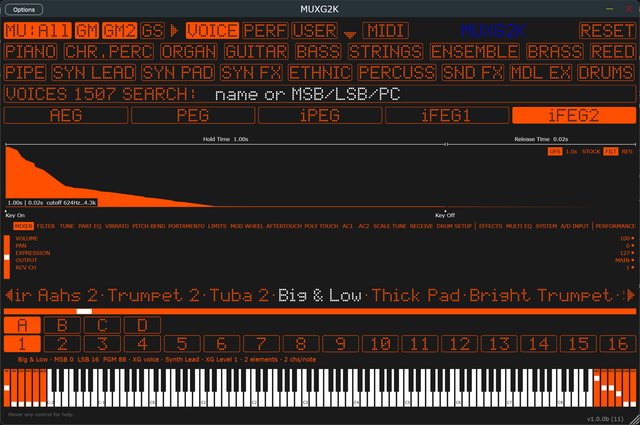
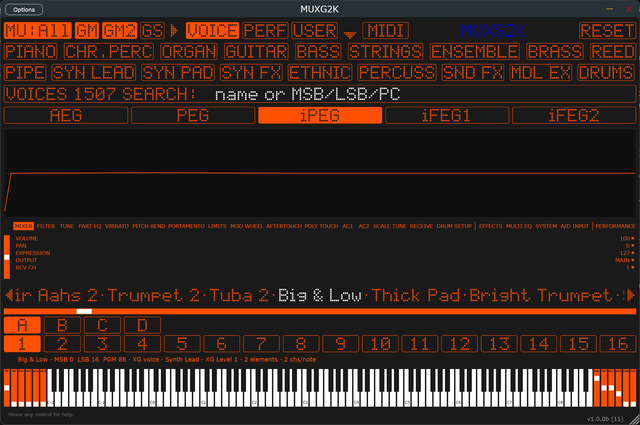
On the XG voices that contain them, you'll see that MUXG2K exposes them as editable envelope controls to the user as iPEG and iFEG on each element.
The reason for exposing them and making them editable in Realtime or saved to presets is because ultimately, MUXG2K will be made available to support MPE and MIDI 2.0 and these parameters then become part of the 5D control too. E.g you might have Slide controlling FEG cut-off, but Pressure iFEG 1 resonance and iFEG2 cut-off for example.
Exposed internal Yamaha PEG
Exposed internal Yamaha FEG (Element 1)
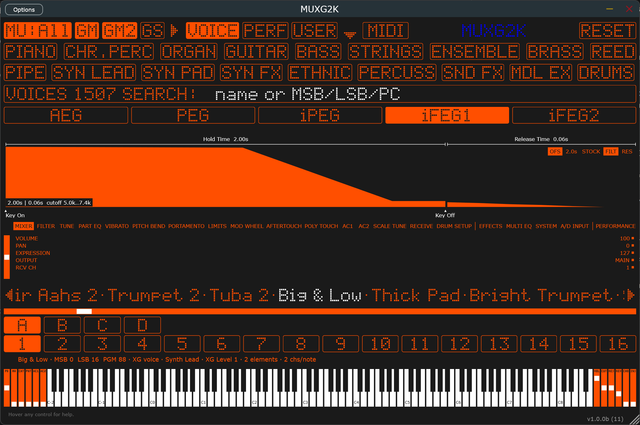
Exposed internal Yamaha FEG (Element 2)