It looks like someone bought this board already. The shipping price was a little too steep for me. There is a high likelihood […]
Show full quote
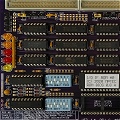
It looks like someone bought this board already. The shipping price was a little too steep for me. There is a high likelihood that someone here bought it after you posted that link, so for whoever bought it, could you send me an image of the BIOS? I happen to have this board already, but would like to see if your BIOS is newer than mine. I can also send you my BIOS image. It is dated 10/7/96.
EDIT: Looking further at the images on the ebay site for this board, it seems that board's BIOS was dated 1/10/96, which is quite a bit older than the one I have.
The BIOS from the TMF PCI400-4 (sometimes referred to by the brand "Taken") does not work reliably in my Zida Tomato 4DPS 2.1 board. The main difference seems to be related to FSB jumpers and how the BIOS interprets the FSB jumpers. If anyone has the official manual for the PCI400-4, please share it.
In comparing both the Taken and Zida boads, I have determined that the Taken board has L2 and memory throughput equivalent to a fast UMC board, whereas the Zida board was lacking about 20% behind. Both Advanced Chipset settings were set equivalently. I am very interested to see if this 4.00A BIOS will clear this up. For whoever has it, please share it.
I have tested the Taken board with a Voodoo3 3000 PCI and it works very well. It also works well with a Matrox Millennium G200. I am in the process of doing a Matrox G200 vs. Voodoo3 3000 show down using an AMD X5-133. The PS/2 mouse port also works fine in Windows 98SE. The correct pin-outs are (1-5), Data, Clock, Gnd, Empty, Vcc.
As far as RAM is concerned, the manual for the 4DPS board mentions this board will only take 64 MB of FPM RAM, however I have found that it will work fine with 128 MB FPM RAM, at least the sticks I have worked. The BIOS lets you set write-through or write-back for L2 cache and set the TAG bit, so you could run your L2 in write-through mode and cache all 128 MB of RAM if you install 512 KB of cache. I have 512 KB of cache installed on my Taken and Zida boards. CTCM7 properly reports all RAM as cacheable when 128 MB is installed and when the cache is set to write-through mode. The ability to cache 128 MB of RAM and the ability to use a Voodoo 3 3000 are the biggest advantages of this board over a good UMC board. The advantage of the Voodoo 3 over a Voodoo 1/2 is that you do not need a consume a second PCI slot for a 2D card.
It is my overall hope that this board will be the SiS equivalent of a UMC-based Biostar MB-8433UUD. After the Voodoo vs. Matrox show down, I'll need to determine if the Cyrix 5x86 is up to snuff on the SiS. The main drawback of the Taken board is that it requires FPM RAM, no EDO. The Biostar board will take FPM and EDO RAM, however the Taken board has a built-in coin cell battery, whereas the Biostar board has a removable RTC module (a small drawback of the Biostar UMC board).
Some initial benchmark tests have revealed that the Taken board is ever so slightly faster for Cachechk's memory speed. The SiS has 42.8 MB/s, whereas the UMC was at 39.7 MB/s. Perhaps the advantage of using EDO in the UMC board will equalise this effect.
Quake 2 at 640x480 in 3dfx OpenGL mode is 8.7 fps with an AMD X5-133. The frame rate will probably be playable with a POD or fast Cyrix. I have not yet experimented with overclocked FSBs on this board.
One other drawback of the Zida or Taken board is that the I could only get the onboard CPU voltage regulator to output 3.35 V and 4.96 V. It doesn't seem to have a 3rd jumper option for 3.6 V. The Biostar UMC board, on the other hand, had a 3rd voltage regulator resistor option. I will likely modify the Zida board's 3.35 V setting to be 3.0 - 4.0 V variable.