Reply 20 of 33, by feipoa
- Rank
- l33t++
The ATA133 card with the CF card only benchmarks as fast as 20 MB/s, so this test is inconclusive. The CF card is 133X, which is limited to 20 MB/s.
I may have figured out the solution. It seems that only one of my MB8433 motherboards will work stably with the Adaptec SCSI card set at above 40 MB/s. It is a version 3.0 board, and the southbridge is UM8886BF with datecode 9634-FXO. The northbridge is UM8881F with datecode 9633-EYT. This board also was only overclocked to 66 MHz for less than 1 hour. I'm not sure if this minimal overclocking played a role in its greatness.
That is the only southbridge with FXO I've seen. Most UMC 1996-era southbridges are FXS or FXA. 1995-era southbridges are often DYS. Most 1996-era northbridges are EYT or EYA. Most 1995-era southbridges are ETA or ETO.
I thought that only the first 2 letters had any possible impact on the chip's revisions, not the 3rd letter.
rg100, what are your north/southbridge datecodes?
This recent finding really seems to solidify my plans to order all new 1997-era chipsets. I'll probably still persue my plans for a clock amplifier and divider since this will allow for running the FSB at 66 MHz and the use of the CPU's 4x multiplier. I may also continue looking into a PCI clock amplifier, but these curiosities are now less urgent.
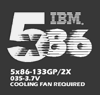
I now have 3 slot fans, a front case fan, and a CPU cooler on my backup 486 rig, running a Cyrix 5x86-120 at 133 MHz (2x66MHz). I also put in a much more powerful power supply fan. I'm hoping this rig now can be run with the case on and branch prediction. I think I'm going to leave my main rig alone (the one I'm typing on). I probably got a little too greedy trying to run it at 66 MHz too. I'm going to put my Cyrix 5x86-133GP back in there; I should probably weld the case shut to prevent itchy hands.
Plan your life wisely, you'll be dead before you know it.