Reply 140 of 143, by evasive
correct, the bios chip is missing.
this layout is not known in TRW so that cannot help.
The photo quality is not good enough to see any markings that may identify the board. This is going to be a real challenge.
correct, the bios chip is missing.
this layout is not known in TRW so that cannot help.
The photo quality is not good enough to see any markings that may identify the board. This is going to be a real challenge.
PC@LIVE wrote on 2025-12-01, 09:40:ruthan wrote on 2025-12-01, 03:43:#: 128 I have 1 unknow board to identify- First i need to help to identify it and after i can post a bios (unless of use of some […]
#: 128
I have 1 unknow board to identify- First i need to help to identify it and after i can post a bios (unless of use of some programmer). With a bit of luck we if we identify it we could be able to find bios online.
Multiple photos so i created own identify thread there are all other labels and text info:
386 mainboard identification help , it has Opti 82C381 + 82C382 chipsManufacturer/Identifier: Unknown - 386XO cache
Chipset: main Chips used - Opti 82C381+82C382
BIOS/Version: AMI
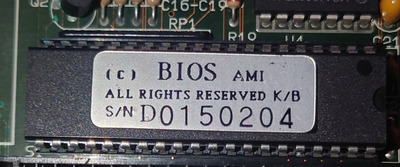
Well in my opinion, what you think is the BIOS chip (in the photo), it is actually the BIOS chip of the keyboard, the real BIOS chip is not there, it should be between the two square chips, one is a chips.
Agree with PC@LIVE.
BIOS should be in this empty DIL28 socket.
This is a 386 board; I have two examples which walked off a local workplace in the 90s. They are identical, and both have an AMD Am386 DX/DXL-40 in the slot. Both boards blew a tantalum capacitor when booted for the first time, down in the ISA slots. I replaced the capacitors; one still has a dead short somewhere (overcurrent protection activates on the PSU as soon as I turn it on). The other is now working. Please excuse the tall boy replacement (soldered it with the leads intact with the expectation that it wasn't going to work).
BIOS attached. July 7, 1991 is at the end of the file. Header states: P386DX/33/40WB IVN 1.1 MAY,1992 and BIOS string is: 30-0100-008003-00101111-070791-OPWB3/B
Silkscreen: P386WB/33/40 VER 5.00.
Back had a label, and the warranty sticker. Warranty: "CE226620122 (CPI) Warranty Void if Removed" Label: "386-40 W/64K SN: 22662022 BT070892113357 Made in Hong Kong"
It seems to have 9 ISA slots, with one double row? When I search retroweb for 9 slots, I only get a few examples, none of which resemble this. Wasn't sure if I'm barking up the right tree.

FlynnTinkers wrote on 2026-01-15, 05:05:This is a 386 board; I have two examples which walked off a local workplace in the 90s. They are identical, and both have an AMD […]
This is a 386 board; I have two examples which walked off a local workplace in the 90s. They are identical, and both have an AMD Am386 DX/DXL-40 in the slot. Both boards blew a tantalum capacitor when booted for the first time, down in the ISA slots. I replaced the capacitors; one still has a dead short somewhere (overcurrent protection activates on the PSU as soon as I turn it on). The other is now working. Please excuse the tall boy replacement (soldered it with the leads intact with the expectation that it wasn't going to work).
BIOS attached. July 7, 1991 is at the end of the file. Header states: P386DX/33/40WB IVN 1.1 MAY,1992 and BIOS string is: 30-0100-008003-00101111-070791-OPWB3/B
Silkscreen: P386WB/33/40 VER 5.00.
Back had a label, and the warranty sticker. Warranty: "CE226620122 (CPI) Warranty Void if Removed" Label: "386-40 W/64K SN: 22662022 BT070892113357 Made in Hong Kong"
It seems to have 9 ISA slots, with one double row? When I search retroweb for 9 slots, I only get a few examples, none of which resemble this. Wasn't sure if I'm barking up the right tree.
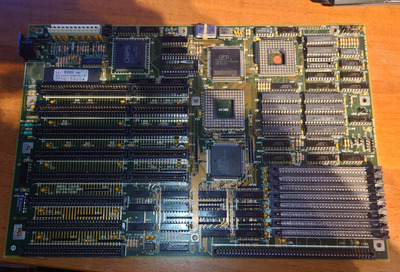
It's a common design sold under many names, this particular one from QDI https://theretroweb.com/motherboards/s/qdi-p386
If you search retroweb by PGA132 + 82C391 + 85C206 you'll find like 20 of them
The extra slot in not ISA, it's for a memory card