VOGONS


Reply 40 of 51, by Mike_

User metadata
Rank Newbie
Rank
Newbie
CharlieFoxtrot wrote on Yesterday, 12:38:

Of course these old power supplies can stil be in fully functioning condition and have several years ahead of them, I’ve personally checked and recapped several such units and I’ve not claimed otherwise. But saying thta you can trust such vintage power supplies if it has brand X capacitors is absolutely wrong. Blindly trusting such mains voltage equipment can lead to a disaster at some point. And the worst case scenario is not the vintage system the PSU should provide smooth DC power, but your house.

This is extremely unlikely, especially considering that we are talking about devices that are usually inside a metal chassis and which are used when you are home anyways. Even if there is a fire inside the case, there's not that much burning material inside and you can just turn off mains power and use an extinguishing blanket (which you should have anyways) to put it out.

I'd just worry about whether it's going to blow up your vintage system. And I'd guess checking out ripple voltages with an oscilloscope should give a good indication if it's about to fail.

momaka wrote on 2026-04-25, 22:39:

The problem with the modern PSUs that use DC-DC converters for the 3.3V and 5V rails is that regardless of whether the fan depends on the temperature or the power use (or both), it's still probably only for the 12V rail output, since that's what's used on a modern PC. The DC-DC converters are typically not monitored for temperature. And here's the thing: even a rather power-hungry old 5V-heavy PC won't typically draw over 120-140 Watts of power. Because of this, a modern PSU won't heat up much on the overall due to it's high efficiency. However, the DC-DC regulators will already be running close to the maximum of their capacity while the PSU is barely idling the fan. So that's what @shevalier meant that new PSUs are not quite ideal for heavy 3.3V and 5V heavy loads. Though I would say that really only applies for the very 5V-heavy "hitters". In the case of the O/P's system, that's setup won't be as power-hungry on the 5V rail as some other socket A systems are. So IME, a modern PSU with DC-DC converters would also be possible to use in this case.

That's pretty dumb design if the DC-DC converters aren't using the same heatsink (and as such would have roughly similar temperature)... But anyways, I thought that using a modern PSU with about 130W for 3,3V/5V is better than getting a vintage PSU in unknown condition if you are not comfortable with soldering and such.

Btw, if modern PSUs use DC-DC converters for 3,3V and 5V, why do they have such low combined limits for them? I mean, if they are both converted from 12V, how does load for 3,3V affect the 5V converter?

Reply 41 of 51, by shevalier

User metadata
Rank Oldbie
Rank
Oldbie
Mike_ wrote on Yesterday, 13:38:

Btw, if modern PSUs use DC-DC converters for 3,3V and 5V, why do they have such low combined limits for them? I mean, if they are both converted from 12V, how does load for 3,3V affect the 5V converter?

This is because, electrically speaking, the ATX 3.1 650W power supply unit is essentially a 1kW power supply unit.
However, in terms of heat dissipation (long-term power), it remains at 650W.

In fanless PSUs, the same chokes in the DC/DC converters are larger, in order to improve efficiency and reduce heat build-up.

Last edited by shevalier on 2026-04-26, 14:24. Edited 2 times in total.

Aopen MX3S, PIII-S Tualatin 1133, Radeon 9800Pro@XT BIOS, Audigy 4 SB0610
JetWay K8T8AS, Athlon DH-E6 3000+, Radeon HD2600Pro AGP, Audigy 2 Value SB0400
Gigabyte Ga-k8n51gmf, Turion64 ML-30@2.2GHz , Radeon X800GTO PL16, Diamond monster sound MX300

Reply 42 of 51, by CharlieFoxtrot

User metadata
Rank Oldbie
Rank
Oldbie
Mike_ wrote on Yesterday, 13:38:

This is extremely unlikely, especially considering that we are talking about devices that are usually inside a metal chassis and which are used when you are home anyways. Even if there is a fire inside the case, there's not that much burning material inside and you can just turn off mains power and use an extinguishing blanket (which you should have anyways) to put it out.

I'd just worry about whether it's going to blow up your vintage system. And I'd guess checking out ripple voltages with an oscilloscope should give a good indication if it's about to fail.

Sure, you are absolutely correct and because of what you describe, for example PSUs inside the CRTs are far more hazardous, because the fire can spread easily from the plastic casing. Of course fire inside AT or ATX PSU is nothing to scoff at.

My main point was more the general attitude and lack of proper respect and caution regarding old high voltage equipment. It is this kind of thinking that often leads to very unfortunate results, whether it is something that gets broken or at worst case, starts a fire.

Reply 43 of 51, by Mike_

User metadata
Rank Newbie
Rank
Newbie
shevalier wrote on Yesterday, 14:01:

This is because, electrically speaking, the ATX 3.1 650W power supply unit is essentially a 1kW power supply unit.
However, in terms of heat dissipation (long-term power), it remains at 650W.

But I mean, the 12V rail is so much more beefy that it doesn't matter in this case at all.

My point was that if both 3,3V and 5V rails have 25A limit, why do they have a combined limit of eg. 130W?

Reply 44 of 51, by shevalier

User metadata
Rank Oldbie
Rank
Oldbie
Mike_ wrote on Yesterday, 14:20:
shevalier wrote on Yesterday, 14:01:

This is because, electrically speaking, the ATX 3.1 650W power supply unit is essentially a 1kW power supply unit.
However, in terms of heat dissipation (long-term power), it remains at 650W.

But I mean, the 12V rail is so much more beefy that it doesn't matter in this case at all.

My point was that if both 3,3V and 5V rails have 25A limit, why do they have a combined limit of eg. 130W?

The DС/DС board can dissipate (roughly) 10 watts of heat, with 90% efficiency.
This gives us a 100-watt load.
We don’t mind how this is distributed between the buses, as long as the board as a whole doesn’t overheat.
Of course, the figures are made up, but that’s exactly how it works.

If properly cooled, they will deliver the highest possible output power, rather than the maximum total power.

Aopen MX3S, PIII-S Tualatin 1133, Radeon 9800Pro@XT BIOS, Audigy 4 SB0610
JetWay K8T8AS, Athlon DH-E6 3000+, Radeon HD2600Pro AGP, Audigy 2 Value SB0400
Gigabyte Ga-k8n51gmf, Turion64 ML-30@2.2GHz , Radeon X800GTO PL16, Diamond monster sound MX300

Reply 45 of 51, by Mike_

User metadata
Rank Newbie
Rank
Newbie
shevalier wrote on Yesterday, 14:39:
The DС/DС board can dissipate (roughly) 10 watts of heat, with 90% efficiency. This gives us a 100-watt load. We don’t mind how […]
Show full quote

The DС/DС board can dissipate (roughly) 10 watts of heat, with 90% efficiency.
This gives us a 100-watt load.
We don’t mind how this is distributed between the buses, as long as the board as a whole doesn’t overheat.
Of course, the figures are made up, but that’s exactly how it works.

If properly cooled, they will deliver the highest possible output power, rather than the maximum total power.

So does the DC/DC board have a single heat sink for MOSFETs or why it has a fixed heat dissipation limit? I'd imagine that it needs to have separate FETs and coils for both rails anyways.

Reply 46 of 51, by shevalier

User metadata
Rank Oldbie
Rank
Oldbie
Mike_ wrote on Yesterday, 15:48:
shevalier wrote on Yesterday, 14:39:
The DС/DС board can dissipate (roughly) 10 watts of heat, with 90% efficiency. This gives us a 100-watt load. We don’t mind how […]
Show full quote

The DС/DС board can dissipate (roughly) 10 watts of heat, with 90% efficiency.
This gives us a 100-watt load.
We don’t mind how this is distributed between the buses, as long as the board as a whole doesn’t overheat.
Of course, the figures are made up, but that’s exactly how it works.

If properly cooled, they will deliver the highest possible output power, rather than the maximum total power.

So does the DC/DC board have a single heat sink for MOSFETs or why it has a fixed heat dissipation limit? I'd imagine that it needs to have separate FETs and coils for both rails anyways.

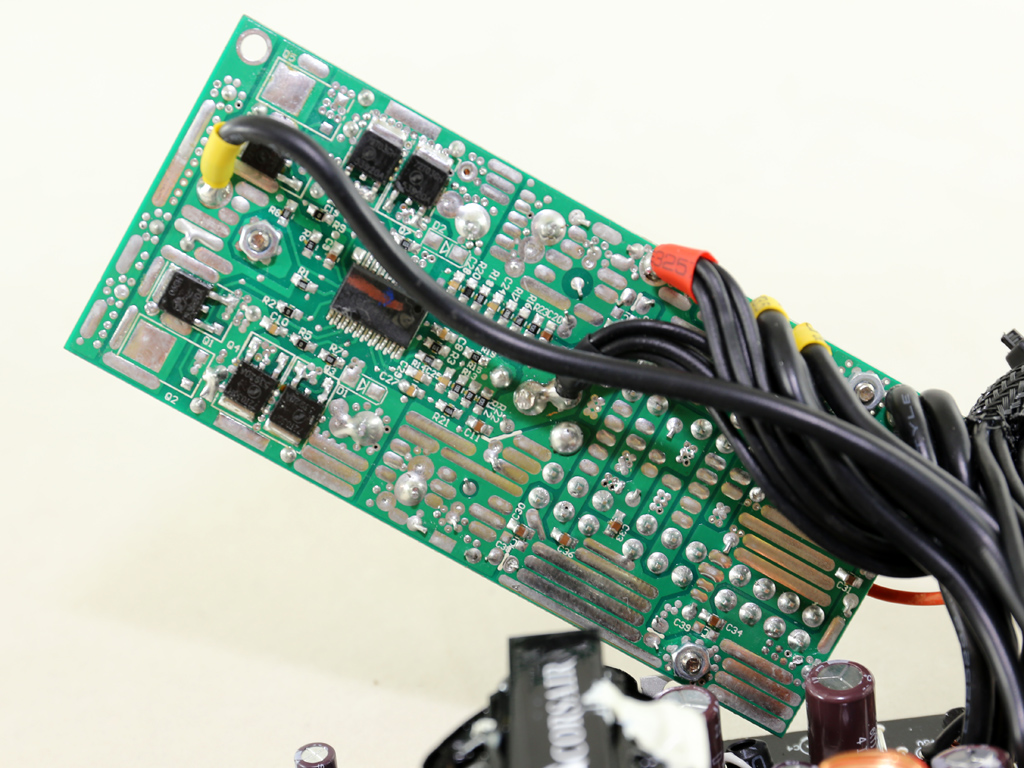
Most often, they do not have a separate heat sink for the MOSFET.
https://www.tomshardware.com/reviews/corsair- … psu,4799-3.html
CYiBoPJZqb5ZfP5m7ytFtM.jpg
enRDaG75GZfp3cworK9zuc.jpg
Given the rated power and the presence of a fan, there is no real need for one; the surface area of the board is quite sufficient.
The required power rating is specified somewhere deep within the ATX specification and will look something like this:
+5V min 0, max 20A
+3.3V min 0, max 20A
* Total power for +5V and +3.3V- no more than XXX watts
At the same time, the surface area of the PCB has been kept to a minimum in order to accommodate all the components, and because, according to the test results, this area is sufficient for a ‘total power of XXX watts’
I’m saying that if manufacturers were tasked with ensuring 5×20+3.3×20 simultaneously, they would most likely just add heatsinks to the MOSFETs.
But they don’t do that now, because why spend extra money?

I’ll say it again.
I’m more than certain that some PSU models will operate perfectly well in a constant-power mode of 5V×20A+3.3V×20A+ 12V×0A.
But we don’t know which ones, because no one has tested them in that mode.

Aopen MX3S, PIII-S Tualatin 1133, Radeon 9800Pro@XT BIOS, Audigy 4 SB0610
JetWay K8T8AS, Athlon DH-E6 3000+, Radeon HD2600Pro AGP, Audigy 2 Value SB0400
Gigabyte Ga-k8n51gmf, Turion64 ML-30@2.2GHz , Radeon X800GTO PL16, Diamond monster sound MX300

Reply 47 of 51, by lti

User metadata
Rank Member
Rank
Member
CharlieFoxtrot wrote on Yesterday, 12:38:

Besides, I have opened quite a bunch of PSUs from this era and I don’t remember a single one having those ”quality japanese ones”.

Astec and Newton Power used them.

Reply 48 of 51, by momaka

User metadata
Rank Oldbie
Rank
Oldbie
AlexZ wrote on Yesterday, 07:57:

Period correct Eurocase 350X has 3.3V+5V = 185W max and had both -5V and -12V.

Period-correct Eurocase is also... amusing to look at inside. 😁
If you have one, I welcome you to try and pull anywhere near that 185W combined rating on the 3V3 & 5V rails - synthetic or real PC load (well, the latter would be a little harder to build). Though I'd rather you not find the hard way how much those PSUs are capable of... or more precisely, how much they aren't.
The numbers on their labels are very inflated.

AlexZ wrote on Yesterday, 07:57:

Historically, I remember 300W PSUs being used up to about ~1Ghz CPUs, 350W up to ~2Ghz (Athlon XP, Athlon 64), 400W for early dual cores. From the Athlon XP PCs I bought many had 350W.

It was the same here in Bulgaria, along with a few other Eastern-European countries from what I know.
Most of this problem was exacerbated precisely because too many people used cheap PSUs with completely bloated ratings on their labels.
Which is why keep going back to mentioning OEM PSUs from Dell, HP, Gateway, and the like. They weren't cutting corners by giving you 200-250 Watt PSUs in their machines. They were intelligently giving you well-designed PSUs properly specced to each PC that were usually far superior than the no-name brands with the inflated labels... and all of that while still maintaining the same cost-efficiency.

AlexZ wrote on Yesterday, 07:57:

I only buy used PSUs in person, never have them shipped to me. I once refused to buy a Corsair 600W that was too dirty. It had so much dirt I have never seen in a PSU. If you would like to have them shipped, ask the seller to disassemble them and take close pictures.

When I was living in the US, I bought quite a few "as-is" PSUs for $1 from Ebay. Not a single one I couldn't fix and make into something semi-decent. Most just needed new caps and nothing else.

Speaking of dirty PSUs and Corsair, I was at the flea market today and remembered this thread... so grabbed me a pretty filthy CX500 for 3 Euro. Someone had already removed the top cover, but didn't dig in any deeper. The problem (or at least only obvious one so far) was visible on the spot: very slightly bulged cap on the 5VSB.
I'll see if I can take a picture of it tomorrow... and then prep it for a wash this week. There's a nicotine-infused dust carpet on everything inside - yeah, it's one of those "smoker's specials". 🤣
Don't ask why I do this to myself.
P.S. There's also a CX430 next to my foot as I type this. It's slightly less dirty, but likely also won't go without a wash first. It's in for a primary cap replacement as the original is clearly ruptured - a classic failure on these PSUs, due to using too small-a-cap in that spot. The whole ordeal was documented on badcaps by a Greek fellow over 10 years ago, if anyone wants to go on a hunt for that info/read.

shevalier wrote on Yesterday, 09:06:

Used units with an APFC may have a different issue.

The power supply turns on, all voltages are present, but the system does not boot.

This definitely applies to CWT PSH -1/2 as portrayed by Chieftec and Corsair.
Due to being over 10 years old, the adhesive under the megaohm SMD resistors begins to conduct 🙁
The APFC controller detects that the voltage is already high and does not allow it to rise to 380 volts.
Therefore, the Power Good signal is not sent, and the motherboard does not boot.
The problem with these resistors is that they are from a special high-voltage series (up to 500 volts).
If you use a standard thick-film resistor, the 200-volt voltage will cause them to degrade within a year or two.
You need to install 3 of them (3*650kOhm) instead of 2 *1 MOhm during repair.

That is precisely why using a power supply that is more than 10 years old poses a real lottery.

Interesting issue.
Do you have a link to the report where this was found? I'm just curious to read it.
IME, the same issue would also surface when the primary cap starts going "dry" (loss of capacitance due to over-stress over time) and/or input MPP cap (pre-APFC DC smoothing) loosing capacitance due to, again, over-stress.

In any case, my conclusion is that for PSUs with APFC, after 10-15 years (depending on how under or overbuilt the PSU is) parts might need checking.

Mike_ wrote on Yesterday, 13:38:

That's pretty dumb design if the DC-DC converters aren't using the same heatsink (and as such would have roughly similar temperature)...

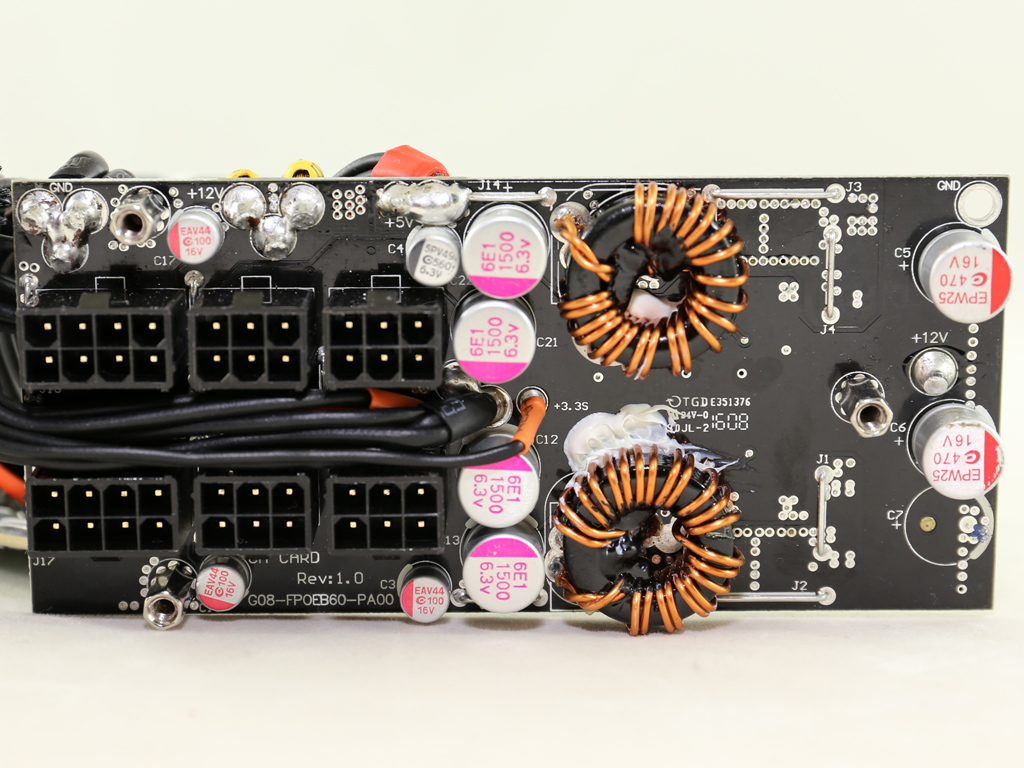
They can't be, because the DC-DC modules are, well, nowadays exactly that: little individual "daughter" PCBs added to the PSU. They draw power from the 12V rail and produce 5V or 3.3V, then feed it back to the PSU's PCB before it goes out to the cables.
But even if these were integrated on the PSU's main PCB, it would still be hard to temperature-couple these circuits to the one for the 12V rail. Main reason: it's the main inductors on these DC-DC converters that will usually heat up the most. Being of the large toroidal type makes them hard to thermally couple.
Now, the PSU designer can go out of their way and place individual thermistors to monitor the temperature of the DC-DC converters to make sure they are staying cool too... but ain't nobody got time (or interest) for that, particularly given how little power is used from the 3.3V and 5V rails anymore. Perhaps if retro PCs really became a mainstream movement in society, then something might change (though I doubt it, as heavy 3.3V and 5V use is really rather rare outside of socket A and dual PPro/PII/P3 systems.)

Mike_ wrote on Yesterday, 13:38:

But anyways, I thought that using a modern PSU with about 130W for 3,3V/5V is better than getting a vintage PSU in unknown condition if you are not comfortable with soldering and such.

My thoughts exactly!

Mike_ wrote on Yesterday, 13:38:

Btw, if modern PSUs use DC-DC converters for 3,3V and 5V, why do they have such low combined limits for them? I mean, if they are both converted from 12V, how does load for 3,3V affect the 5V converter?

Good question I have been wondering about myself.
I think it's just for "compliance" at this point or probably some other similar reason.
If the DC-DC modules are specced to something like, say, 20 Amps each, then the theoretical limit should be 100W for the 5V rail (5V x 20A) + 66.6 Watts for the 3.3V rail (3.3V x 20A)... totaling 166 Watts max.

CharlieFoxtrot wrote on Yesterday, 12:38:

This is so wrong in many ways. No one should trust very old components that have a manufacturer shelf life even when sitting unused, but especially when we are talking about electronics with unknown hours and history.

I used to think this way too, but...
1) old quality-made electrolytic capacitors (especially Japanese ones... save for a few series that were know to have systematic problems/failures, like Nichicon PR leaking from the bungs) are pretty damn reliable. I also want to write otherwise, but they just are. Time and again I keep opening old stuff for restoration, and it's just amazing how many still hold up fine after 40+ years in use (some with 20+ years in storage, some used until the day before I got them.) This does not mean to say I didn't have to replace anything. But it's rare. Usually the small caps are the ones to dry / start drying first.
2) the shelf life is exponentially longer when the caps have sat in more or less "average" storage conditions - e.g. not necessarily air-conditioned storage, but not quite as bad as in someone's backyard under a tarp... though even that's actually not too harsh in terms of temperature variation (however, it is for moisture, and that's probably the more silent killer to electronics in general.)

CharlieFoxtrot wrote on Yesterday, 12:38:

Besides, I have opened quite a bunch of PSUs from this era and I don’t remember a single one having those ”quality japanese ones”.

Well, they were rare, I will give you that 😀 ... though it really does depend on where you looked.

Indeed not every old OEM PSU used good quality caps. In fact, very few did, and for some it was very sporradic.
IME, Astec were about the best in that regard, with their preferred brand often being Nichicon. However, some of their really old units (early 90's) did use Nichicon PR and I think another series from United Chemicon that had the same problem as PR. Eventually PR got phased out and Astec switched to Nichicon's PL series... which have been OK so far... or at least, not wide-spread problems with leaking like PR did.
LiteOn also often used Japanese capacitors (usually United Chemicon) in their proprietary pinned PSUs for Dell and HP around the Pentium II/3 era.
Delta was the most hit-and-miss about using Japanese capacitors (when they did, it'd be Rubycon.)
Hipro/Chicony almost never used Japanese caps (or maybe just a few pieces in random units), but they more than made up for that with over-designed (over-sized) output filtering... so stress is kept low on the caps and thus they tend to last.

CharlieFoxtrot wrote on Yesterday, 12:38:

And you know exactly how these used CPUs are maintained during thelast 25 years or so unless you have owned that PSU from the beginning?

Nope.
But I don't care either. I open each PSU I get, clean it out, give it a good visual inspection, and if it all passes (e.g. no excessive corrosion or signs of components overheating / PCB darkening), plug it in (not attached to any hardware) and see what happens.

CharlieFoxtrot wrote on Yesterday, 12:38:

You really can’t directly compare industrial equipment to your cheap consumer grade PSUs in any way. I bet in many industrial applications linear PSUs are still a thing because reliability is prioritized instead of the size and efficiency.

Well, then consider you'll be learning something new today 😀 , as there's quite a lot of non-idustrial hardware out there still on the job powering all kinds of industrial applications (some of them even pretty "mission-critical").

CharlieFoxtrot wrote on Yesterday, 12:38:

And PSUs that are used in equipment that are exposed to elements and/or dirt, you can bet that these conditions are take into the account in the overall design. None of this is true with your run of the mill desktop PSUs which are not even up to the quality of server grade components.

Oh, I'm not going to be taking any bets on that. 😀
Reality vs. expectations can be quite... different.
The most recent example of this was the last place I worked when I was still in the US - a toll road. If you think everything was well-designed to the smallest screw, that all of the equipment was industrial type, and if all the environmental conditions were taken into account... well, you'd be wrong on all 3 accounts.
The old equipment we decommissioned (for no other reason than a system feature upgrade... and budget reasons) was pretty consumer-grade. For the system computers in particular, except for the PicMG industrial backplane and system blade, everything else was run-of-the-mill hardware: CPU was a Pentium-4 (approximately half were socket 478 Northwood and Prescott, and the other half LGA 775 Cedar Mills) cooled by some thin "Cooljag" CPU coolers, RAM was regular desktop DIMMs, the HDD was regular 2.5" or 3.5" (a mix of everything.... though quite a few old Maxtors clacking around), and the PSUs were just good quality flex-ATX units (mostly from 3Y-Power and a few from FSP). And all of this ran 24/7 with hardly any downtime or fail for many years (10+ for most of the hardware)... not to mention a good number were housed in non air-conditioned "shacks" on the side of the road, sucking up dist, dirt, smoke, heat/frost, salt, and whatever you find on large highway.
Then came the "new" system - a custom industrial board with an Intel Atom CPU of some sort. Boy, did those overheat and crash all the time. At first, someone in upper management / engineering blamed the HDDs were slow (yes, really! :sadface: ). So we replaced those with industrial type SSDs. No change in the behavior as some of us techs expected. We tried also different PSUs (including some of the old decommissioned ones), because that was also suggested to us (lol)... still, no change. TLDR: the new "industrial" boards just couldn't hold their marbles without air conditioning, and good/strong one at that. Only after upgrading all of the "shacks" with new and efficient A/C units did the problems come down to a more reasonable level. I say "more reasonable", because approximately 1/3 of the issues were also software-driven. But I am digressing quite far here.

The point is, not everything "out there" in the industrial world is industrial equipment. In fact, for quite a few factories I visited, the hardware all varied in age and was mostly just as old as the factories were, in most cases. The number of standard 386/486 through Pentium 3 desktop hardware that is running various stuff may be staggering to some... yet, this is the reality. I'm not even going to tell you what kind of hardware (or how old) the backup comms for a local airport were running on.

CharlieFoxtrot wrote on Yesterday, 12:38:

Again, and like I said myself, how much the PSU is used, how it is stored and maintained affects how long the components of the PSU will last. You have no clue how many hours those caps have seen, what kind of temperatures they have been exposed to (this also varies by the design, for example caps right next to mosfets can have significantly shorter lifespan) or how the unit has been stored after it has been decomessioned.

And like I said, you don't need to know those things.
If the PSU appears in decent condition on the outside and inside (e.g. no excessive rust to indicate the PSU was stored someplace wet, no seized fan, no very darkened or burned PCB or components to indicated something had overheated), and especially if it uses good quality Japanese brand of capacitors, there really is no reason to believe it won't be working and can't be trusted.

CharlieFoxtrot wrote on Yesterday, 12:38:

But saying thta you can trust such vintage power supplies if it has brand X capacitors is absolutely wrong.

I disagree.
I am not a brand loyalist by any means at all, but I have just seen enough old equipment with Japanese caps (still working fine) over the years to know I can be comfortable with it - so much that I can even recommend it to others (otherwise, I prefer to sit quiet and not say anything when I don't know any better.)

CharlieFoxtrot wrote on Yesterday, 12:38:

Blindly trusting such mains voltage equipment can lead to a disaster at some point.
And the worst case scenario is not the vintage system the PSU should provide smooth DC power, but your house.

By that statement, we probably shouldn't power up anything at our homes, old or new, until verified by at least 3 senior-level NASA engineers/electricians, the FCC chairman, and maybe a priest too.

C'mon, people buy far worse electronic garbage online and think nothing of it.
Yet someone dares to even suggest a "vintage" PSU of barely a decade or two of age and Oh, noes, the horrors! The sky will fall, the earth will be scorched.
Sorry, but I just find this argument ridiculous.
Burn down your house? How?! A properly-designed good quality PSU, even in the most terrible of condition, will maybe (yes, just *maybe*) blow/smoke a few components, followed by a quiet pop from its internal fuse (unless you have sensitive breakers in your home and those decide to act first)... and that's about all you can expect. Perhaps if you pour gassoline on it, things might be more interesting.

Again, I'd rather "take the risk" with an old but well-designed PSU from a well-regarded manufacturer than some new unit of unknown quality... and, well, I am - all of my PCs are running on old PSUs: some repaired, some just recapped, and some still in stock condition.

CharlieFoxtrot wrote on Yesterday, 14:10:

Sure, you are absolutely correct and because of what you describe, for example PSUs inside the CRTs are far more hazardous, because the fire can spread easily from the plastic casing. Of course fire inside AT or ATX PSU is nothing to scoff at.

Fires from modern SMPS are... well, maybe not impossible, but so unlikely that it just shouldn't be one of those things to worry about... unless, of course, it's a cheapo PSU with garbage cables and full of design mistakes.

And speaking of cables, people should worry a lot more about cheap power cables than the actual power supplies. I can't tell you how many I have seen melt around the plug - exit or wall-side. On the worst garbage, the cables aren't even rated the full line voltage sometimes and with very thin wires.

And let's not even stray further to talk what causes most electrical fires. Computers (be it old or new) are really (and I mean REALLY) far down on that list. Top hitters are portable heaters, window A/C units, and countertop "mini" ovens... and of course, some of the random electronic garbage from Amazon/Ali/Temu/etc. (questionable lithium batteries, anyone? 😁 )

Not saying PSUs should be completely disregarded in terms of safety. But this is getting akin to paying attention to a tiny gnat in the room when there's a heard of large elephants too.

CharlieFoxtrot wrote on Yesterday, 14:10:

My main point was more the general attitude and lack of proper respect and caution regarding old high voltage equipment.

High voltage??
I think you meant Line Voltage.

Even 480V 3p is not really considered "high voltage" in some workplaces. But I'd say that's where the line starts, more or less... but that's besides the point of this thread already.

lti wrote on Yesterday, 19:27:
CharlieFoxtrot wrote on Yesterday, 12:38:

Besides, I have opened quite a bunch of PSUs from this era and I don’t remember a single one having those ”quality japanese ones”.

Astec and Newton Power used them.

Ah yes, Newton Power, thank you for reminding me about these.
IIRC, they were a daughter company to Delta... or related in some other way I can't remember.
Same good quality units, though.


Reply 49 of 51, by cyclone3d

User metadata
Rank l33t++
Rank
l33t++
AlexZ wrote on Yesterday, 07:57:
Those Seasonics have only ~130W on 3.3V+5V […]
Show full quote

Those Seasonics have only ~130W on 3.3V+5V

SS-650KM - 3.3V+5V = 125W max
SS-600ES - 3.3V+5V = 130W max
SS-500ET - 3.3V+5V = 130W max
SS-760XP - 3.3V+5V = 125W max
SS-620GB - 3.3V+5V = 130W max

Some PSUs sold locally:

Dell OptiPlex 235W 3.3V+5V = 88W max
Dell XK376 305W - 3.3V+5V = 150W max
Chieftec GPF-250P 3.3V+5V = 90W max
Chieftec GPA-400S8 3.3V+5V = 120W max
Seasonic SSP-350GT APFC 3.3V+5V = 80W max
Seasonic SS-400ET APFC 3.3V+5V = 130W max
HP FH-XD301MYF (300W) 3.3V+5V = 103W max
Eurocase ATX-350WA-12, 3.3V+5V = 100W max

This illustrates many 350-400W PSUs are too new and 250W ones have low max load on 3.3V+5V. Period correct Eurocase 350X has 3.3V+5V = 185W max and had both -5V and -12V. Sometimes newer PSUs like Chill CP-510A also do have -5V and -12V, including strong 3.3V+5V rails, 330W in this case. Sometimes they sell for 1 EUR on auction, but one has to keep an eye on them.

Historically, I remember 300W PSUs being used up to about ~1Ghz CPUs, 350W up to ~2Ghz (Athlon XP, Athlon 64), 400W for early dual cores. From the Athlon XP PCs I bought many had 350W.

I only buy used PSUs in person, never have them shipped to me. I once refused to buy a Corsair 600W that was too dirty. It had so much dirt I have never seen in a PSU. If you would like to have them shipped, ask the seller to disassemble them and take close pictures.

As stated before, a ton of those old PSUs were rated for max momentary load. Newer PSUs are rated for constant load. Completely different metrics.

I've not had any issues using newer PSUs on older builds.

Yamaha modified setupds and drivers
Yamaha XG repository
YMF7x4 Guide
Aopen AW744L II SB-LINK

Reply 50 of 51, by The Serpent Rider

User metadata
Rank l33t++
Rank
l33t++

FSP ATX-400PNF has proven to be pretty decent option. 180W on combined +5V/+3.3 rail, works ok on Athlon XP 3000+ setup. Short cables though.

I must be some kind of standard: the anonymous gangbanger of the 21st century.

Reply 51 of 51, by CharlieFoxtrot

User metadata
Rank Oldbie
Rank
Oldbie
momaka wrote on Yesterday, 21:10:
Period-correct Eurocase is also... amusing to look at inside. :D If you have one, I welcome you to try and pull anywhere near th […]
Show full quote
AlexZ wrote on Yesterday, 07:57:

Period correct Eurocase 350X has 3.3V+5V = 185W max and had both -5V and -12V.

Period-correct Eurocase is also... amusing to look at inside. 😁
If you have one, I welcome you to try and pull anywhere near that 185W combined rating on the 3V3 & 5V rails - synthetic or real PC load (well, the latter would be a little harder to build). Though I'd rather you not find the hard way how much those PSUs are capable of... or more precisely, how much they aren't.
The numbers on their labels are very inflated.

AlexZ wrote on Yesterday, 07:57:

Historically, I remember 300W PSUs being used up to about ~1Ghz CPUs, 350W up to ~2Ghz (Athlon XP, Athlon 64), 400W for early dual cores. From the Athlon XP PCs I bought many had 350W.

It was the same here in Bulgaria, along with a few other Eastern-European countries from what I know.
Most of this problem was exacerbated precisely because too many people used cheap PSUs with completely bloated ratings on their labels.
Which is why keep going back to mentioning OEM PSUs from Dell, HP, Gateway, and the like. They weren't cutting corners by giving you 200-250 Watt PSUs in their machines. They were intelligently giving you well-designed PSUs properly specced to each PC that were usually far superior than the no-name brands with the inflated labels... and all of that while still maintaining the same cost-efficiency.

AlexZ wrote on Yesterday, 07:57:

I only buy used PSUs in person, never have them shipped to me. I once refused to buy a Corsair 600W that was too dirty. It had so much dirt I have never seen in a PSU. If you would like to have them shipped, ask the seller to disassemble them and take close pictures.

When I was living in the US, I bought quite a few "as-is" PSUs for $1 from Ebay. Not a single one I couldn't fix and make into something semi-decent. Most just needed new caps and nothing else.

Speaking of dirty PSUs and Corsair, I was at the flea market today and remembered this thread... so grabbed me a pretty filthy CX500 for 3 Euro. Someone had already removed the top cover, but didn't dig in any deeper. The problem (or at least only obvious one so far) was visible on the spot: very slightly bulged cap on the 5VSB.
I'll see if I can take a picture of it tomorrow... and then prep it for a wash this week. There's a nicotine-infused dust carpet on everything inside - yeah, it's one of those "smoker's specials". 🤣
Don't ask why I do this to myself.
P.S. There's also a CX430 next to my foot as I type this. It's slightly less dirty, but likely also won't go without a wash first. It's in for a primary cap replacement as the original is clearly ruptured - a classic failure on these PSUs, due to using too small-a-cap in that spot. The whole ordeal was documented on badcaps by a Greek fellow over 10 years ago, if anyone wants to go on a hunt for that info/read.

shevalier wrote on Yesterday, 09:06:

Used units with an APFC may have a different issue.

The power supply turns on, all voltages are present, but the system does not boot.

This definitely applies to CWT PSH -1/2 as portrayed by Chieftec and Corsair.
Due to being over 10 years old, the adhesive under the megaohm SMD resistors begins to conduct 🙁
The APFC controller detects that the voltage is already high and does not allow it to rise to 380 volts.
Therefore, the Power Good signal is not sent, and the motherboard does not boot.
The problem with these resistors is that they are from a special high-voltage series (up to 500 volts).
If you use a standard thick-film resistor, the 200-volt voltage will cause them to degrade within a year or two.
You need to install 3 of them (3*650kOhm) instead of 2 *1 MOhm during repair.

That is precisely why using a power supply that is more than 10 years old poses a real lottery.

Interesting issue.
Do you have a link to the report where this was found? I'm just curious to read it.
IME, the same issue would also surface when the primary cap starts going "dry" (loss of capacitance due to over-stress over time) and/or input MPP cap (pre-APFC DC smoothing) loosing capacitance due to, again, over-stress.

In any case, my conclusion is that for PSUs with APFC, after 10-15 years (depending on how under or overbuilt the PSU is) parts might need checking.

Mike_ wrote on Yesterday, 13:38:

That's pretty dumb design if the DC-DC converters aren't using the same heatsink (and as such would have roughly similar temperature)...

They can't be, because the DC-DC modules are, well, nowadays exactly that: little individual "daughter" PCBs added to the PSU. They draw power from the 12V rail and produce 5V or 3.3V, then feed it back to the PSU's PCB before it goes out to the cables.
But even if these were integrated on the PSU's main PCB, it would still be hard to temperature-couple these circuits to the one for the 12V rail. Main reason: it's the main inductors on these DC-DC converters that will usually heat up the most. Being of the large toroidal type makes them hard to thermally couple.
Now, the PSU designer can go out of their way and place individual thermistors to monitor the temperature of the DC-DC converters to make sure they are staying cool too... but ain't nobody got time (or interest) for that, particularly given how little power is used from the 3.3V and 5V rails anymore. Perhaps if retro PCs really became a mainstream movement in society, then something might change (though I doubt it, as heavy 3.3V and 5V use is really rather rare outside of socket A and dual PPro/PII/P3 systems.)

Mike_ wrote on Yesterday, 13:38:

But anyways, I thought that using a modern PSU with about 130W for 3,3V/5V is better than getting a vintage PSU in unknown condition if you are not comfortable with soldering and such.

My thoughts exactly!

Mike_ wrote on Yesterday, 13:38:

Btw, if modern PSUs use DC-DC converters for 3,3V and 5V, why do they have such low combined limits for them? I mean, if they are both converted from 12V, how does load for 3,3V affect the 5V converter?

Good question I have been wondering about myself.
I think it's just for "compliance" at this point or probably some other similar reason.
If the DC-DC modules are specced to something like, say, 20 Amps each, then the theoretical limit should be 100W for the 5V rail (5V x 20A) + 66.6 Watts for the 3.3V rail (3.3V x 20A)... totaling 166 Watts max.

CharlieFoxtrot wrote on Yesterday, 12:38:

This is so wrong in many ways. No one should trust very old components that have a manufacturer shelf life even when sitting unused, but especially when we are talking about electronics with unknown hours and history.

I used to think this way too, but...
1) old quality-made electrolytic capacitors (especially Japanese ones... save for a few series that were know to have systematic problems/failures, like Nichicon PR leaking from the bungs) are pretty damn reliable. I also want to write otherwise, but they just are. Time and again I keep opening old stuff for restoration, and it's just amazing how many still hold up fine after 40+ years in use (some with 20+ years in storage, some used until the day before I got them.) This does not mean to say I didn't have to replace anything. But it's rare. Usually the small caps are the ones to dry / start drying first.
2) the shelf life is exponentially longer when the caps have sat in more or less "average" storage conditions - e.g. not necessarily air-conditioned storage, but not quite as bad as in someone's backyard under a tarp... though even that's actually not too harsh in terms of temperature variation (however, it is for moisture, and that's probably the more silent killer to electronics in general.)

CharlieFoxtrot wrote on Yesterday, 12:38:

Besides, I have opened quite a bunch of PSUs from this era and I don’t remember a single one having those ”quality japanese ones”.

Well, they were rare, I will give you that 😀 ... though it really does depend on where you looked.

Indeed not every old OEM PSU used good quality caps. In fact, very few did, and for some it was very sporradic.
IME, Astec were about the best in that regard, with their preferred brand often being Nichicon. However, some of their really old units (early 90's) did use Nichicon PR and I think another series from United Chemicon that had the same problem as PR. Eventually PR got phased out and Astec switched to Nichicon's PL series... which have been OK so far... or at least, not wide-spread problems with leaking like PR did.
LiteOn also often used Japanese capacitors (usually United Chemicon) in their proprietary pinned PSUs for Dell and HP around the Pentium II/3 era.
Delta was the most hit-and-miss about using Japanese capacitors (when they did, it'd be Rubycon.)
Hipro/Chicony almost never used Japanese caps (or maybe just a few pieces in random units), but they more than made up for that with over-designed (over-sized) output filtering... so stress is kept low on the caps and thus they tend to last.

CharlieFoxtrot wrote on Yesterday, 12:38:

And you know exactly how these used CPUs are maintained during thelast 25 years or so unless you have owned that PSU from the beginning?

Nope.
But I don't care either. I open each PSU I get, clean it out, give it a good visual inspection, and if it all passes (e.g. no excessive corrosion or signs of components overheating / PCB darkening), plug it in (not attached to any hardware) and see what happens.

CharlieFoxtrot wrote on Yesterday, 12:38:

You really can’t directly compare industrial equipment to your cheap consumer grade PSUs in any way. I bet in many industrial applications linear PSUs are still a thing because reliability is prioritized instead of the size and efficiency.

Well, then consider you'll be learning something new today 😀 , as there's quite a lot of non-idustrial hardware out there still on the job powering all kinds of industrial applications (some of them even pretty "mission-critical").

CharlieFoxtrot wrote on Yesterday, 12:38:

And PSUs that are used in equipment that are exposed to elements and/or dirt, you can bet that these conditions are take into the account in the overall design. None of this is true with your run of the mill desktop PSUs which are not even up to the quality of server grade components.

Oh, I'm not going to be taking any bets on that. 😀
Reality vs. expectations can be quite... different.
The most recent example of this was the last place I worked when I was still in the US - a toll road. If you think everything was well-designed to the smallest screw, that all of the equipment was industrial type, and if all the environmental conditions were taken into account... well, you'd be wrong on all 3 accounts.
The old equipment we decommissioned (for no other reason than a system feature upgrade... and budget reasons) was pretty consumer-grade. For the system computers in particular, except for the PicMG industrial backplane and system blade, everything else was run-of-the-mill hardware: CPU was a Pentium-4 (approximately half were socket 478 Northwood and Prescott, and the other half LGA 775 Cedar Mills) cooled by some thin "Cooljag" CPU coolers, RAM was regular desktop DIMMs, the HDD was regular 2.5" or 3.5" (a mix of everything.... though quite a few old Maxtors clacking around), and the PSUs were just good quality flex-ATX units (mostly from 3Y-Power and a few from FSP). And all of this ran 24/7 with hardly any downtime or fail for many years (10+ for most of the hardware)... not to mention a good number were housed in non air-conditioned "shacks" on the side of the road, sucking up dist, dirt, smoke, heat/frost, salt, and whatever you find on large highway.
Then came the "new" system - a custom industrial board with an Intel Atom CPU of some sort. Boy, did those overheat and crash all the time. At first, someone in upper management / engineering blamed the HDDs were slow (yes, really! :sadface: ). So we replaced those with industrial type SSDs. No change in the behavior as some of us techs expected. We tried also different PSUs (including some of the old decommissioned ones), because that was also suggested to us (lol)... still, no change. TLDR: the new "industrial" boards just couldn't hold their marbles without air conditioning, and good/strong one at that. Only after upgrading all of the "shacks" with new and efficient A/C units did the problems come down to a more reasonable level. I say "more reasonable", because approximately 1/3 of the issues were also software-driven. But I am digressing quite far here.

The point is, not everything "out there" in the industrial world is industrial equipment. In fact, for quite a few factories I visited, the hardware all varied in age and was mostly just as old as the factories were, in most cases. The number of standard 386/486 through Pentium 3 desktop hardware that is running various stuff may be staggering to some... yet, this is the reality. I'm not even going to tell you what kind of hardware (or how old) the backup comms for a local airport were running on.

CharlieFoxtrot wrote on Yesterday, 12:38:

Again, and like I said myself, how much the PSU is used, how it is stored and maintained affects how long the components of the PSU will last. You have no clue how many hours those caps have seen, what kind of temperatures they have been exposed to (this also varies by the design, for example caps right next to mosfets can have significantly shorter lifespan) or how the unit has been stored after it has been decomessioned.

And like I said, you don't need to know those things.
If the PSU appears in decent condition on the outside and inside (e.g. no excessive rust to indicate the PSU was stored someplace wet, no seized fan, no very darkened or burned PCB or components to indicated something had overheated), and especially if it uses good quality Japanese brand of capacitors, there really is no reason to believe it won't be working and can't be trusted.

CharlieFoxtrot wrote on Yesterday, 12:38:

But saying thta you can trust such vintage power supplies if it has brand X capacitors is absolutely wrong.

I disagree.
I am not a brand loyalist by any means at all, but I have just seen enough old equipment with Japanese caps (still working fine) over the years to know I can be comfortable with it - so much that I can even recommend it to others (otherwise, I prefer to sit quiet and not say anything when I don't know any better.)

CharlieFoxtrot wrote on Yesterday, 12:38:

Blindly trusting such mains voltage equipment can lead to a disaster at some point.
And the worst case scenario is not the vintage system the PSU should provide smooth DC power, but your house.

By that statement, we probably shouldn't power up anything at our homes, old or new, until verified by at least 3 senior-level NASA engineers/electricians, the FCC chairman, and maybe a priest too.

C'mon, people buy far worse electronic garbage online and think nothing of it.
Yet someone dares to even suggest a "vintage" PSU of barely a decade or two of age and Oh, noes, the horrors! The sky will fall, the earth will be scorched.
Sorry, but I just find this argument ridiculous.
Burn down your house? How?! A properly-designed good quality PSU, even in the most terrible of condition, will maybe (yes, just *maybe*) blow/smoke a few components, followed by a quiet pop from its internal fuse (unless you have sensitive breakers in your home and those decide to act first)... and that's about all you can expect. Perhaps if you pour gassoline on it, things might be more interesting.

Again, I'd rather "take the risk" with an old but well-designed PSU from a well-regarded manufacturer than some new unit of unknown quality... and, well, I am - all of my PCs are running on old PSUs: some repaired, some just recapped, and some still in stock condition.

CharlieFoxtrot wrote on Yesterday, 14:10:

Sure, you are absolutely correct and because of what you describe, for example PSUs inside the CRTs are far more hazardous, because the fire can spread easily from the plastic casing. Of course fire inside AT or ATX PSU is nothing to scoff at.

Fires from modern SMPS are... well, maybe not impossible, but so unlikely that it just shouldn't be one of those things to worry about... unless, of course, it's a cheapo PSU with garbage cables and full of design mistakes.

And speaking of cables, people should worry a lot more about cheap power cables than the actual power supplies. I can't tell you how many I have seen melt around the plug - exit or wall-side. On the worst garbage, the cables aren't even rated the full line voltage sometimes and with very thin wires.

And let's not even stray further to talk what causes most electrical fires. Computers (be it old or new) are really (and I mean REALLY) far down on that list. Top hitters are portable heaters, window A/C units, and countertop "mini" ovens... and of course, some of the random electronic garbage from Amazon/Ali/Temu/etc. (questionable lithium batteries, anyone? 😁 )

Not saying PSUs should be completely disregarded in terms of safety. But this is getting akin to paying attention to a tiny gnat in the room when there's a heard of large elephants too.

CharlieFoxtrot wrote on Yesterday, 14:10:

My main point was more the general attitude and lack of proper respect and caution regarding old high voltage equipment.

High voltage??
I think you meant Line Voltage.

Even 480V 3p is not really considered "high voltage" in some workplaces. But I'd say that's where the line starts, more or less... but that's besides the point of this thread already.

lti wrote on Yesterday, 19:27:
CharlieFoxtrot wrote on Yesterday, 12:38:

Besides, I have opened quite a bunch of PSUs from this era and I don’t remember a single one having those ”quality japanese ones”.

Astec and Newton Power used them.

Ah yes, Newton Power, thank you for reminding me about these.
IIRC, they were a daughter company to Delta... or related in some other way I can't remember.
Same good quality units, though.
I don’t understand your long posts, where you sort of try to disagree with me, but then you agree with me. I mean, you don’t seem to trust those PSUs either, when you always inspect them and test them. Of course it goes without saying, that caps can and do fail without any visible signs and I’ve encountered countless of such capacitors. Also, caps that have been sitting unused for long periods of time can start to fail rapidly after they are re-energized as the chemistry has changed. Again, no external visible signs and they can even give proper in spec readings to your esr meter at first.

Anyways, you do you. Changing caps to these old PSUs is like a 30-60 min of extremely simple work and parts cost is probably 10€ at best, so I really don’t see a reason why I would want to use these old PSUs with capacitors that are absolutely nearing their end of life. Changing caps to motherboards of this era is generally much more time consuming due to multilayer PCBs.

You are welcome to do the opposite and plug whatever you like to your equipment. But to me it is a no brainer to spend few beans and a bit of time to get rid of the old unreliable caps while I would open and clean the PSU in any case and thus have a reliably working PSU for years to come.