First post, by Leo1976
Hello!
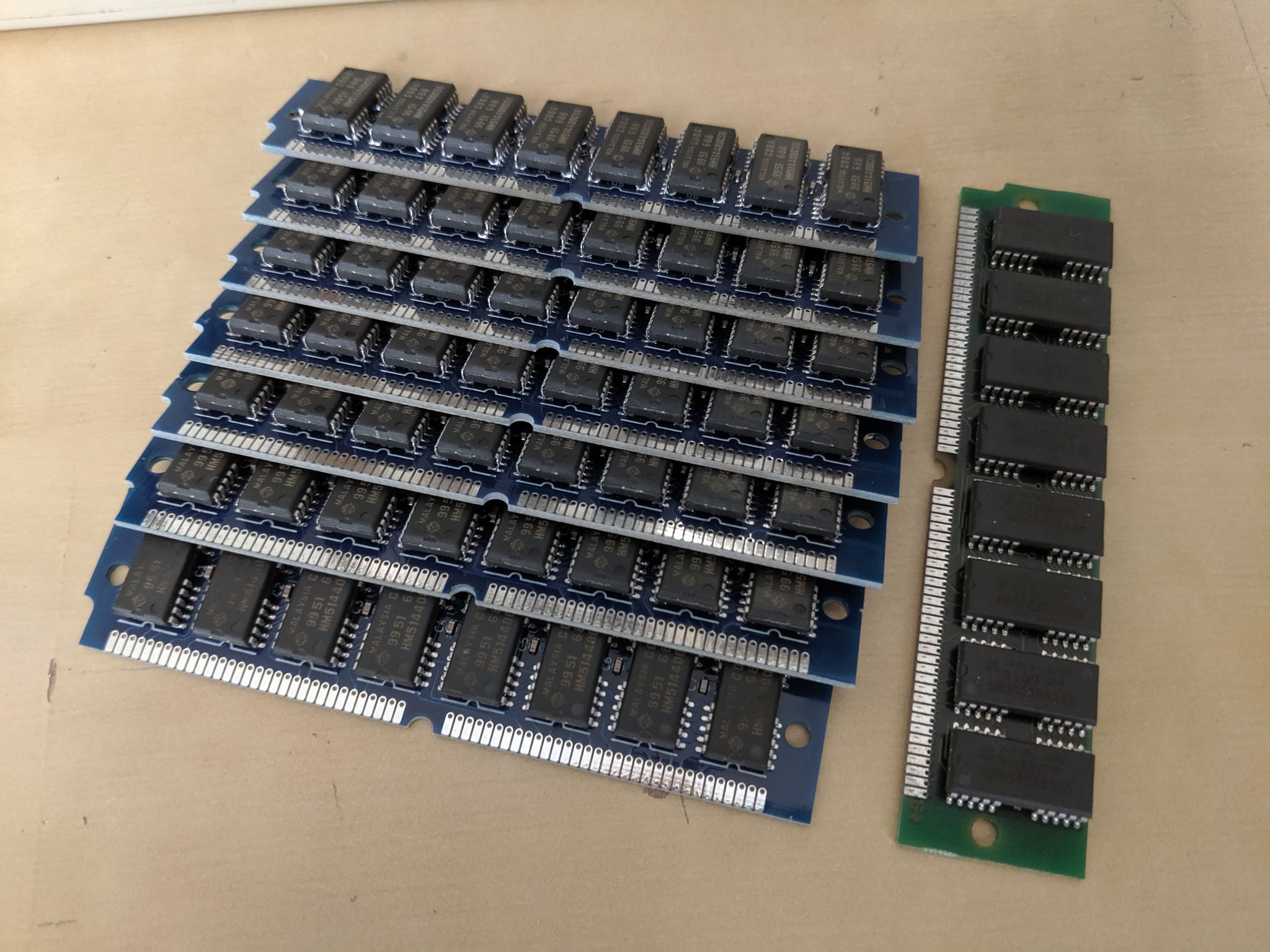
I found 8 pieces of these memory sticks on the attic. I count 64 pins. Does someone know more about these? Which computers used them? I can't use them in my pc motherboards.
Hello!
I found 8 pieces of these memory sticks on the attic. I count 64 pins. Does someone know more about these? Which computers used them? I can't use them in my pc motherboards.
A quick Google search returned this:
64-pin SIMMs (Single In-line Memory Modules) are specialized, vintage memory modules commonly used in early-to-mid 1990s computing for specific applications. They are primarily found in Apple Macintosh computers for ROM/GWorld memory, early 3D graphics cards, and GVP accelerator cards for Amiga computers. These are distinct from standard 72-pin system RAM. [1, 2, 3, 4, 5]
Key Features and Types
• GWorld/VRAM (Apple/Macintosh): 64-pin modules (e.g., PurpleRAM) often provided specialized memory for off-screen graphic caching (GWorld) to accelerate graphics in NuBus Macs.
• ROM SIMMs (Macintosh): 64-pin flash ROM SIMMs (e.g., PurpleROM) were used to store system firmware in 64-pin ROM sockets on older Mac motherboards.
• Amiga/GVP Accelerator Memory: Specific 64-pin SIMMs were used for fast memory on GVP accelerator cards.
• DSP Memory (NeXT): Used as dedicated SRAM for the Motorola DSP56001 chip on NeXT Cube/Station systems.
• Proprietary Use: These are not standard, high-capacity system memory sticks but rather specialized RAM or ROM components for specific accelerators, workstations, or graphics acceleration. [1, 2, 3, 4, 6, 7, 8]
Common Capacities and Speeds
• ROM SIMMs: Typically 2MB.
• GWorld/SRAM SIMMs: Small capacities, including 96kB, 1MB, or 4MB.
• GVP Accelerator SIMMs: Often 4MB, 16MB, or 32MB. [1, 2, 6, 7, 10, 11]
Availability
• Reproduction/New: Some are newly manufactured by third-party sellers (e.g., Jurassic Computing on Tindie) for retrocomputing enthusiasts.
• Vintage: Available in the secondary market (e.g., eBay). [1, 3, 4, 10, 12]
These modules should not be confused with the 72-pin SIMM modules used as main system memory for 486 and early Pentium PCs. [8]
AI responses may include mistakes.
Some of my earliest PCs used those, and I think I still have a few somewhere in a "junk parts" box...
I still have an Aopen P1 which is mounted out in the open (resurrected as an ImageDisk system) that can use either these or newer 72pin RAM.
You can see it (and the empty simm sockets) here: Re: Windows 95 on a Breadboard
IIRC it was a pain that Mac used almost the same sticks at the time - some did support a parity bit, some didn't!
- Dave ; https://dunfield.themindfactory.com ; "Daves Old Computers" ; SW dev addict best known:
ImageDisk: rd/wr ANY floppy PChardware can ; Micro-C: compiler for DOS+ManySmallCPU ; DDLINK: simple/small FileTrans(w/o netSW)via Lan/Lpt/Serial
The inscription on the chips tells you type of memory and capacity. This is Toshiba TC514400ASJ-60. That's 4Mbit FP DRAM. So 8 chips makes 4MB. If there are only chips on one side of the SIMM, it's a 4MB SIMM, if there are 8 on the back too it's 8MB.
And as for that AI above... if it were a ROM SIMM it would have ROM chips, not DRAM 😉
DaveDDS wrote on 2026-04-05, 14:53:Some of my earliest PCs used those, and I think I still have a few somewhere in a "junk parts" box...
I still have an Aopen P1 which is mounted out in the open (resurrected as an ImageDisk system) that can use either these or newer 72pin RAM.
You can see it (and the empty simm sockets) here: Re: Windows 95 on a Breadboard
You sure about that? The board in the link looks like an AOpen AP5T, which has regular 72p SIMMs, not 64p like this (and two 168p DIMM slots).
dionb wrote on 2026-04-05, 17:41:You sure about that? The board in the link looks like an AOpen AP5T, which has regular 72p SIMMs, not 64p like this (and two 168p DIMM slots).
Oh yes, I *AM* completely wrong ! --- It has been many years since I looked at this stuff in detail!
All I knew is that it does take both "short" memory and "long" memory - I didn't actually recall the number of pins on each and that the shorts were 72.
But they did look much like the stuff depicted in the original post.
The long slots are harder to see, at the edge next the power suppuly - there is actually a stick in one, you can see the clips are offset. And yes they are obviously more than 12 pins longer than the short slots (so clearly not 64/72 - 72/168 seems much more realistic).
And It has been a long time since I've seem another board using the short memory - which made me think that someone might nor recognize them now.
Oops... Sorry for the confusion! (btw: I have seen systems with even shorter memory - but never in a PC)
- Dave ; https://dunfield.themindfactory.com ; "Daves Old Computers" ; SW dev addict best known:
ImageDisk: rd/wr ANY floppy PChardware can ; Micro-C: compiler for DOS+ManySmallCPU ; DDLINK: simple/small FileTrans(w/o netSW)via Lan/Lpt/Serial
DaveDDS wrote on 2026-04-05, 18:15:[...]
(btw: I have seen systems with even shorter memory - but never in a PC)
Slightly offtopic, but check out 30p SIMMs (or even SIPPs), they were the default before 72p SIMMs became the standard and much shorter 😉 - 8b wide, so installed per 2 (286/386SX) or 4 (386 or newer) in a bank. Last use I know of is on the CT3670 SB32 for sound fonts.
72p 'short' SIMMs were introduced in 1987 with the IBM PS/2 and as they were 32b wide, you only needed a single SIMM per bank. They were pretty much the standard around the mid 1990s. 64p SIMMs are much rarer beasts, usually seen in non-PC applications as the AI output has tried to indicate.
I've seen them inside printers, and I have seen them in some vintage 9os PCs, but they were quickly done away with when DDR1 memory, and its descendents, came on the scene.
These were in vogue in the same period of time when 100mhz FSB systems started coming out, if memory serves me correctly. It was often an option to use 72pin simms, even though these usually topped out at 66mhz FSB speeds, or use the PC100 style 168pin DIMM memory, for proper 100mhz or 133mhz FSB operation.
This places them (in my head at least) with early P55c type pentium systems.
My memory is not what I remember it being, so I looked for outside verification. Found this lovely and helpful memory technology taxonomy chart.

It is possible to find such creatures for sale, even in this latter age.
https://www.amazon.com/Micron-MT16LSDT3264AG- … n/dp/B076CFPV1X
Edit--
But my reading comprehension seems to be failing me today. This is some very oddball memory if it is 64pins. I DO NOT recall seeing *THAT* on any PCs.
I remember there was a proprietary SODIMM that was used on some ATI video cards of the 90s era that was unobtanium. I dont recall if those were 64pins or not.
Found a thread on the unobtanium ATI VRAM SIMMs
Helping an old ATI Rage Pro PCI
Even FURTHER looking, suggests this is memory for an amiga accelerator card?
https://github.com/schlae/gvpsimm/blob/master/4MB/README.md
dionb wrote on 2026-04-05, 18:44:Slightly offtopic, but check out 30p SIMMs (or even SIPPs), they were the default before 72p SIMMs became the standard ...
Yes, I do recall those - and IIRC the 5150(PC) and 5160(XT) used DIPs!
- Dave ; https://dunfield.themindfactory.com ; "Daves Old Computers" ; SW dev addict best known:
ImageDisk: rd/wr ANY floppy PChardware can ; Micro-C: compiler for DOS+ManySmallCPU ; DDLINK: simple/small FileTrans(w/o netSW)via Lan/Lpt/Serial
DaveDDS wrote on 2026-04-05, 20:26:dionb wrote on 2026-04-05, 18:44:Slightly offtopic, but check out 30p SIMMs (or even SIPPs), they were the default before 72p SIMMs became the standard ...
Yes, I do recall those - and IIRC the 5150(PC) and 5160(XT) used DIPs!
Oooh the Rabbit diphole.
1x16, 1x64, 1x256, 1x1000, 4x16, 4x64, 4x256... Dram, sram...
Lots of ram expansion cards use these too with varying compatibility if the numbers seem to be right.
On topic: that module sure looks like the general 4 or 8 MB module. Fastpage means you don't have to check if the system likes it: both FP and Edo oriented systems tend to eat these happily. A little slower than Edo, but more universal. Ideal for systems that need 8 to 16MB and up te 32MB.
Stuck at 10MHz...
dionb wrote on 2026-04-05, 17:38:The inscription on the chips tells you type of memory and capacity. This is Toshiba TC514400ASJ-60. That's 4Mbit FP DRAM. So 8 chips makes 4MB. If there are only chips on one side of the SIMM, it's a 4MB SIMM, if there are 8 on the back too it's 8MB.
And as for that AI above... if it were a ROM SIMM it would have ROM chips, not DRAM 😉
Yep, just general info for different types of 64-pin modules.
My point was that a quick search showed up results.
OP could have done a quick search and found out information and then if still unsure could have said what info was already known.
waterbeesje wrote on 2026-04-06, 14:47:[...]
On topic: that module sure looks like the general 4 or 8 MB module.
Except it's a 64p module, not a more common 72p one...
I also have a few 64-pin SIMMs that were in a job lot of RAM modules that I acquired. I've been curious about what exactly they're for, because I don't know for sure. But, I assumed that they were from 90's 68k-era Macintoshes due to the fact they were in a bundle alongside a single Apple-branded 68-pin module labelled "4•8 DISPLAY VRAM SIMM" and dated 1992.
Again, I turned up that nearly identical looking 64pin FP Simms were used in vintage amiga accelerator cards.

from this github:
https://github.com/schlae/gvpsimm/blob/master/4MB/README.md
Early Macs are a slightly less niche possibility- the Mac IIfx used 64p SIMMs for example:
https://everymac.com/systems/apple/mac_ii/spe … s/mac_iifx.html
By default it came with 4x 1MB, which could correspond to the 1MB SIMMs listed above. It also supported 4MB and 16MB SIMMs so possibly the 4MB SIMMs were also from one.