Caesum wrote on 2026-04-22, 18:59:
What would be the ideal 5V + 3.3V total be like for my hardware then? Something above 120W?
Is that AMD Duron 1.4 an Applebread (aka Thoroughbred) -based core? Check the full model number in CPU-world.
Funny enough, a 1.4 GHz Applebred Duron and an ASUS Radeon 9200 SE was exactly what I had in my first "own" PC as a teenager.
No, you don't need upwards of 120 Watts for these... not even close.
The Duron Applebred is rated for max of 57 Watts maximum power use. Round that up to 60 Watts just to make the numbers easier. At 5V, that's 12 Amps from the 5V rail if your motherboard does not have a 4-pin 12V CPU connector.
The Radeon 9200 SE (or all Radeon 9200/9250 cards for that matter) are light power sippers at most. You're looking at around 10 Watts under max load, most of which is from the 3.3V and 5V rail. I don't remember which one actually powered the GPU on mine... but let's assume the 5V rail for an even worse case 5V load for your machine. 10 Watts = 2 Amps @ 5V. Add that to the 12 Amps for the CPU and you'll be at 14 Amps. Add 1A more for 2 mechanical HDDs (worst case power draw for them on the 5V rail) and another 3 Amps for RAM + chipset on the motherboard (typically, most motherboards will use a combination of the 5V and 3.3V rail for these, but let's assume it's all or mostly from the 5V rail here, just to take into account the worst possible case)... the result would be 18 Amps max under full system load.
With that said, a PSU with a 20 Amp rating on the 5V rail should more than suffice for your system. If it's a quality-made older OEM PSU, probably even down to 15 Amps would be OK... though probably running the PSU's 5V rail on the limits, which isn't a good idea for long-term usage.
Caesum wrote on 2026-04-22, 18:59:
I'm asking because I'm checking both old and new PSUs atm and it seems most of available ones in Poland are less than 105w. Akyga seems to be a good choice on paper but their 500WAT PSU tends to blow up. On the other hand i assume people try to use it with their modern day hardware not low budget legacy one.
If there are confirmed cases of these blowing up rather than shutting down gracefully when overloaded, then 99.99% chance these are cheap crap half-ass'ed half-bridge design with half of the components missing and not worth half a sh**. 😁
My gut feeling: skip this one.
Not sure how things are in Poland, but here you can go to a local metal recycler place and buy old computers/parts by the kilogram. If they don't do that where you are... just wait outside and see if you can intercept anyone who brings some e-scrap. I did that back in the USA, since most scrap yards didn't allow buying of PCs and electronics directly. 😉
Caesum wrote on 2026-04-22, 10:29:
I was told that generally for these specs I'd need a 350/400 WAT PSU with 25A/30A on the 5V line at least.
No, that's way too overspec for your system and would make finding such a PSU really hard to find.
A lot of people haven't actually measured power draw on their systems, so they always tend to overspec.
The only time I would ever recommend a PSU with more than 22 Amps on the 5V rail is if it's a higher-end (or just more power-hungry) Athlon /XP CPU that's -combined- with an ATI R300/R350/R360 -based video card (aka Radeon 9500, 9700, or 9800). Actually, I have this combo right now (Athlon XP 2500+ and Radeon 9700 non-Pro) running on a Dell/Chicony/HiPro HP-P2507F3P (also nearly the same as a HP-P2507FWP in case the previous model doesn't show anything for anyone) 250 Watt PSU. These are rated for only 22 Amps on the 5V rail, but it's a rock-solid rating.
Further, the only more 5V power-hungry setups than the above are the dual Athlon MP systems, since with these, you can have each CPU drawing up to 70 Watts from the 5V rail... which will translate to roughly 150 Watts from the 5V rail with all the other hardware on the mobo... aka 30 Amps.
The absolute worst case for a 5V-heavy system would be the above combined with a Radeon 9500/9700/9800. Now you're just adding another 50-60 Watts of power draw, most of which from the 5V rail and 3.3V rail. For these cards, close to 2/3 of the power draw is from the 5V rail, so you can expect to need another 6-8 Amps more on the 5V rail... which will bring the grand total very close to 40 Amps.
But you're not building THAT system, so rest assured you don't need such heavy-duty oldschool PSUs. 😉
Caesum wrote on 2026-04-22, 10:29:
EDIT: Also does this PSU look good for my needs? https://www.mediaexpert.pl/komputery-i-tablet … -ak-b1-420-420w It has 28A on 5V line
If it's not a brand I know, chances are the label could be (and likely is) a complete lie.
I would definitely NOT trust that PSU to be capable of 28 Amps on the 5V line. If by some miracle it is, chances are it wouldn't be possible without some heavy load on the 12V rail as well, as it's more than likely a group-regulated PSU (which means the 5V and 12V rail voltage regulation depends on each other.)
gerry wrote on 2026-04-22, 11:22:
(and a top Duron like that is cool!)
If that's an Applbred Duron, then that's the lowest in the seires, with 1.6 and 1.8 GHz being the "mid" and "high" range.
However, all of these have only 92 Kb of L2 cache (IIRC), so they are pretty poor performers out of the box. How I know? - I had one between 2004 and 2007. It was an underwhelming chip even for its time, akin to the P4 Celeron. Unlike the Netburst Celerons, at least on these you could theoretically re-enable the full 256 kb L2 cache by closing some of bridges on the CPU. My Duron, however, came with a green PCB mask and so the contacts on the L bridges are not exposed, thus not easy to close from what I have read. I have vowed to attempt it, though... some day! 😁
gerry wrote on 2026-04-22, 11:22:
For the most part i am just fine with cheaper PSUs, i accept the risks
I do too, but I open and check all PSUs that come across my bench of what they should be capable of theoretically... and if time allows, test them too.
So no issue with using cheaper PSUs, so long as they get rebuilt with proper output filtering (as many usually lack this part) and get tested how well they cross-load.
Now some of you may find this surprising, but not all "old" PSUs are good at cross-loading with a 5V-heavy load.
Caesum wrote on 2026-04-22, 15:10:
Thank you for the answers. I looked at opinions and it seems AKYGA is not a good brand. Also I am reading that modern PSUs might not be actually okay for old PCs due to uneven charge on 5V line (whatever that means).
Instead I am wondering about buying a used PSU that been "renewed" by a shop. One option I found is a XILENCE POWER ATX 350W sps-xp350. It is used and from 2009 I believe. It seems the brand is generally ok?
No idea, haven't opened or seen one of these inside before so I can't tell you anything about it.
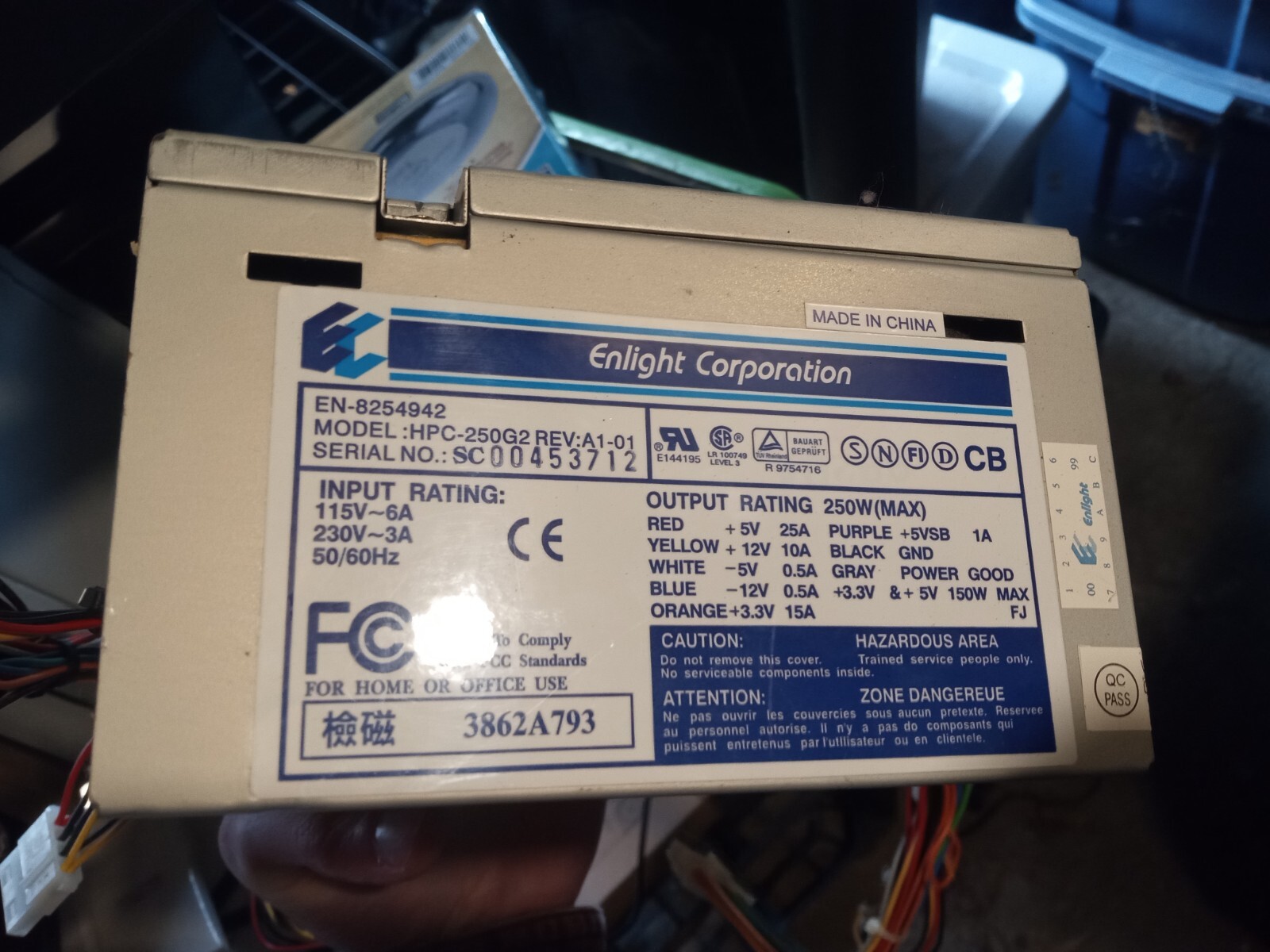
I don't think that particular PSU is from 2009, though. With only 13 Amps on the 12V rail and much more on the 5V rail, that is probably a mid-2000's PSU at best... which would be good in your case.
Actually, this might be what you need for your system. But first, ask your shop what they mean by "renewed". If it's just the dust blown out and PSU only "tested" on a cheap PSU tester.... well, that's not really any better than buying a quality OEM 200-250 Watt PSU in unknown condition and doing up the cleaning and testing yourself.
I know you said you don't want to deal with soldering, so I'll refrain from pushing you in that direction for now. But in all honesty, getting an old quality 200-250W PSU that -possibly- needs a recap might be easier (and cheaper) than looking for something else.
shevalier wrote on 2026-04-22, 16:51:
In those days, graphics cards and RAM were mainly powered by the 3.3V rail.
Well, Yes and No. 😀
I've been doing GPU power draw analysis (though not as accurate/precise as tehsiggi's) on old/"retro" GPUs for a number of years.
And you might be surprised what draws power from what.
Generally speaking, you are correct that the older (2003<) GPUs tend to draw power mostly from the 3.3V and 5V rails... but it still depends.
For example, if I remember correctly, the higher-end GeForce FX cards (FX 5700, 5800, and 5900) draw power from the 12V rail for the GPU and 3.3V for the RAM. RAM power draw is generally under 10 Watts.. so you'll be looking at no more than 3-4 Amps on the 3.3V rail. Only if some parts of the GPU are powered from that you might see more (usually GPU also draws some power from the RAM Vdd/Vddq rails as its memory controller uses the same voltage to communicate with the RAM chips.)
But even then, it depended on who made the board. At least I think OEM/reference design did it the above way. And if I am not mistaken, even the GeForce 4 TI 4400/4600 were the same or very similar. Only GF 3 and I don't know much about, since I still don't have one (poor me!) :p
Now, as for the lower-end stuff like GeForce 2/4 MX, ATI Radeon 7000/7200, RIVA TNT/64/M2 and etc.... you can tell the GPU draw pretty much by the size of the GPU heatsink. If it's a GPU with a small (usually around 40x40 mm) passive heatsink or one with a tiny fan, usually the total power draw of the entire card will be under 15 Watts (for some cards, even less than 10 Watts)... that is, under full load.
So regardless if that power comes from the 5V or 3.3V rail or a combo of the two... it's just not going to add that much relative to what the CPU will pull on a more 5V-heavy PC.
shevalier wrote on 2026-04-22, 16:51:
In other words, it is inferior to the decent quality 250-watt models of that era.
Agreed.
In particular, with those old PSUs, it's not only that they are capable of providing more power on the 3.3V/5V rails, but also how well the PSU will regulate when it is loaded this way.
Old(er) PSUs that are from the 5V-heavy era will give greater priority to regulating the voltage on the 5V rail closer to 5V and not as much on the 12V rail. With these PSUs, the 5V rail will almost always read very close to 5V regardless of how the PSU is loaded. Meanwhile, the 12V rail can appear to swing quite a bit. It's not uncommon to even hear the system fans revving up and down as the 12V rail goes up and down when the CPU transitions between load and idle.
shevalier wrote on 2026-04-22, 16:51:
It would take a long time and be rather tedious to explain, but if the power supply unit’s specifications mention an ‘A(ctive) PFC’, there’s a 99% chance it won’t be very suitable.
It was at that very moment that the topology and power distribution across the rails changed radically.
Indeed.
In fact, the only old/retro PSU I've come across that had APFC but still provided a hefty 5V rail and was good with a 5V-heavy system was an FSP400-60PFN (I believe I have it posted on badcaps.net somewhere, for those curious to see what it's like inside.)
shevalier wrote on 2026-04-22, 19:29:- Modern PSU. A single +12V bus, with the +3.3V and 5V lines derived from it via separate converters. These may be located in ra […]
Show full quote
- Modern PSU. A single +12V bus, with the +3.3V and 5V lines derived from it via separate converters. These may be located in rather unusual places, as modern systems have low power consumption on these lines and do not require special cooling.
And the temperature sensor monitors the 12V line.
Under a load of 150 W, the main power rail (+12 V) won’t even break a sweat, and the fan won’t kick in. Yet the converters are already overloaded.
The question is which of today’s power supplies can operate in this mode for an extended period — it is precisely these non-standard tests that need to be carried out.
That is why no one can guarantee anything.
Actually, it's probably only these types of modern PSUs that should be better-suited towards providing stable power for an old 5V-heavy system.
But yes, it really is a question of how hot the 3.3V and 5V buck regulator modules will get inside these PSUs and thus how long they will last.
I have the same suspicion as you that they will cook in thus not make the PSU last too long. But again, that will depend on the PSU's fan controller, as you noted.
I personally despise "ECO" PSUs that turn their fans off. Ever put a thermal camera on those? It's like the Radeon 3870/4850/4870 stock cooling profiles all over again: they literally wait until stuff is too hot and then they turn on - as if really done on purpose to guarantee the product will eventually fail (but not before the warranty expires, of course!) IMO/IME, the fan should always be running on a PSU. It's there already! Why have it sit around and do nothing?! (Yes, I know, the "noiseless PC" crowd will probably like to insert a few words here... but honestly, that crowd can go f- themselves for all I care.) Even when barely turning, it will provide much needed cooling on certain components (namely, the APFC inductor and input cap, which tend to be the hottest stuff.)
Anyways, I guess I'm just ranting about modern PSUs at this point, so I'll stop here. Just to be on-point, though - even such PSUs would still be an OK option for an old system, though I suppose with a cooling/fan modification: either open the PSU and wire the fan to run permanently on some set voltage -OR- just "rig it" with another fan on top of the PSU's fan so that the DC-DC buck regulators for the 3.3V and 5V rails are always getting some cooling (along with the APFC filter cap.)