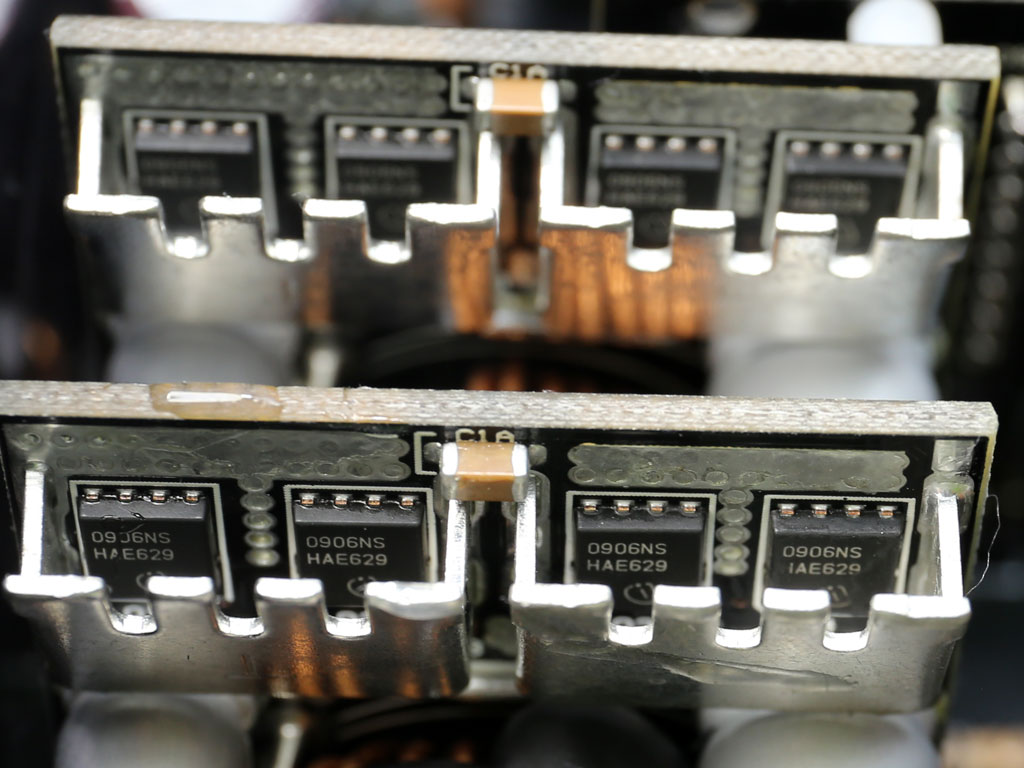
^ Sounds like an ISO-450PP.

I've found this venerable review from 2005 with some pics of its guts (written in Russian, I believe): https://www.ixbt.com/power/psu/iso-450pp.shtml
The maker was CWT.
Passive PFC.
2500 rpm 80mm fan sucking air from PSU rear, old style. According to the reviewer, he couldn't find any fan speed control circuit. Good for cooling, but noisy.
I like how they berated the hopeless stamped fan grill. These restrictive, noisy stamped grilles need to be destroyed on sight:

"I would also like to additionally note the well-known disadvantage of stamped grilles of holes compared to ventilation holes closed with mesh or wire - this is a higher noise level that occurs when air passes through them, as well as, often, a reduction in the usable area of the ventilation hole itself."
Quite moving how back in the day they complained about its weak +12V rail (exactly the opposite problem than we have now with modern PSUs 😀 ):
"... the reduced power along the 12 V line is a serious limiting factor, since modern systems consume the greatest amount of energy precisely along this line ..."

Beefy 680uF 200V bulk caps from Teapo (not so bad, could have been much worse).

TL494 controller.
More Teapos on the output filtering, of sizes varying from 2200 to 1000uF according to the reviever. From what can be seen in the not so good pictures, two 2200uF on +5V, another two on +3.3V, and one 2200uF on +12V, all with Pi coils. Good enough.

Very well behaved PSU at ripple suppression:
"In general, ripple values are low and within acceptable limits. Thus, the maximum ripple value for the 5V channel was 9 mV in the first case and 4 mV in the second (permissible limit 50 mV), and for the 12V channel - 6 mV in the first case and 8 mV in the second (permissible limit 120 mV)."
Not so good at voltage regulation:
"There are no complaints only about the 5V channel; voltage deviations in most cases are within three percent. Voltage deviations on the 12V channel can be considered, in general, satisfactory, although a couple of times they exceeded the permissible five percent threshold. The voltage value of 3.3V, as a rule, left the permissible range when the load on this line exceeded 6A. In general, the power supply can be considered suitable for use in systems with low power consumption."
Again most moving, they used this PSU to power what we'd consider nowadays a nice retrocomp:
AMD Athlon 64 3000+ processor
Cooler GlacialTech 7200
Motherboard MSI K8N Neo Platinum
RAM Patriot LL 512 MB
Video card Gigabyte GV-N66256DP
Hard drives: 2 HDD Samsung SP 0812C in RAID 0, HDD WD 1600JD
Antec SX630II case
It run FarCry for an hour without exploding 😀
Reviewer conclusions:
"This power supply should not be used with systems consuming more than 250W at peak. Design disadvantages include small radiators, as well as the lack of fan control circuits, resulting in a high noise level."
My 2c: I'd check voltage regulation with a multimeter. If voltages remain passable, I'd recap the PSU with good jap lythic caps (after ~20 years the health of all those Teapo caps is anyone's guess).
Then I'd replace the fan with a new, less noisy modern one, cut off the offending stamped grill, and Bob's your uncle.
.