VOGONS


Any sense buying modern PSU for old hardware?

Topic actions

Reply 160 of 189, by Mike_

User metadata
Rank Member
Rank
Member
appiah4 wrote on 2026-06-01, 06:27:

I mean, you don't even have to go Chinese to find reasonably priced but reliable good capacitors. There are Koeran brands like Samyoung, Samwha etc. that I don't mind using for any of my repair jobs..

It's not like Japanese caps are that expensive either, unless you are buying them in small quantities from Digikey. Prices for small quantities are there often more than three times what you would pay per piece if you were buying them by the thousands. LCSC is a much more affordable place to buy a small number of caps.

Reply 161 of 189, by TELVM

User metadata
Rank Oldbie
Rank
Oldbie

Greetings. I just want to thank and congratulate everyone involved in this highly interesting and informative thread. Kudos to you gentlemen!

Hi Momaka!

Regarding the use of modern PSUs with DC-DC for the minor rails on classic "+5V heavy" retrocomps ...

What if we DIY attach heatsinks to the OEM naked FETs ...

file.php?mode=view&id=243658
^ Before.

file.php?mode=view&id=243659
^ After (crude photoshop just to get the idea).

And rig or swap the PSU fan to make sure it will always blow a healthy amount of cooling air on them?

The QM3054M FETs in the pic are rated (provided proper heatsinking) @ 97A .

.

Let the air flow!

Reply 162 of 189, by shevalier

User metadata
Rank Oldbie
Rank
Oldbie
TELVM wrote on 2026-06-06, 16:07:

^ After (crude photoshop just to get the idea).

It will all depend on the size of this heat sink.
Initially, the entire multilayer board acts as a heat sink; with dimensions of 5 cm × 4 cm on both sides, the surface area will be 40 cm^2.
To operate without a fan, this area must be doubled.
Furthermore, fanless heat sinks must have a large gap between the fins to allow for convection.
SuperFlower used to do it like this.
in_vrms3.jpg

Aopen MX3S, PIII-S Tualatin 1133, Radeon 9800Pro@XT BIOS, Audigy 4 SB0610
JetWay K8T8AS, Athlon DH-E6 3000+, Radeon HD2600Pro AGP, Audigy 2 Value SB0400
Gigabyte Ga-k8n51gmf, Turion64 ML-30@2.2GHz , Radeon X800GTO PL16, Diamond monster sound MX300

Reply 163 of 189, by TELVM

User metadata
Rank Oldbie
Rank
Oldbie

Interestingly, there seems to be still a niche in modern PC hardware that remains "+5V heavy": Custom loop water pumps.

Apparently some of them draw their juice from the +5V line.

People test their water loop with just the pump connected to the PSU. In those conditions, there is a hefty draw from the +5V line, but no draw at all from the +12V line (the only one temperature-monitored by most modern PSUs).

And then KABOOM occurs:

PSUs exploding during water loop test

A remarkable comment from Jon Gerow, aka JonnyGURU:

"... 99% of PSUs out there don't have a heatsink or thermistor on the minor rails, so if you just load the minor rails and not the +12V for an extended amount of time, they will eventually overheat. That's why the newer Corsair PSUs have such a high fan RPM when the minor rails are loaded. It's to keep them cool ..."

.

Let the air flow!

Reply 164 of 189, by Takino-42

User metadata
Rank Newbie
Rank
Newbie

I have an "ISO" power supply with 20A at 3.3V and 32V at 5V, 200W max load for em, the nice thing is also -5V line. Any comments on this one? Still works after spending plenty of years in my AM2 Athlon pc

Reply 165 of 189, by TELVM

User metadata
Rank Oldbie
Rank
Oldbie

^ Sounds like an ISO-450PP.

file.php?mode=view&id=243710

I've found this venerable review from 2005 with some pics of its guts (written in Russian, I believe): https://www.ixbt.com/power/psu/iso-450pp.shtml

The maker was CWT.

Passive PFC.

2500 rpm 80mm fan sucking air from PSU rear, old style. According to the reviewer, he couldn't find any fan speed control circuit. Good for cooling, but noisy.

I like how they berated the hopeless stamped fan grill. These restrictive, noisy stamped grilles need to be destroyed on sight:

file.php?mode=view&id=243711

"I would also like to additionally note the well-known disadvantage of stamped grilles of holes compared to ventilation holes closed with mesh or wire - this is a higher noise level that occurs when air passes through them, as well as, often, a reduction in the usable area of the ventilation hole itself."

Quite moving how back in the day they complained about its weak +12V rail (exactly the opposite problem than we have now with modern PSUs 😀 ):

"... the reduced power along the 12 V line is a serious limiting factor, since modern systems consume the greatest amount of energy precisely along this line ..."

file.php?mode=view&id=243713

Beefy 680uF 200V bulk caps from Teapo (not so bad, could have been much worse).

file.php?mode=view&id=243712

TL494 controller.

More Teapos on the output filtering, of sizes varying from 2200 to 1000uF according to the reviever. From what can be seen in the not so good pictures, two 2200uF on +5V, another two on +3.3V, and one 2200uF on +12V, all with Pi coils. Good enough.

file.php?mode=view&id=243714

Very well behaved PSU at ripple suppression:

"In general, ripple values are low and within acceptable limits. Thus, the maximum ripple value for the 5V channel was 9 mV in the first case and 4 mV in the second (permissible limit 50 mV), and for the 12V channel - 6 mV in the first case and 8 mV in the second (permissible limit 120 mV)."

Not so good at voltage regulation:

"There are no complaints only about the 5V channel; voltage deviations in most cases are within three percent. Voltage deviations on the 12V channel can be considered, in general, satisfactory, although a couple of times they exceeded the permissible five percent threshold. The voltage value of 3.3V, as a rule, left the permissible range when the load on this line exceeded 6A. In general, the power supply can be considered suitable for use in systems with low power consumption."

Again most moving, they used this PSU to power what we'd consider nowadays a nice retrocomp:

AMD Athlon 64 3000+ processor
Cooler GlacialTech 7200
Motherboard MSI K8N Neo Platinum
RAM Patriot LL 512 MB
Video card Gigabyte GV-N66256DP
Hard drives: 2 HDD Samsung SP 0812C in RAID 0, HDD WD 1600JD
Antec SX630II case

It run FarCry for an hour without exploding 😀

Reviewer conclusions:

"This power supply should not be used with systems consuming more than 250W at peak. Design disadvantages include small radiators, as well as the lack of fan control circuits, resulting in a high noise level."

My 2c: I'd check voltage regulation with a multimeter. If voltages remain passable, I'd recap the PSU with good jap lythic caps (after ~20 years the health of all those Teapo caps is anyone's guess).

Then I'd replace the fan with a new, less noisy modern one, cut off the offending stamped grill, and Bob's your uncle.

.

Let the air flow!

Reply 166 of 189, by Takino-42

User metadata
Rank Newbie
Rank
Newbie
TELVM wrote on 2026-06-07, 10:41:
^ Sounds like an ISO-450PP. […]
Show full quote

^ Sounds like an ISO-450PP.

file.php?mode=view&id=243710

I've found this venerable review from 2005 with some pics of its guts (written in Russian, I believe): https://www.ixbt.com/power/psu/iso-450pp.shtml

The maker was CWT.

Passive PFC.

2500 rpm 80mm fan sucking air from PSU rear, old style. According to the reviewer, he couldn't find any fan speed control circuit. Good for cooling, but noisy.

I like how they berated the hopeless stamped fan grill. These restrictive, noisy stamped grilles need to be destroyed on sight:

file.php?mode=view&id=243711

"I would also like to additionally note the well-known disadvantage of stamped grilles of holes compared to ventilation holes closed with mesh or wire - this is a higher noise level that occurs when air passes through them, as well as, often, a reduction in the usable area of the ventilation hole itself."

Quite moving how back in the day they complained about its weak +12V rail (exactly the opposite problem than we have now with modern PSUs 😀 ):

"... the reduced power along the 12 V line is a serious limiting factor, since modern systems consume the greatest amount of energy precisely along this line ..."

file.php?mode=view&id=243713

Beefy 680uF 200V bulk caps from Teapo (not so bad, could have been much worse).

file.php?mode=view&id=243712

TL494 controller.

More Teapos on the output filtering, of sizes varying from 2200 to 1000uF according to the reviever. From what can be seen in the not so good pictures, two 2200uF on +5V, another two on +3.3V, and one 2200uF on +12V, all with Pi coils. Good enough.

file.php?mode=view&id=243714

Very well behaved PSU at ripple suppression:

"In general, ripple values are low and within acceptable limits. Thus, the maximum ripple value for the 5V channel was 9 mV in the first case and 4 mV in the second (permissible limit 50 mV), and for the 12V channel - 6 mV in the first case and 8 mV in the second (permissible limit 120 mV)."

Not so good at voltage regulation:

"There are no complaints only about the 5V channel; voltage deviations in most cases are within three percent. Voltage deviations on the 12V channel can be considered, in general, satisfactory, although a couple of times they exceeded the permissible five percent threshold. The voltage value of 3.3V, as a rule, left the permissible range when the load on this line exceeded 6A. In general, the power supply can be considered suitable for use in systems with low power consumption."

Again most moving, they used this PSU to power what we'd consider nowadays a nice retrocomp:

AMD Athlon 64 3000+ processor
Cooler GlacialTech 7200
Motherboard MSI K8N Neo Platinum
RAM Patriot LL 512 MB
Video card Gigabyte GV-N66256DP
Hard drives: 2 HDD Samsung SP 0812C in RAID 0, HDD WD 1600JD
Antec SX630II case

It run FarCry for an hour without exploding 😀

Reviewer conclusions:

"This power supply should not be used with systems consuming more than 250W at peak. Design disadvantages include small radiators, as well as the lack of fan control circuits, resulting in a high noise level."

My 2c: I'd check voltage regulation with a multimeter. If voltages remain passable, I'd recap the PSU with good jap lythic caps (after ~20 years the health of all those Teapo caps is anyone's guess).

Then I'd replace the fan with a new, less noisy modern one, cut off the offending stamped grill, and Bob's your uncle.

.

should do just great for my slot 1 build! I also have a FSP ATX-300PA. Unfortunately it lacks -5V line but is nice and quiet, and has some decent radiators for my eyes (definitely bigger than the ISO supply shown here). Suprisingly it also came from a celeron D computer

Reply 167 of 189, by Caesum

User metadata
Rank Newbie
Rank
Newbie

Okay so I got back to my hometown and finally installed that PSU that I bought over a month ago (Chieftec 350W GPS-350EB-101A). At first I thought I bought too modern hardware, because the main power cable had 24 instead of 20 pins. Then I realised you can just detach the last 4 pins from the rest. So far it works nicely. I haven't noticed any issues although I haven't used that PC extensively yet. Played Tomb Raider 1 quite nicely, Redguard was choppy but I feel it's because the game has terrible coding. Harry Potter 2 was lagging a bit but I guess it's an old HDD issue. Either way so far so good, will update this topic if anything goes wrong.

Reply 168 of 189, by TELVM

User metadata
Rank Oldbie
Rank
Oldbie

"... 99% of PSUs out there don't have a heatsink or thermistor on the minor rails, so if you just load the minor rails and not the +12V for an extended amount of time, they will eventually overheat. That's why the newer Corsair PSUs have such a high fan RPM when the minor rails are loaded. It's to keep them cool ..."

^ Intrigued by this comment from JonnyGURU, I've checked some of the very thorough PSU reviews in Hardware Busters.

Like the Corsair RM650e Review.

[SARCASM] In common with many modern PSUs, it's so incredibly smart that it keeps the fan at 0 rpm below ~50% overall load. For as we all know, a stopped fan is the cleverest solution to cool the hot electrical components inside a PSU [/SARCASM]:

file.php?mode=view&id=243834

^ The interesting one for us is the cross-load test 2 (CL2), where the +5V line is loaded to the max (20A), while +12V & +3.3V are under no load.

Under those conditions, most other modern PSUs that only monitor the +12V line, detecting no load on said +12V, will keep the fan stopped. And with no airflow, the DC-DC FETs that regulate +5V will roast into KABOOM (as people testing water pumps in the link above discovered the hard way).

However in this Corsair unit, under the same conditions, the fan spins @ 1110 rpm. Meaning the +5V rail is also monitored, and (regardless of the load on +12V) the fan is ramped up when high load is detected on +5V, giving the +5V FETs a much better chance to survive.

Similar behaviour can be observed on some other recent Corsair PSUs, like RM750x Shift.

.

Let the air flow!

Reply 169 of 189, by tehsiggi

User metadata
Rank Oldbie
Rank
Oldbie

Depending on "how" they detect load, the 5V and 3.3V also just create load that is measurable on the 12V output, since it's the only output coming from the AC/DC part of the PSU.

AGP Card Real Power Consumption
AGP Power monitor - diagnostic hardware tool
Graphics card repair collection

Reply 170 of 189, by TELVM

User metadata
Rank Oldbie
Rank
Oldbie

Circa 2009 AD Antec Truepower New TP-650. The platform was Seasonic, custom tailored for Antec:

file.php?mode=view&id=243908

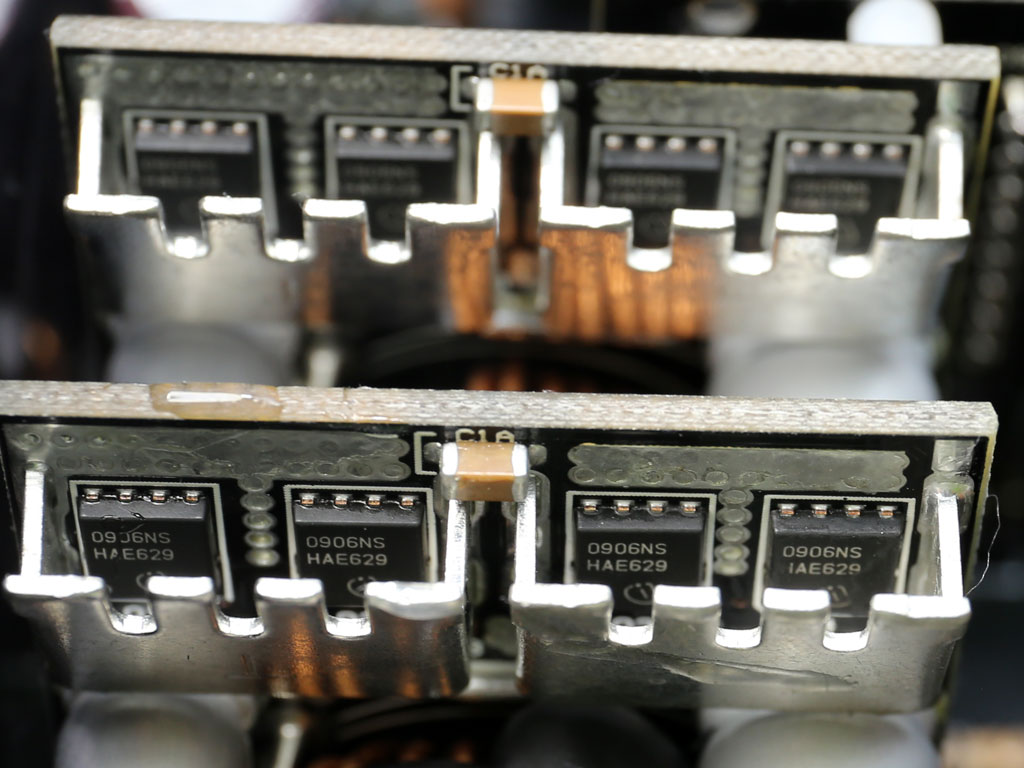
Not unlike contemporary (@ 2026 AD) PSUs, it has a daughterboard for the DC-DC converters generating +5V & +3.3V:

file.php?mode=view&id=243909

^ The FETs are on the backside of this daughterboard.

The interesting point is that, back in the day, Seasonic took the trouble to attach a heatsink to said FETs:

file.php?mode=view&id=243910

file.php?mode=view&id=243911

file.php?mode=view&id=243912

Let the air flow!

Reply 171 of 189, by TELVM

User metadata
Rank Oldbie
Rank
Oldbie

According to the OEM specs, the TP-650 can handle 25A on every minor rail, 170W max combined.

file.php?mode=view&id=243913

Let the air flow!

Reply 172 of 189, by shevalier

User metadata
Rank Oldbie
Rank
Oldbie

There’s another (not so) funny thing about the case.
If it’s a modern case, with the PSU at the bottom and air intake from below, that’s one thing.
If it’s an old-school one, with the PSU on top (and no exhaust fan to boot), the DC/DC converters will fare very differently indeed.

Aopen MX3S, PIII-S Tualatin 1133, Radeon 9800Pro@XT BIOS, Audigy 4 SB0610
JetWay K8T8AS, Athlon DH-E6 3000+, Radeon HD2600Pro AGP, Audigy 2 Value SB0400
Gigabyte Ga-k8n51gmf, Turion64 ML-30@2.2GHz , Radeon X800GTO PL16, Diamond monster sound MX300

Reply 173 of 189, by Living

User metadata
Rank Member
Rank
Member

why not use 20+ years old psu's? 3 words:

Peace of mind.

Reply 174 of 189, by shevalier

User metadata
Rank Oldbie
Rank
Oldbie
Living wrote on 2026-06-11, 13:05:

why not use 20+ years old psu's? 3 words:

Peace of mind.

Have you seen the prices for the Pentium 3S at a CUBX with 1 GB of RAM?
It’ll be a shame if some modern Chieftec goes burn and takes everything down with it.

Aopen MX3S, PIII-S Tualatin 1133, Radeon 9800Pro@XT BIOS, Audigy 4 SB0610
JetWay K8T8AS, Athlon DH-E6 3000+, Radeon HD2600Pro AGP, Audigy 2 Value SB0400
Gigabyte Ga-k8n51gmf, Turion64 ML-30@2.2GHz , Radeon X800GTO PL16, Diamond monster sound MX300

Reply 175 of 189, by TELVM

User metadata
Rank Oldbie
Rank
Oldbie
shevalier wrote on 2026-06-11, 12:53:

... If it’s an old-school one, with the PSU on top (and no exhaust fan to boot), the DC/DC converters will fare very differently indeed.

You mean in that situation the PSU fan will suck warm air from inside a poorly ventilated old-style PC case, correct?

Living wrote on 2026-06-11, 13:05:

why not use 20+ years old psu's? ...

To name but one reason, you can't trust 20+ year old lytic caps from the plague era, often from disreputable brands ...

Urban Dictionary: Fuhjyyu

And most people can't (and shouldn't, unless they know very well what they're doing) tinker inside a PSU to recap.

So for most people a new modern PSU is the only viable option to power their retrocomps.

I believe the purpose of this thread is to discuss the suitability of modern, relatively "minor rails weak" PSUs for this application.

.

Let the air flow!

Reply 176 of 189, by Feallan

User metadata
Rank Newbie
Rank
Newbie
shevalier wrote on 2026-06-11, 14:41:
Living wrote on 2026-06-11, 13:05:

why not use 20+ years old psu's? 3 words:

Peace of mind.

Have you seen the prices for the Pentium 3S at a CUBX with 1 GB of RAM?
It’ll be a shame if some modern Chieftec goes burn and takes everything down with it.

Is this something that could really happen? I would think the worst case scenario is a blown fuse in the PSU. I did have a catastrophic failure of a PC PSU myself (GTX 480 had way higher power draw under a stress test than I anticipated... nothing to be proud of 🤣), but all the other parts of that PC survived without any apparent damage. I've read multiple stories on the internet over the years about capacitors in PC PSUs popping under load, even catching fire etc. What makes these particular devices special? Never seen such stories on retro game consoles, CRT TVs etc, all of which contain PSUs.

Reply 177 of 189, by cyclone3d

User metadata
Rank l33t++
Rank
l33t++

Well, there was the multi-year Chinesium capacitor plague. And it didn't only happen that one time. A few years before the first one, the same exact thing happened again.

That and the PSU manufacturers being absolute scum buckets and using the cheapest parts and circuits possible and also lying on their spec sheets and stickers about what those power supplies could actually handle.

And then there is the fact that those same power supplies obviously had very bad ripple (dirty power output).

The capacitors were also undersized and the ratings on them were lies as well.

They put rating on capacitors that could never be possible for the size they were.

Antec and many other "reputable" brands of the time did this as well.

Consoles are very low power draw comparitively.

TVs generally had decent power circuits and the capacitors were sized properly.

I've been building computers for over 30 years now and have seen it all.

Yamaha modified setupds and drivers
Yamaha XG repository
YMF7x4 Guide
Aopen AW744L II SB-LINK

Reply 178 of 189, by shevalier

User metadata
Rank Oldbie
Rank
Oldbie
TELVM wrote on 2026-06-11, 18:53:

You mean in that situation the PSU fan will suck warm air from inside a poorly ventilated old-style PC case, correct?

Yes. The difference in temperatures will be quite significant.
If the PSU is positioned at the bottom, the temperature of the incoming air will be the same as the ambient temperature; if it is positioned at the top, it will be the same as the temperature inside the case.
In other words, these are the temperatures shown by the thermometer on the wall and the one displayed by the motherboard’s monitoring system.
You don’t need any special equipment to see them.

Feallan wrote on 2026-06-11, 22:13:

Is this something that could really happen? I would think the worst case scenario is a blown fuse in the PSU. I did have a catastrophic failure of a PC PSU myself (GTX 480 had way higher power draw under a stress test than I anticipated... nothing to be proud of 🤣), but all the other parts of that PC survived without any apparent damage. I've read multiple stories on the internet over the years about capacitors in PC PSUs popping under load, even catching fire etc. What makes these particular devices special? Never seen such stories on retro game consoles, CRT TVs etc, all of which contain PSUs.

There are no fuses in the power supply unit.
I mean, there is one at the input, but it protects the mains supply, not the power supply unit itself.
All control and protection systems are based on feedback and monitoring, much like an acrobat standing at the top of a pole.
If a catastrophic failure occurs (such as a cramp in the legs), there is nothing left to regulate.
If the upper switch of the +3.3V DC/DC converter fails, the main PSU converter is switched off and the +12V capacitors (in a modern 550W PSU model, this would be around 6 000 μF) discharge onto the motherboard.

PS
If you’re referring to those ‘black things marked R003’, they are current sensors (high-precision high-power foil resistors), the signal from which was used to monitor the current on the +12V bus.
At one time, it was widely believed that the current on this bus needed to be limited on each branch for electrical safety.
Fortunately, that nonsense is now a thing of the past.

Aopen MX3S, PIII-S Tualatin 1133, Radeon 9800Pro@XT BIOS, Audigy 4 SB0610
JetWay K8T8AS, Athlon DH-E6 3000+, Radeon HD2600Pro AGP, Audigy 2 Value SB0400
Gigabyte Ga-k8n51gmf, Turion64 ML-30@2.2GHz , Radeon X800GTO PL16, Diamond monster sound MX300

Reply 179 of 189, by TELVM

User metadata
Rank Oldbie
Rank
Oldbie
Feallan wrote on 2026-06-11, 22:13:

... I would think the worst case scenario is a blown fuse in the PSU ...

Disclaimer - Not for the faint of heart ...

Worst Case Scenario

Feallan wrote on 2026-06-11, 22:13:

... I did have a catastrophic failure of a PC PSU myself (GTX 480 had way higher power draw under a stress test than I anticipated... nothing to be proud of 🤣), but all the other parts of that PC survived without any apparent damage ...

^ You were lucky. Probably one of the primary switching transistors blew up, and the PSU died relatively peacefully, not damaging the components downstream.

Other PSU modes of failure aren't so kind to the attached hardware.

.

Let the air flow!