Ahrle wrote on 2026-06-16, 01:46:Thanks, will probably help staying upright a little longer :D […]
Show full quote
dominusprog wrote on 2026-06-11, 05:48:
Ahrle wrote on 2026-06-09, 20:49:Project 357575 case arrived last Friday: […]
Show full quote
Project 357575 case arrived last Friday:
Quite the troubleshooting lesson!
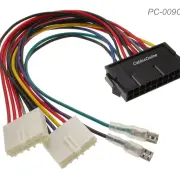
Defective turbo LED panel (gave up, now solid 66), keylock on (no key), and nearly 20 hours spent on power issues (turned out as wrong facing IDE cable).
Finally finished yesterday.
ET4000 ISA was unfortunately sent up in smoke after direct contact with NE2000 during test process and network troubleshooting.
The attachment IMG_20260609_030945269.jpg is no longer available
Screwholes of m/b plate are misaligned, never seen this before.
Board has to be slightly slanted.
This makes the bottom ISA inaccessible, due to no room for a backplate.
The attachment IMG_20260609_020314367.jpg is no longer available
CT3900 and ET4000/W32 arrived as well.
~7mm between CT and PC speaker housing 😁
The attachment IMG_20260609_180355075.jpg is no longer available
The attachment IMG_20260609_182536491.jpg is no longer available
The attachment IMG_20260609_223557648.jpg is no longer available
The screw on the sound card is a nice touch. But why not use a VLB HDD controller too?
Thanks, will probably help staying upright a little longer 😁
For the controller:
- already had that one and already spent some $2300 on this project (ebay nowadays is no joke haha)
- ISA card will allow high mounting, minimizing harness
- mainly, I read somewhere VLB will clock down 10 MHz for each VLB card present (ie 50-40-33 MHz due to bus sharing)?
Wow, that's a lot to spend without having a 133 Mhz Cyrix 5x86 upgrade a Mach 64 2MB VLB and a Voodoo 1 in it. (That's just an "easy" $1000 worth, not a recommendation) You must have had very specific hardware in mind.
VLB... two random cards have a chance that they will only play nice at 33. Random single cards, you might find only like 33 by themselves, where if they'll do 40 they are glitchy even with the wait states set. Back in the later 90s, when VLB were $1 a piece out of computer fair junk boxes, I was able to determine that by mixing and matching and cherrypicking, that you could indeed match VGA and I/O that would do 50 and even 60 together. It's not such a viable option now when they get to $150 a piece for tested/working cards. The most viable candidates though will do 40 by themselves with no wait states, tightest timings. Find a VGA and i/o that do that and there's a good chance they will pair at 50 with wait states set. In general the most willing VGAs I found for higher speeds had GD5428 or GD5429 VGA chipsets and 60ns SOJ RAM on. The i/o cards were typically UMC based. I think one pair I had that went well were a PT-429 VGA and a PT-426 i/o both from Pine, could still be a coin flip though. Also I am poor at model number recall for my ultimate 60mhz pair, might have been one of the Pine cards and one similar. Card models may be less relevant than "silicon lottery" of the chipsets, only tested a dozen or so, not the thousand you need to figure that out. 66Mhz may even have been possible with my golden pair, I could boot at 66, but being at the raggedy edge with the motherboard, CPU, RAM, cache etc does not give you much clue about what particular component is the weak link, and it would crash on almost everything in a short time. Motherboard also may be a factor, either in model or silicon lottery, so a perfect pair of VLB might not do 50, or even 40 on a "bad" motherboard.
Board to case fit. One of the standoff holes, think it was one of the ones in the middle, near ISA slot length distance from back, would have a somewhat random variance in position. Some cases might have a long slot for the hole, some might only support one position, but it was always a maybe it will, maybe it won't thing. Thus frequently necessary to use a standoff with the bottom nub cut off, so it just sat freely on the backplate. One of the corner screw to standoff holes was also not entirely standardised, many boards have an ovalled or double hole there. If a board doesn't and doesn't screw down straight, might be necessary to drill and tap a new standoff hole to suit. The two "most standard" holes seem to be the one on the back right, and the middle back, get those two aligned and then work on fudging, relocating, working around any that don't align after you've got those in. Be aware that sometimes the card slot frame is screwed on and can have minor variance in position, which may require loosening screw and tapping into place.
Unicorn herding operations are proceeding, but all the totes of hens teeth and barrels of rocking horse poop give them plenty of hiding spots.