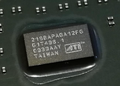
The problem with the modded BIOSes are the modded romsips were made for higher frequencies. Using them at default FSB clocks may cause instabilities. You can test in memtest. You may get no errors but random frezzes at some multies. To prevent this issue, I've included to the B4 Revision BIOSes an automatic romsip value 68h. It sets a higher value for lower clocks and it helps to get a stable system. Default BIOSes uses also higher 68h values. Modded BIOSes uses lower values for higher clocks. You can skip the Auto function by selecting "default" value in the romsips 68h setting. Maybe worth to test it at the default value.
TREF, tRC, tRFC and Alpha Timings are dram Timings. For TCCD, I would suggest:
TRC: 11-13
TRFC:14-16
TREF: 2500-3600
Alpha: 4-5-6-x-x-x-x or higher
Drive strength: auto or 2-4 if you prefere manual settings
Slew rate: auto or 7-8 for manual settings. Abit boards like value 7
Romsip table : you can leave it at auto for the table in BIOS. The DFI tables may help in OC.
A hanging system just before the boot might be caused by a wrong setting in the added settings. I would suggest to do a longer clear CMOS. Somewhere like 5 minutes. Then reflash the BIOS. Maybe some of the CMOS values are not cleared propperly. I had this issue on few boards. You can see it in the BIOS when the default values for the "new" settings are not at their default values after a clear CMOS.
You also could try a different BIOS Version. Merlins ED could be a solution.
A responce would be nice as it helps to improve the compability.
Edit.
Thunderbird and Palomino CPUs will limit the FSB clocks to 200 - 230MHz.
Thoroughbred B and Barton CPUs do fine at high clocks.