You're right that it's diminishing returns, like many DSP processes. MUXG2K's default is 4-point like the hardware, because that slight high-frequency droop is part of how the hardware sounds. The 32-point windowed sinc only runs if you switch on HQ Interpolation, and it's off by default.
A 4-point kernel rolls off the top octave a little (about 1 dB above 4 kHz) and only rejects the mirror-image frequencies by roughly 30 dB. The 32-point Kaiser sinc keeps the response flat almost to Nyquist and pushes those images down to around 95 dB. You'd mostly hear that as slightly more top end and cleaner high notes on bright sounds. It isn't night and day; 8 or 16 points would get you most of the way.
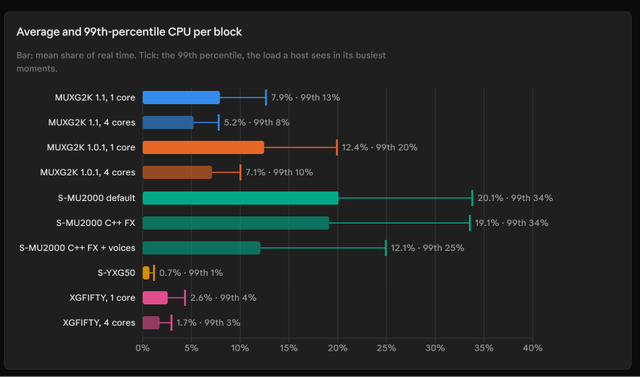
The cost is smaller than it looks. 32 multiply-adds per voice per sample is tiny for a modern CPU, and the work vectorises well. In a full song it adds about 3% CPU, because the effects and filters take far more of the time than fetching samples.
One honest limit: the sinc's cutoff is fixed relative to the sample's own rate. It doesn't move as a note is pitched up, so it won't remove aliasing on notes played far above their original pitch. The hardware doesn't either.