VOGONS


Athlon 1400/133 vs Duron 1300/100

Topic actions

Reply 20 of 35, by Carlos S. M.

User metadata
Rank Oldbie
Rank
Oldbie

You can try finding an old Athlon XP like XP 1600+ - 2000+ Palomino if the board supports the Duron 1300

What is your biggest Pentium 4 Collection?
Socket 423/478 Motherboards with Universal AGP Slot
Socket 478 Motherboards with PCI-E Slots
LGA 775 Motherboards with AGP Slots
Experiences and thoughts with Socket 423 systems

Reply 21 of 35, by kanecvr

User metadata
Rank Oldbie
Rank
Oldbie
meljor wrote:

KT133A, KT266A, KT333 (early ones still couldn't do 166fsb, so later ones were like an ''A''),KT400A

KT333 boards can do FSB 166, but not all. You're right by saying it's a pain in the ass. There's 3 revisions of the KT333 chipset - the early one that can't do 166 (rev CD), the later one that can - rev CE (both with 3,3V universal AGP) and a budget version witch is basically a cut down KT400 (rev CF) and only does agp 1.5v despite it having a physical universal AGP slot.

candle_86 wrote:
PhilsComputerLab wrote:

I like to use KT600 boards with these older Athlon and Duron processors. Runs very well and makes a great DOS / Windows 98 hybrid gaming machine. To me it seems that around 1 GHz is sort of a sweet spot between performance and power draw.

But for older type games wouldn't KT333 make more sense it supports AGP 2/4

It makes sense if you want to use a Voodoo 3 /4 / 5 (top machine in my sig) but otherwise you can go with a KT400 / KT600 + whatever AGP 4x card + 2x Voodoo 2 SLi witch on a machine this fast equal voodoo 3 2000 performance, but lack it's high-res capabilities.

melbar wrote:
386SX wrote:

Hi,
What do you think about the lack of SSE and hardware prefetch of the Palomino vs the Morgan core?

Would be interesting how much each of technology (SSE / data prefech) result in better performace for the AMD cpu's.

My research on 'tomshardware'-benchmarks has shown that, for example, the speed difference (due to data prefech unit) between PIII coppermine and PIII tualatin is around (~) 3% to 6% at equal clock & FSB speed.

The athlon 1333 beats both the coppermine and tualatin when it comes to FPU performance. I'm actually swapping my tualatin for a 1400Mhz Athlon + FIC AD11 (DDR1 / AMD 760) as my main win98 machine, partly because the athlon is faster, but mostly to preserve my Abit ST6 and 1400Mhz Tualatin CPU. It will stay as a complete machine, but It will only be used occasionally instead of daily to try to get as much life out of it as possible.

A great reason to use a KT133 / KT266 + duron / early athlon combo instead of a PIII is that they are much cheaper and easyer to find then socket 370 stuff, not to mention faster. A KT266 also uses DDR witch is also cheaper and easier to find. The only downside is that eary non-XP athlons are thirsty and get quiet a bit hotter then a PIII - but finding a decent copper core 80mm fan cooler is easy, and will keep temps in check.

Last edited by kanecvr on 2017-01-04, 03:58. Edited 1 time in total.

Reply 22 of 35, by Imperious

User metadata
Rank Oldbie
Rank
Oldbie

If You have a Award bios in your motherboard then it can easily be patched with updated cpu microcode that lets you use a Barton.

I have a Barton running perfectly in my KT133 motherboard which only supports 100fsb. Higher multipliers are only accessible via a hardware mod. The true power of the
cpu is being held back mainly by 133mhz sdram though as well as an older chipset. The 512kb cache is recognised no problems.

Atari 2600, TI994a, Vic20, c64, ZX Spectrum 128, Amstrad CPC464, Atari 65XE, Commodore Plus/4, Amiga 500
PC's from XT 8088, 486, Pentium MMX, K6, Athlon, P3, P4, 775, to current Ryzen 5600x.

Reply 23 of 35, by kanecvr

User metadata
Rank Oldbie
Rank
Oldbie
Imperious wrote:

If You have a Award bios in your motherboard then it can easily be patched with updated cpu microcode that lets you use a Barton.

I have a Barton running perfectly in my KT133 motherboard which only supports 100fsb. Higher multipliers are only accessible via a hardware mod. The true power of the
cpu is being held back mainly by 133mhz sdram though as well as an older chipset. The 512kb cache is recognised no problems.

I see absolutely no point (other then because you can) in using a barton on a KT133 board. Even my using the 2600+ on a KT333 is pushing it since the machine is already bottlenecked by the Voodoo 5... and all the bios hacking and hardware modding is frankly a pain in the ass. Just get a KT333 board if you want to run a barton + 3.3v video card and be done with it - or get a newer KT600/KT880/NF2 if you plan to use a 1.5v video card.

Reply 24 of 35, by Imperious

User metadata
Rank Oldbie
Rank
Oldbie
kanecvr wrote:
Imperious wrote:

If You have a Award bios in your motherboard then it can easily be patched with updated cpu microcode that lets you use a Barton.

I have a Barton running perfectly in my KT133 motherboard which only supports 100fsb. Higher multipliers are only accessible via a hardware mod. The true power of the
cpu is being held back mainly by 133mhz sdram though as well as an older chipset. The 512kb cache is recognised no problems.

I see absolutely no point (other then because you can) in using a barton on a KT133 board. Even my using the 2600+ on a KT333 is pushing it since the machine is already bottlenecked by the Voodoo 5... and all the bios hacking and hardware modding is frankly a pain in the ass. Just get a KT333 board if you want to run a barton + 3.3v video card and be done with it - or get a newer KT600/KT880/NF2 if you plan to use a 1.5v video card.

You're right, I did it just too see how far I could push the board and because I like tinkering with things. It is handy having access to cpu speeds from 450mhz all the way up to 2400mhz although
stability ends after 2300mhz. The ISA slot also makes for good Dos compatibility.

Atari 2600, TI994a, Vic20, c64, ZX Spectrum 128, Amstrad CPC464, Atari 65XE, Commodore Plus/4, Amiga 500
PC's from XT 8088, 486, Pentium MMX, K6, Athlon, P3, P4, 775, to current Ryzen 5600x.

Reply 25 of 35, by kanecvr

User metadata
Rank Oldbie
Rank
Oldbie
Imperious wrote:
kanecvr wrote:
Imperious wrote:

If You have a Award bios in your motherboard then it can easily be patched with updated cpu microcode that lets you use a Barton.

I have a Barton running perfectly in my KT133 motherboard which only supports 100fsb. Higher multipliers are only accessible via a hardware mod. The true power of the
cpu is being held back mainly by 133mhz sdram though as well as an older chipset. The 512kb cache is recognised no problems.

I see absolutely no point (other then because you can) in using a barton on a KT133 board. Even my using the 2600+ on a KT333 is pushing it since the machine is already bottlenecked by the Voodoo 5... and all the bios hacking and hardware modding is frankly a pain in the ass. Just get a KT333 board if you want to run a barton + 3.3v video card and be done with it - or get a newer KT600/KT880/NF2 if you plan to use a 1.5v video card.

You're right, I did it just too see how far I could push the board and because I like tinkering with things. It is handy having access to cpu speeds from 450mhz all the way up to 2400mhz although
stability ends after 2300mhz. The ISA slot also makes for good Dos compatibility.

Now 450Mhz is cool. Disable L2 cache and it makes a decent dos machine if you like tinkering and don't want to shell out a premium for a super-7 machine - but as far as I know you need a Athlon XP-M to go with it, since some socket A chips are multiplier locked and others won't go under 600Mhz, while the XP-M will.

Reply 26 of 35, by gdjacobs

User metadata
Rank l33t++
Rank
l33t++

KT133 for obscene performance with DOS/Quake+Duke3D?

All hail the Great Capacitor Brand Finder

Reply 27 of 35, by 386SX

User metadata
Rank l33t
Rank
l33t

Regarding the the Asus board A7V133 if I remember corretcly I tried up to something like the XP 1800+. Overally it looks like a fast machine, I wasn't expecting the Thunderbird to be this good at 1333/133. The last I tried was the 900/100 version and the Duron 1200 was still better imho.
It would be nice to test the 1Ghz Slot A. 😀

Reply 28 of 35, by Tetrium

User metadata
Rank l33t++
Rank
l33t++

Thunderbird 1400 is definitely a lot hotter than Tualatin 1400!
Ahh, the ASUS A7V133. Used to work with these boards a lot, these were finicky but "fun" to work with! 😁
And a good 5v PSU will definitely help in getting it to run stable.

These old sA thunderbirds were easy to unlock with a pencil btw, but these had issues running 13x and 14x multipliers (for use in the ASUS A7V boards we used).

Still have an A7V133 build with a Palomino 2000+ here somewhere. I remember there used to be a forum dedicated to the A7V133 which was a great resource of information at the time.

Whats missing in your collections?
My retro rigs (old topic)
Interesting Vogons threads (links to Vogonswiki)
Report spammers here!

Reply 29 of 35, by Carlos S. M.

User metadata
Rank Oldbie
Rank
Oldbie

just wondering, what is the KT133A motherboard model?

again, you can find on ebay cheap Palomino Athlon XPs as better option over both Duron and Thunderbird, also try Athlon XP-Ms if the board can work with newer Athlon XPs

Athlon XP-M has unlocked multiplier, so you can mess with it and set to a desidered clock

What is your biggest Pentium 4 Collection?
Socket 423/478 Motherboards with Universal AGP Slot
Socket 478 Motherboards with PCI-E Slots
LGA 775 Motherboards with AGP Slots
Experiences and thoughts with Socket 423 systems

Reply 30 of 35, by melbar

User metadata
Rank Oldbie
Rank
Oldbie
kanecvr wrote:

There's 3 revisions of the KT333 chipset - the early one that can't do 166 (rev CD), the later one that can - rev CE (both with 3,3V universal AGP) and a budget version witch is basically a cut down KT400 (rev CF) and only does agp 1.5v despite it having a physical universal AGP slot.

The revisions can be seen on top of each northbridge, right?

#1 K6-2/500, #2 Athlon1200, #3 Celeron1000A, #4 A64-3700, #5 P4HT-3200, #6 P4-2800, #7 Am486DX2-66

Reply 31 of 35, by Tetrium

User metadata
Rank l33t++
Rank
l33t++
melbar wrote:
kanecvr wrote:

There's 3 revisions of the KT333 chipset - the early one that can't do 166 (rev CD), the later one that can - rev CE (both with 3,3V universal AGP) and a budget version witch is basically a cut down KT400 (rev CF) and only does agp 1.5v despite it having a physical universal AGP slot.

The revisions can be seen on top of each northbridge, right?

I suppose also by software? I'm not too keen about having to remove the northbridge heatsink just so I can take a look at it (though I suppose it's probably the best option if you want to be sure).

Whats missing in your collections?
My retro rigs (old topic)
Interesting Vogons threads (links to Vogonswiki)
Report spammers here!

Reply 32 of 35, by 386SX

User metadata
Rank l33t
Rank
l33t
Tetrium wrote:
Thunderbird 1400 is definitely a lot hotter than Tualatin 1400! Ahh, the ASUS A7V133. Used to work with these boards a lot, thes […]
Show full quote

Thunderbird 1400 is definitely a lot hotter than Tualatin 1400!
Ahh, the ASUS A7V133. Used to work with these boards a lot, these were finicky but "fun" to work with! 😁
And a good 5v PSU will definitely help in getting it to run stable.

These old sA thunderbirds were easy to unlock with a pencil btw, but these had issues running 13x and 14x multipliers (for use in the ASUS A7V boards we used).

Still have an A7V133 build with a Palomino 2000+ here somewhere. I remember there used to be a forum dedicated to the A7V133 which was a great resource of information at the time.

😀 I like these motherboards too, they have that right old-feeling of that period and a nice expandibility if we consider from the 600Mhz to the up the 1800/2000+ of the SSE XP's.

Reply 33 of 35, by Tetrium

User metadata
Rank l33t++
Rank
l33t++
386SX wrote:
Tetrium wrote:
Thunderbird 1400 is definitely a lot hotter than Tualatin 1400! Ahh, the ASUS A7V133. Used to work with these boards a lot, thes […]
Show full quote

Thunderbird 1400 is definitely a lot hotter than Tualatin 1400!
Ahh, the ASUS A7V133. Used to work with these boards a lot, these were finicky but "fun" to work with! 😁
And a good 5v PSU will definitely help in getting it to run stable.

These old sA thunderbirds were easy to unlock with a pencil btw, but these had issues running 13x and 14x multipliers (for use in the ASUS A7V boards we used).

Still have an A7V133 build with a Palomino 2000+ here somewhere. I remember there used to be a forum dedicated to the A7V133 which was a great resource of information at the time.

😀 I like these motherboards too, they have that right old-feeling of that period and a nice expandibility if we consider from the 600Mhz to the up the 1800/2000+ of the SSE XP's.

The funny thing is, the amount of tweaking by jumper reminded me a lot about the s7/ss7/s3 boards I had set up a lot of times before that.

And finally managing to get these b***es running stable was totally worth it 🤣! My god, spending many hours troubleshooting one problem after the next one and reading up. But once we got the hang of these ASUS boards, it was kinda as smooth sailing as trying to get AGP running on any typical ss7 board 😀

We ended up doing everything by jumper, BIOS updates I think, good and beefy CPU HSFs, good case cooling, using the least number of DIMMs we could get away with and if we had to use more than one, we used memory modules that were as similar as possible and in a very particular order, set all voltages slightly higher for increased stability (including I/O voltage), use only a single harddrive on IDE 1 and optical on IDE 2 and we ended up never using that extra RAID controller.

And there were probably more little things like these (maybe some particular trick with the drivers?) but I forgot.

Ow and resetting the BIOS...these boards had only solder dots instead of 2 pins for a jumper, so we learned to have very steady hands when shorting these solder dots with a flatbed screwdriver.

We had tons of these boards (and its slower sibling, the ASUS A7V) so we had a lot of room to experiment and some of them did die by the sheer stupidity of my colleges 😵

In the end I ended up having a choice of taking a box full of these boards home or having to bin them. Obviously my choice was obvious 🤣
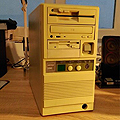

Whats missing in your collections?
My retro rigs (old topic)
Interesting Vogons threads (links to Vogonswiki)
Report spammers here!

Reply 34 of 35, by 386SX

User metadata
Rank l33t
Rank
l33t
Tetrium wrote:
The funny thing is, the amount of tweaking by jumper reminded me a lot about the s7/ss7/s3 boards I had set up a lot of times be […]
Show full quote
386SX wrote:
Tetrium wrote:
Thunderbird 1400 is definitely a lot hotter than Tualatin 1400! Ahh, the ASUS A7V133. Used to work with these boards a lot, thes […]
Show full quote

Thunderbird 1400 is definitely a lot hotter than Tualatin 1400!
Ahh, the ASUS A7V133. Used to work with these boards a lot, these were finicky but "fun" to work with! 😁
And a good 5v PSU will definitely help in getting it to run stable.

These old sA thunderbirds were easy to unlock with a pencil btw, but these had issues running 13x and 14x multipliers (for use in the ASUS A7V boards we used).

Still have an A7V133 build with a Palomino 2000+ here somewhere. I remember there used to be a forum dedicated to the A7V133 which was a great resource of information at the time.

😀 I like these motherboards too, they have that right old-feeling of that period and a nice expandibility if we consider from the 600Mhz to the up the 1800/2000+ of the SSE XP's.

The funny thing is, the amount of tweaking by jumper reminded me a lot about the s7/ss7/s3 boards I had set up a lot of times before that.

And finally managing to get these b***es running stable was totally worth it 🤣! My god, spending many hours troubleshooting one problem after the next one and reading up. But once we got the hang of these ASUS boards, it was kinda as smooth sailing as trying to get AGP running on any typical ss7 board 😀

We ended up doing everything by jumper, BIOS updates I think, good and beefy CPU HSFs, good case cooling, using the least number of DIMMs we could get away with and if we had to use more than one, we used memory modules that were as similar as possible and in a very particular order, set all voltages slightly higher for increased stability (including I/O voltage), use only a single harddrive on IDE 1 and optical on IDE 2 and we ended up never using that extra RAID controller.

And there were probably more little things like these (maybe some particular trick with the drivers?) but I forgot.

Ow and resetting the BIOS...these boards had only solder dots instead of 2 pins for a jumper, so we learned to have very steady hands when shorting these solder dots with a flatbed screwdriver.

We had tons of these boards (and its slower sibling, the ASUS A7V) so we had a lot of room to experiment and some of them did die by the sheer stupidity of my colleges 😵

In the end I ended up having a choice of taking a box full of these boards home or having to bin them. Obviously my choice was obvious 🤣

😁

Anyway I'll update if the Athlon 1400/133 will run stable or not. My Enermax 365W will need to work a lot with the 72W TDP but it ran ok with the Barton config so it should be fine.

Reply 35 of 35, by melbar

User metadata
Rank Oldbie
Rank
Oldbie
Tetrium wrote:

I suppose also by software? I'm not too keen about having to remove the northbridge heatsink just so I can take a look at it (though I suppose it's probably the best option if you want to be sure).

Allright, but i've seen already that i've a KT333 as a backup. I thought it's useless cause I have also KT400 boards.

The manual says, it's a CE stepping. So it might can be seen with a tool in windows...
Have no V3/V4/V5, but in case if i can get a good buy, i'd have a fast platform for it.

#1 K6-2/500, #2 Athlon1200, #3 Celeron1000A, #4 A64-3700, #5 P4HT-3200, #6 P4-2800, #7 Am486DX2-66