VOGONS


What retro activity did you get up to today?

Topic actions

Reply 29080 of 30758, by PTherapist

User metadata
Rank Oldbie
Rank
Oldbie
Daniël Oosterhuis wrote on 2025-01-15, 08:43:
Spent the last weekend and yesterday afternoon building a new logic board for my SEGA MegaCD. The previous one had severe cap le […]
Show full quote

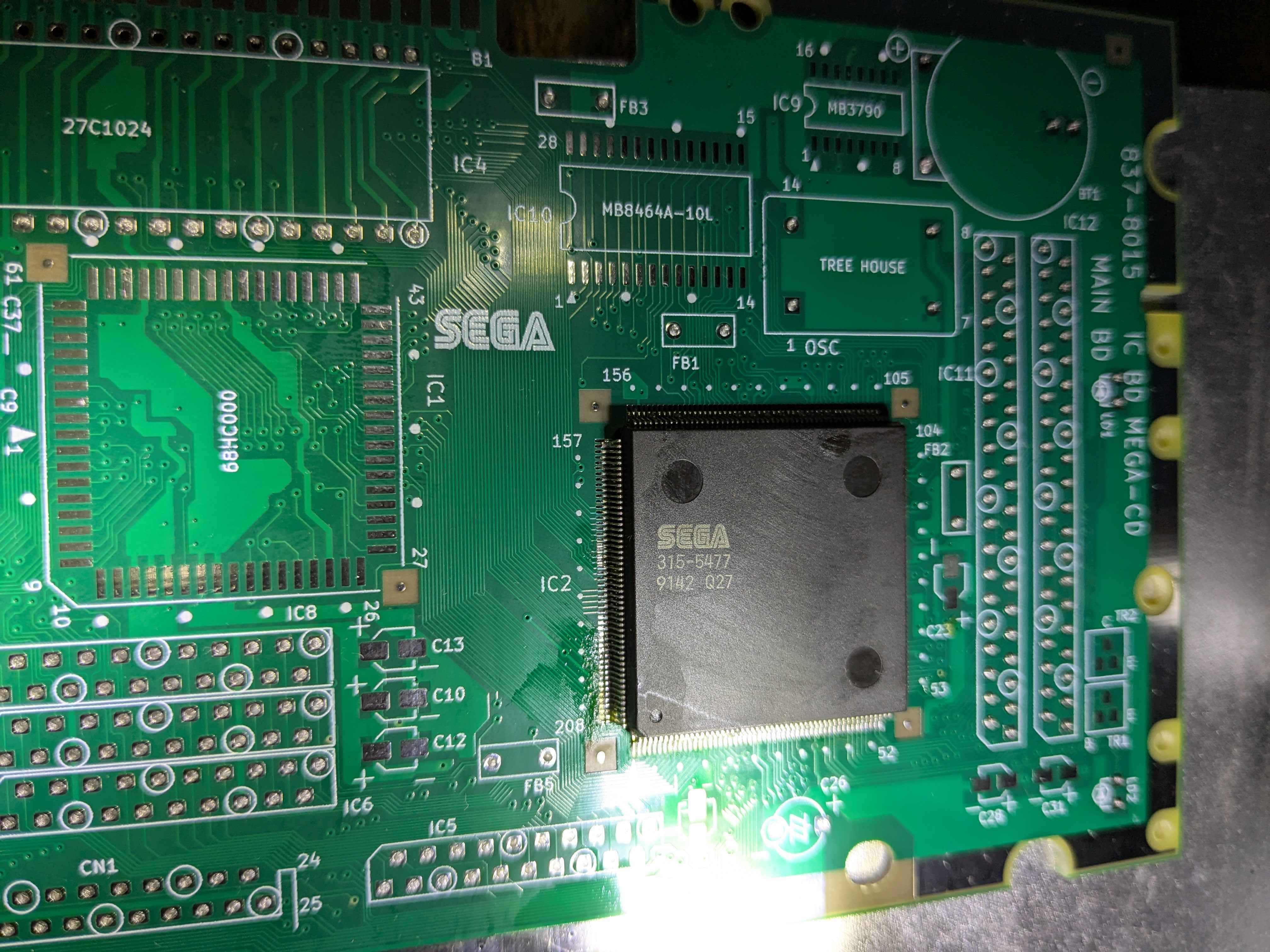
Spent the last weekend and yesterday afternoon building a new logic board for my SEGA MegaCD.
The previous one had severe cap leakage, leading to corroded solder joints that had completely let go on one side of the QFP.

My attempts to reflow it just started to cause bent pins and screwed up pads, as fighting against that amount of corrosion is futile.
So I decided to hold off on trying to continue to fix the original board, and wait for a new JLCPCB order of various PCBs and 3D printed things to tack on some new logic boards, as there do exist modern open source recreations of the main (Mega)CD logic boards.

However, someone on a Dutch classifieds site was selling some of their extras for 10 bucks a pop, so I decided to just buy that.
It was a HASL board, where I would probably have sprung for ENIG, but to be honest, the MegaDrives themselves are HASL (other than a few with carbon coated pins on the extension connector), and it doesn't seem like the MegaCD expansion connectors are all having metal reaction issues with those boards, so eh, it'll be fine.

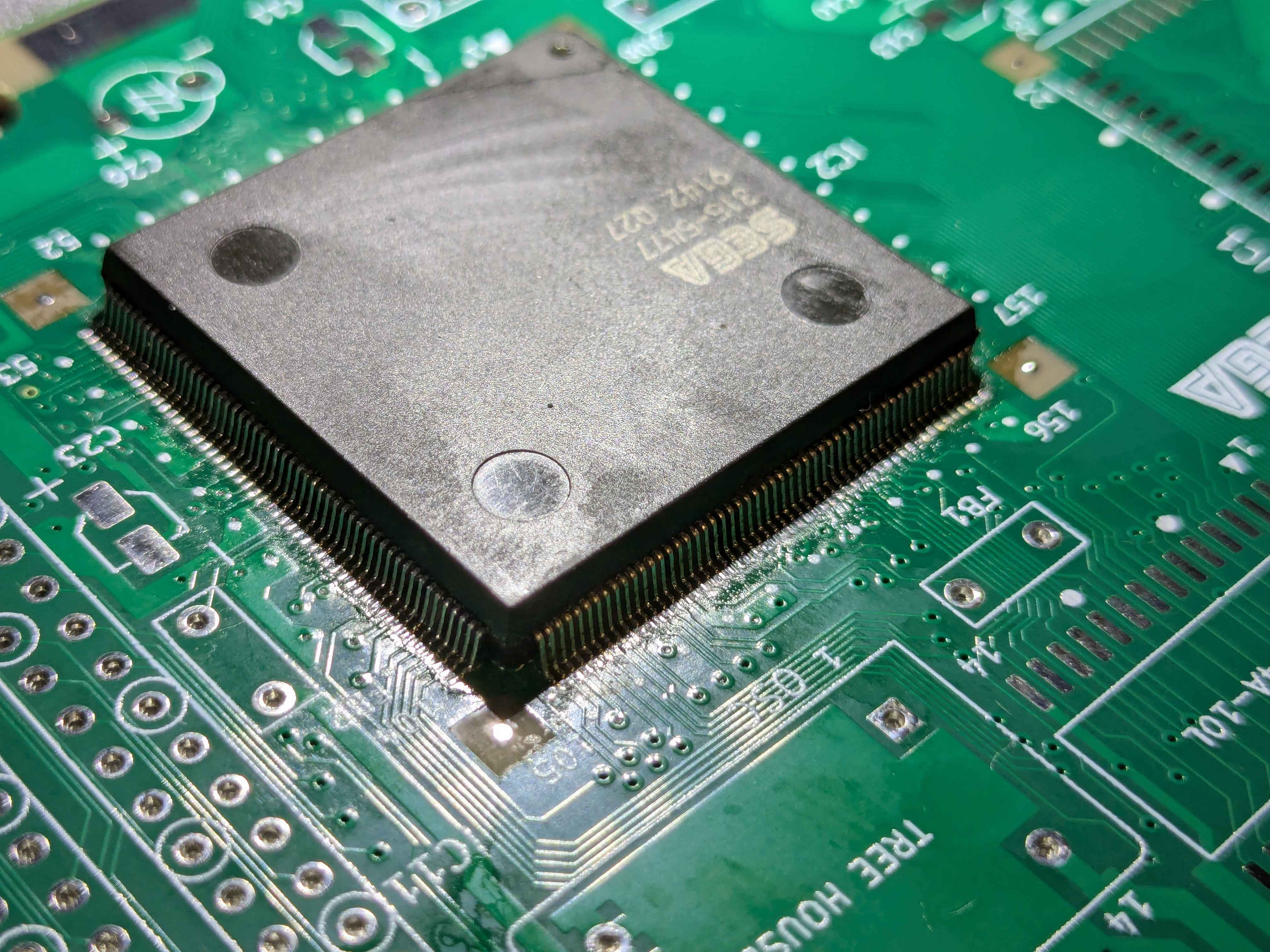
Once the board was under the microscope, the first thing I tackled was the ASIC.
This will be the trickiest component to get soldered down correctly, so I want this done before continuing with the rest.

(Click on the thumbnails for full resolution pics)

ASIC1thumb.jpgASIC3thumb.jpg

ASIC2thumb.jpg

That went well, even the slightly malformed pins at least have a solid solder connection, and are not bridged together.
I have some footage from the microscope of soldering one of the sides of the QFP here, if it is of any interest.

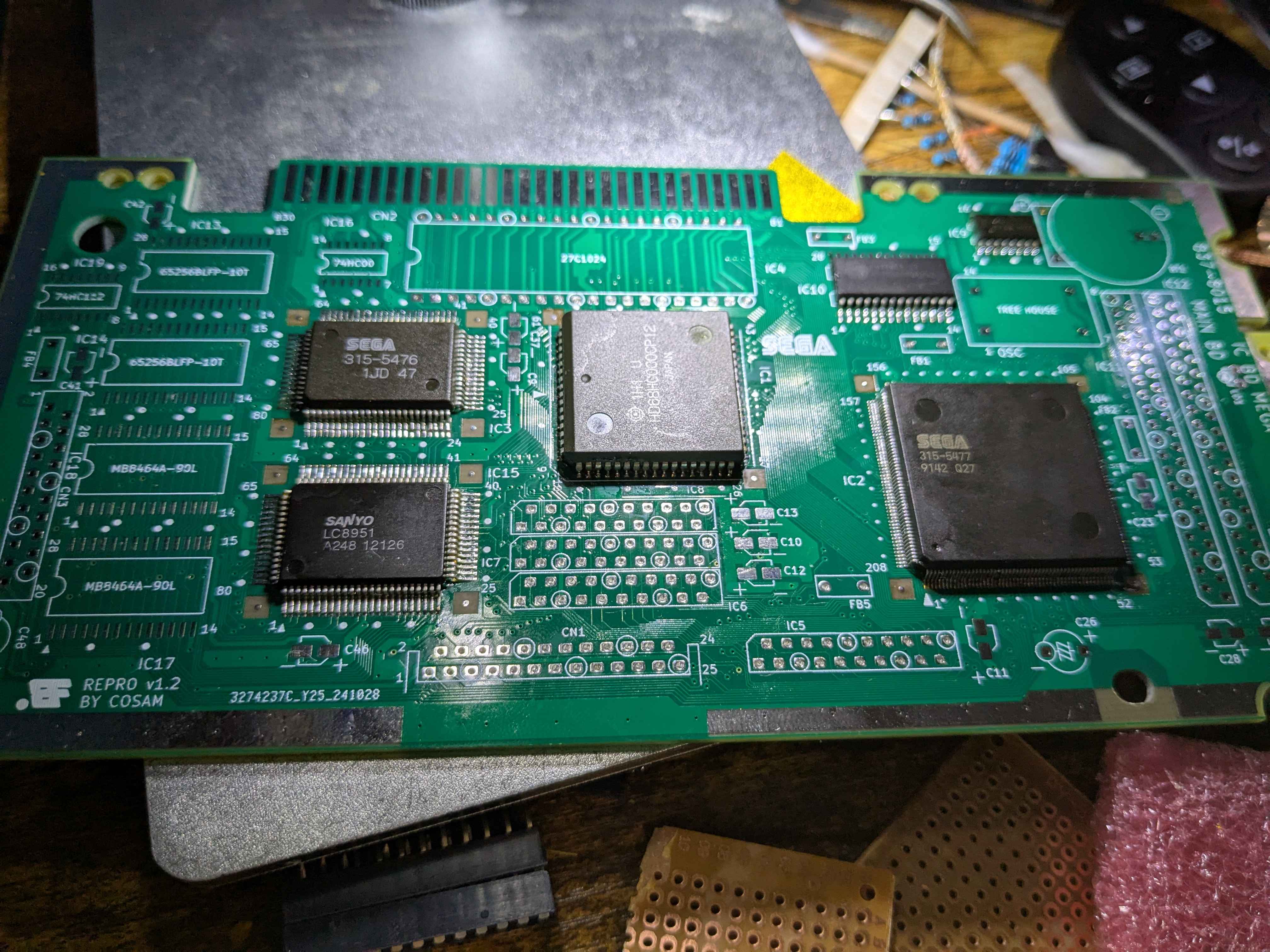
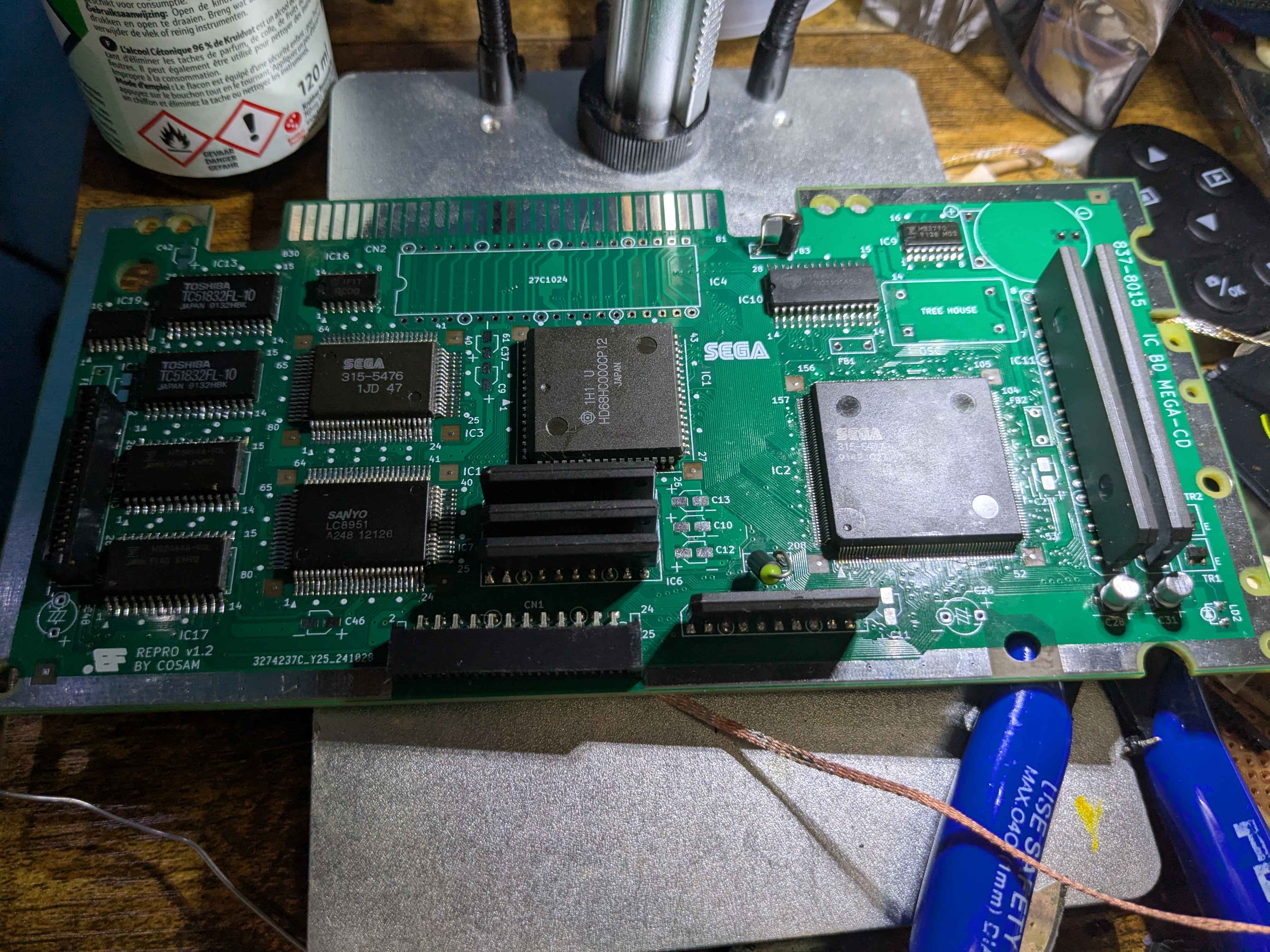
Anyways, with the QFP down, I started fitting the rest of the components.
I was out of some capacitors and ROM socket that I thought I still had in stock, so I couldn't complete the work last weekend, but I got most of it on:

Boardthumb.jpgboardthumb.jpg

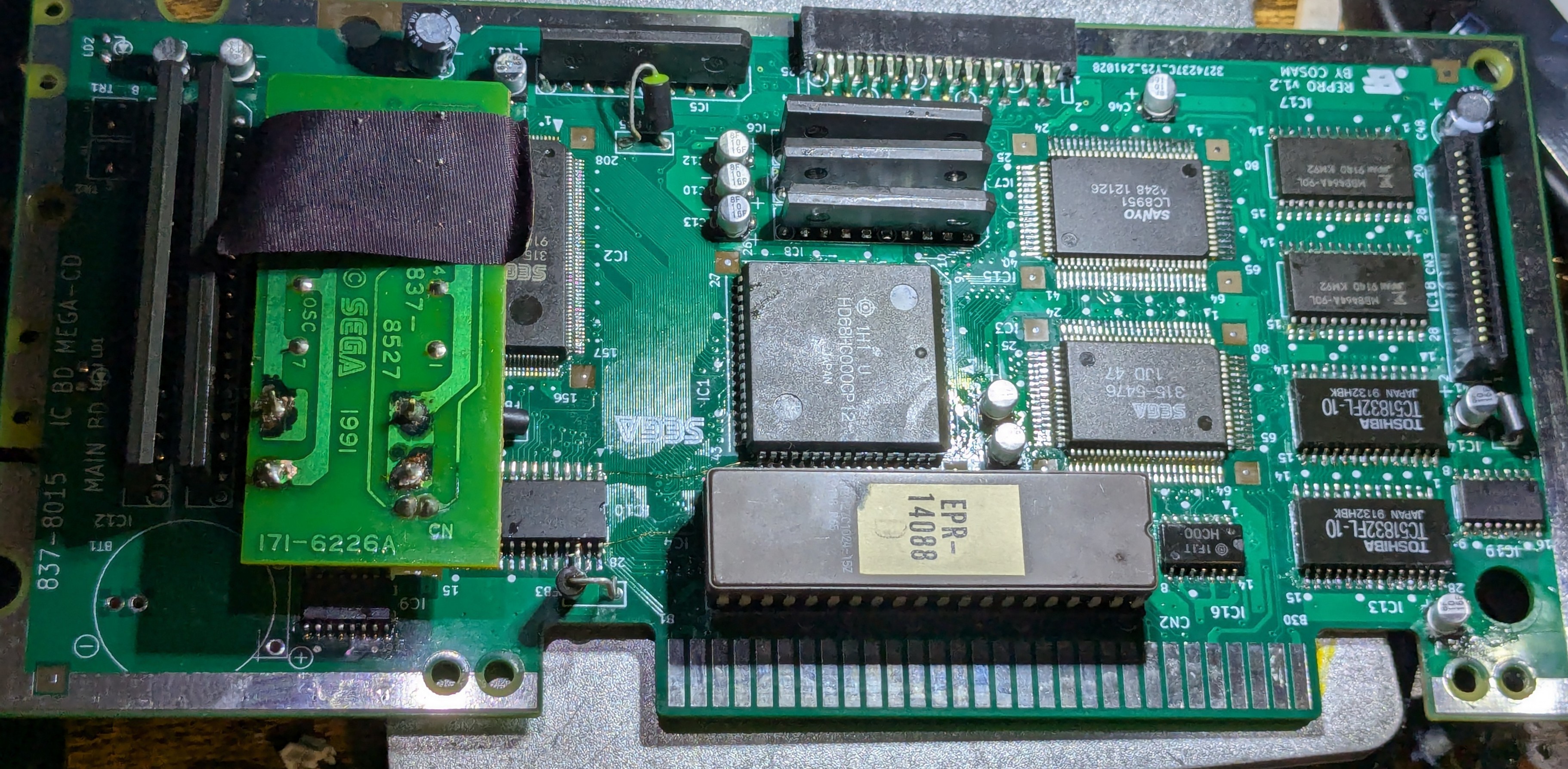
Yesterday I put the last bits on, which means it just needs an ultrasonic bath but is otherwise done!
I also added a slight mod for the save game chip, by installing a larger FRAM chip in place of the original SRAM, which does not need the battery to keep its data (Cypress rates it for 151 years of data retention after power off).

There's a mod where you run two extra address line pins to the 68k CPU, described on this page, which in tandem with a custom region-free BIOS allows full addressing of the chip's 32KB of memory without the use of bank switching.
That is a four times increase over the original 8KB, which usually gets filled up rather quickly.

finalthumb.jpg

So, the symptoms I was having on the previous board were that there was a persistent ticking sound, that coincided with stuttering on the BIOS splash screen music, alongside corrupted graphics at the BIOS splash screen (the MegaCD logo that shows off the rotational sprite manipulation was mostly invisible, sometimes showing corrupted bits of it), no life out of the CD drive, and a system hang the moment you'd go into the CD player interface.
There's some footage of that here, though I did not record the CD player interface hanging the system.

Well, what did I get on the first boot up of this board?
The good news, it's way better than before, as now the graphics corruption is complete gone, and the CD player interface now no longer hangs the system, as seen here.

The CD drive is still not showing signs of life, and the sound issue is still present.
But, for a first boot of a freshly populated-by-hand PCB with all sorts of fun SMD chips, I'm calling it a win either way!

I also haven't recapped the power board and CD drive yet, so I figured that would need to be addressed before moving on with any further diagnostics.
I was reading on the RetroSix Wiki that three 100uF capacitors on the power board in particular could cause "stuttering audio", though no sample was given of what that sounds like.

So just for a test, I recapped those three capacitors (not sure if I have the others on hand, if I had been more clever I'd have ordered those too...), which now results in a CD drive that's opening and closing the tray, and normal sound, but the video output has gone out (I checked and it's not the MegaDrive at fault).
I'm guessing with the CD drive now actually drawing power and operating to a certain degree, the rest of the crappy capacitors on the power board are strained harder, which might be causing the new problem, so I'm not too worried about is, especially as the recreated board wasn't messed with after the first power on test, soldering or components wise.

But I'm very happy with the current progress none the less 😀
I admire your dedication, the Model 1 Mega CD does need lots of work.

My soldering abilities are not up to the task, so I had my Mega CD main board sent off to be recapped last month. Luckily mine wasn't in too bad shape, only suffering from a dead SRAM chip that was replaced also with the FRAM mod.

I've heard people talk about recapping the CD & power boards too, but in my case everything seems to work fine now, so I'm leaving it be until it breaks haha.


Reply 29081 of 30758, by PTherapist

User metadata
Rank Oldbie
Rank
Oldbie

Today I did something that I've never attempted before - desoldered & resoldered an EPROM DIP chip.

I bought an old French Thomson TO7/70 micro computer back in November/December. It didn't come with a BASIC cartridge, so the computer was essentially useless. However, it did come with the "Colorpaint" cartridge, a particularly useless drawing/painting program.

So I opened up the cartridge today and desoldered the EPROM chip and then put it into my programmer to back it up - just to ensure it was working correctly mostly, since the ROM is widely available online.

After backing it up, I put the EPROM into my UV Eraser to blank it and then I wrote the BASIC ROM, downloaded from the internet, onto the EPROM.

Soldered the chip back in, as there was no room inside the cartridge to add a socket.

All working great, I now have a usable working computer. My mediocre soldering skills are definitely improving. 🤣

Reply 29082 of 30758, by Daniël Oosterhuis

User metadata
Rank Member
Rank
Member
PTherapist wrote on 2025-01-15, 17:09:

I've heard people talk about recapping the CD & power boards too, but in my case everything seems to work fine now, so I'm leaving it be until it breaks haha.

Mine came from Japan, and I have noticed that devices with known bad caps do tend to be worse over there.
Some first gen PowerMac stuff I got from Japan also had massively leaky caps, even though all the first gen PowerMac stuff in the West generally hasn't really started leaking yet, or is just starting to.

Don't know if it's humidity or storage conditions, but the ones on the power board were super crusty and nasty too.
I did find it wasn't the source for my lack of video, it was actually on the "tree house" oscillator board, as frequent desoldering and resoldering from when I was trying to fix the original board (it overhangs the ASIC) had weakened a through hole.

Bodged it and I'm now getting good video + audio, though the CD drive still isn't fully operational.
I'll finish the recap this weekend, and give the CD drive some fresh lubrication too, which'll hopefully get it fully operational.

sUd4xjs.gif

Reply 29083 of 30758, by H3nrik V!

User metadata
Rank l33t
Rank
l33t
vutt wrote on 2025-01-14, 15:39:

There is however one concern - CPU SL52Q VCORE suppose to be 1.75V but Bios/win tools are showing 1.8V. I need to find my multimeter...

I wouldn't worry too much about those 50 mV over voltage ...

If it's dual it's kind of cool ... 😎

--- GA586DX --- P2B-DS --- BP6 ---

Please use the "quote" option if asking questions to what I write - it will really up the chances of me noticing 😀

Reply 29084 of 30758, by PcBytes

User metadata
Rank l33t
Rank
l33t

Recapped two of my recently bought mainboards and diagnosed two PA-2013s as being dead.

Mobos recapped:
-1x FIC PA-2013 - the first sample I got in fully functional state (as in cache working properly) - recapped using Panasonic FL and FJ series
-MSI 815EM Pro ver 5 - replaced 2700uF Teapos with 2200uF Nichicon HZ.

"Enter at your own peril, past the bolted door..."
Main PC: i5 3470, GB B75M-D3H, 16GB RAM, 2x1TB
98SE : P3 650, Soyo SY-6BA+IV, 384MB RAM, 80GB

Reply 29085 of 30758, by ChrisK

User metadata
Rank Member
Rank
Member

What will you do with those dead PA-2013s? Planning to invest some more effort in resurrecting them? Or letting them go?

RetroPC: K6-III+/400ATZ @6x83@1.7V / CT-5SIM / 2x 64M SDR / 40G HDD / RIVA TNT / V2 SLI / CT4520
ModernPC: Phenom II 910e @ 3GHz / ALiveDual-eSATA2 / 4x 2GB DDR-II / 512G SSD / 750G HDD / RX470

Reply 29086 of 30758, by PcBytes

User metadata
Rank l33t
Rank
l33t
ChrisK wrote on 2025-01-16, 08:49:

What will you do with those dead PA-2013s? Planning to invest some more effort in resurrecting them? Or letting them go?

I'll keep them as I have a semi-functional one which needs a cache transplant. The semi-functional one has had a thread here, and basically freezes with a blinking cursor in the upper left corner inbetween the Energy Star POST screen and the PCI/ISA device lisiting.

"Enter at your own peril, past the bolted door..."
Main PC: i5 3470, GB B75M-D3H, 16GB RAM, 2x1TB
98SE : P3 650, Soyo SY-6BA+IV, 384MB RAM, 80GB

Reply 29087 of 30758, by ChrisK

User metadata
Rank Member
Rank
Member

Alright, just wanted to be sure they aren't getting to waste until it's clear they definitely can't be safed 😉
Don't know their exact state but according your picture they are looking quite a bit "used", even besides the dust.
Sometimes it's just some minimal failure that prevents showing some signs of life. Anyway, you'll do the right thing 😀

RetroPC: K6-III+/400ATZ @6x83@1.7V / CT-5SIM / 2x 64M SDR / 40G HDD / RIVA TNT / V2 SLI / CT4520
ModernPC: Phenom II 910e @ 3GHz / ALiveDual-eSATA2 / 4x 2GB DDR-II / 512G SSD / 750G HDD / RX470

Reply 29088 of 30758, by PcBytes

User metadata
Rank l33t
Rank
l33t
ChrisK wrote on 2025-01-16, 09:11:

Alright, just wanted to be sure they aren't getting to waste until it's clear they definitely can't be safed 😉
Don't know their exact state but according your picture they are looking quite a bit "used", even besides the dust.
Sometimes it's just some minimal failure that prevents showing some signs of life. Anyway, you'll do the right thing 😀

I did test them (they were the first to be tested) and so far the only one working was the Winbond cache one (how ironic considering the semi-functional one is also Winbond). Both boards with TMTech cache chips do not work - one powers up but no POST, the other won't even turn on and has a nasty gouge across several traces.

I recapped two of them - the first TMTech that powers up got polymers, and the working Winbond got a full Panasonic treatment.

"Enter at your own peril, past the bolted door..."
Main PC: i5 3470, GB B75M-D3H, 16GB RAM, 2x1TB
98SE : P3 650, Soyo SY-6BA+IV, 384MB RAM, 80GB

Reply 29089 of 30758, by Ozzuneoj

User metadata
Rank l33t
Rank
l33t

I've been tinkering with some random video cards today and I am being reminded of yet another reason that I don't spend much time with ATi hardware before the R300\RV350 era.

I have two 8MB ATi Rage Pro cards that look nearly identical, except one is a "Rage Pro Turbo PCI" with 8MB onboard and the other is a "3D Rage Pro PCI" with 4MB onboard + a matching 4MB expansion and TV outputs. When I ran some games on them I noticed the one with the expansion was HORRIBLY slow. Like, it felt like a first gen S3 Virge, even at 640x480. The other card ran significantly faster. Not great, but far far better than the other card... certainly decent enough for a 2D\3D accelerator from 1997.

The attachment ati_Rage_woe.jpg is no longer available

The BIOS chip on the slow one is marked RAGEPR PQFP 41904 107, the faster one is RAGEPR PQFP 41902 106.

I decided to check their clock speeds with PowerStrip and... whelp... I think I found the problem!? According to PowerStrip the faster one is clocked at 75Mhz Core, 100Mhz memory (higher than it seemingly should be, but correct for the 10ns SGRAM). The slow one? 36Mhz Core 48Mhz RAM!! What gives? Why is it clocked SO low??? Even the RAM is massively underclocked, since it also has 10ns SGRAM like the other card.

PowerStrip calls the faster one an Xpert 98, the slower one is an XpertPlay 98 or something like that.

I don't get this since everything I can find online says that the a Rage Pro is a Rage Pro, and any variations were just rebadge attempts by ATi to get people to take another look at their cards after they improved their drivers.

Also, the one with the memory expansion has a label on the back that says "NON-UPGRADEABLE" ... @_@

ATi was just such a baffling company back in those days. They had ~10 years more experience in this industry than most of the other companies that were succeeding in 2D+3D in the late 90s, their hardware was very well built (tantalum caps, nicely built boards, efficient and low heat output), most of their products were entirely first-party... but there was so much of this just inexplicable weirdness from them that just exacerbated their driver woes.

I am going to pop the BIOS chip out of the fast card (the OLDER version as far as I can tell) and drop it into the slow one to see if it "magically" turns it into a useful card with no other drawbacks. I bet it will. I will post back later once I have done this.

EDIT: Forgot to mention, they're using the same installation of the 2474 Rage driver.

EDIT2: Well, I didn't have to swap the BIOS chips. Inexplicably both cards are running fine now after some reboots and swapping cards back and forth. Powerstrip still detects the 4+4MB card with weirdly low clocks, so that appears to be wrong.

I also checked the clocks with SIV and the 4+4MB 3D Rage Pro shows 75Mhz core and 75Mhz memory, which is actually accurate. SIV also says that the 8MB Rage Pro Turbo is 200Mhz core, 100Mhz memory... which is clearly wrong. So, yeah, these cards must just be hard to measure the clock speed on. I haven't looked for an ATi Rage specific overclocking tool yet.

I haven't run any benchmarks to see if either is faster than the other, but I don't think it matters much at this point. They're probably decent cards for games up to 1998 or so.

Last edited by Ozzuneoj on 2025-01-17, 19:49. Edited 4 times in total.

Now for some blitting from the back buffer.

Reply 29090 of 30758, by DarthSun

User metadata
Rank Member
Rank
Member
Ozzuneoj wrote on 2025-01-17, 01:05:
I've been tinkering with some random video cards today and I am being reminded of yet another reason that I don't spend much tim […]
Show full quote

I've been tinkering with some random video cards today and I am being reminded of yet another reason that I don't spend much time with ATi hardware before the R300\RV350 era.

I have two 8MB ATi Rage Pro cards that look nearly identical, except one is a "Rage Pro Turbo PCI" with 8MB onboard and the other is a "3D Rage Pro PCI" with 4MB onboard + a matching 4MB expansion and TV outputs. When I ran some games on them I noticed the one with the expansion was HORRIBLY slow. Like, it felt like a first gen S3 Virge, even at 640x480. The other card ran significantly faster. Not great, but far far better than the other card... certainly decent enough for a 2D\3D accelerator from 1997.

The attachment ati_Rage_woe.jpg is no longer available

The BIOS chip on the slow one is marked RAGEPR PQFP 41904 107, the faster one is RAGEPR PQFP 41902 106.

I decided to check their clock speeds with PowerStrip and... whelp... I think I found the problem!? According to PowerStrip the faster one is clocked at 75Mhz Core, 100Mhz memory (higher than it seemingly should be, but correct for the 10ns SGRAM). The slow one? 35Mhz Core 58Mhz RAM!! What gives? Why is it clocked SO low??? Even the RAM is massively underclocked, since it also has 10ns SGRAM like the other card.

PowerStrip calls the faster one an Xpert 98, the slower one is an XpertPlay 98 or something like that.

I don't get this since everything I can find online says that the a Rage Pro is a Rage Pro, and any variations were just rebadge attempts by ATi to get people to take another look at their cards after they improved their drivers.

Also, the one with the memory expansion has a label on the back that says "NON-UPGRADEABLE" ... @_@

ATi was just such a baffling company back in those days. They had ~10 years more experience in this industry than most of the other companies that were succeeding in 2D+3D in the late 90s, their hardware was very well built (tantalum caps, nicely built boards, efficient and low heat output), most of their products were entirely first-party... but there was so much of this just inexplicable weirdness from them that just exacerbated their driver woes.

I am going to pop the BIOS chip out of the fast card (the OLDER version as far as I can tell) and drop it into the slow one to see if it "magically" turns it into a useful card with no other drawbacks. I bet it will. I will post back later once I have done this.

EDIT: Forgot to mention, they're using the same installation of the 2474 Rage driver.

I have PQFP 41901/107.

The attachment 225621_irajzc2lgoi2vle9_atiragepro_pci_4+4m.jpg is no longer available
The attachment 225621_wnmds7h4p0qjitat_3800x2_rage_2800.jpg is no longer available
The attachment 225621_niqfetkhxmtcviqo_sst_memmax.jpg is no longer available
The attachment 225621_qovviywqfpp0dmkb_a64800speedsys.jpg is no longer available

The 3 body problems cannot be solved, neither for future quantum computers, even for the remainder of the universe. The Proton 2D is circling a planet and stepping back to the quantum size in 11 dimensions.

Reply 29091 of 30758, by Ozzuneoj

User metadata
Rank l33t
Rank
l33t
DarthSun wrote on 2025-01-17, 01:35:
Ozzuneoj wrote on 2025-01-17, 01:05:
I've been tinkering with some random video cards today and I am being reminded of yet another reason that I don't spend much tim […]
Show full quote

I've been tinkering with some random video cards today and I am being reminded of yet another reason that I don't spend much time with ATi hardware before the R300\RV350 era.

I have two 8MB ATi Rage Pro cards that look nearly identical, except one is a "Rage Pro Turbo PCI" with 8MB onboard and the other is a "3D Rage Pro PCI" with 4MB onboard + a matching 4MB expansion and TV outputs. When I ran some games on them I noticed the one with the expansion was HORRIBLY slow. Like, it felt like a first gen S3 Virge, even at 640x480. The other card ran significantly faster. Not great, but far far better than the other card... certainly decent enough for a 2D\3D accelerator from 1997.

The attachment ati_Rage_woe.jpg is no longer available

The BIOS chip on the slow one is marked RAGEPR PQFP 41904 107, the faster one is RAGEPR PQFP 41902 106.

I decided to check their clock speeds with PowerStrip and... whelp... I think I found the problem!? According to PowerStrip the faster one is clocked at 75Mhz Core, 100Mhz memory (higher than it seemingly should be, but correct for the 10ns SGRAM). The slow one? 35Mhz Core 58Mhz RAM!! What gives? Why is it clocked SO low??? Even the RAM is massively underclocked, since it also has 10ns SGRAM like the other card.

PowerStrip calls the faster one an Xpert 98, the slower one is an XpertPlay 98 or something like that.

I don't get this since everything I can find online says that the a Rage Pro is a Rage Pro, and any variations were just rebadge attempts by ATi to get people to take another look at their cards after they improved their drivers.

Also, the one with the memory expansion has a label on the back that says "NON-UPGRADEABLE" ... @_@

ATi was just such a baffling company back in those days. They had ~10 years more experience in this industry than most of the other companies that were succeeding in 2D+3D in the late 90s, their hardware was very well built (tantalum caps, nicely built boards, efficient and low heat output), most of their products were entirely first-party... but there was so much of this just inexplicable weirdness from them that just exacerbated their driver woes.

I am going to pop the BIOS chip out of the fast card (the OLDER version as far as I can tell) and drop it into the slow one to see if it "magically" turns it into a useful card with no other drawbacks. I bet it will. I will post back later once I have done this.

EDIT: Forgot to mention, they're using the same installation of the 2474 Rage driver.

I have PQFP 41901/107.

Sorry, I don't see anything in those screenshots that shows the clocks on that card. Do you know what the core\mem clocks are on yours?

Now for some blitting from the back buffer.

Reply 29092 of 30758, by DarthSun

User metadata
Rank Member
Rank
Member
Ozzuneoj wrote on 2025-01-17, 03:34:
DarthSun wrote on 2025-01-17, 01:35:
Ozzuneoj wrote on 2025-01-17, 01:05:
I've been tinkering with some random video cards today and I am being reminded of yet another reason that I don't spend much tim […]
Show full quote

I've been tinkering with some random video cards today and I am being reminded of yet another reason that I don't spend much time with ATi hardware before the R300\RV350 era.

I have two 8MB ATi Rage Pro cards that look nearly identical, except one is a "Rage Pro Turbo PCI" with 8MB onboard and the other is a "3D Rage Pro PCI" with 4MB onboard + a matching 4MB expansion and TV outputs. When I ran some games on them I noticed the one with the expansion was HORRIBLY slow. Like, it felt like a first gen S3 Virge, even at 640x480. The other card ran significantly faster. Not great, but far far better than the other card... certainly decent enough for a 2D\3D accelerator from 1997.

The attachment ati_Rage_woe.jpg is no longer available

The BIOS chip on the slow one is marked RAGEPR PQFP 41904 107, the faster one is RAGEPR PQFP 41902 106.

I decided to check their clock speeds with PowerStrip and... whelp... I think I found the problem!? According to PowerStrip the faster one is clocked at 75Mhz Core, 100Mhz memory (higher than it seemingly should be, but correct for the 10ns SGRAM). The slow one? 35Mhz Core 58Mhz RAM!! What gives? Why is it clocked SO low??? Even the RAM is massively underclocked, since it also has 10ns SGRAM like the other card.

PowerStrip calls the faster one an Xpert 98, the slower one is an XpertPlay 98 or something like that.

I don't get this since everything I can find online says that the a Rage Pro is a Rage Pro, and any variations were just rebadge attempts by ATi to get people to take another look at their cards after they improved their drivers.

Also, the one with the memory expansion has a label on the back that says "NON-UPGRADEABLE" ... @_@

ATi was just such a baffling company back in those days. They had ~10 years more experience in this industry than most of the other companies that were succeeding in 2D+3D in the late 90s, their hardware was very well built (tantalum caps, nicely built boards, efficient and low heat output), most of their products were entirely first-party... but there was so much of this just inexplicable weirdness from them that just exacerbated their driver woes.

I am going to pop the BIOS chip out of the fast card (the OLDER version as far as I can tell) and drop it into the slow one to see if it "magically" turns it into a useful card with no other drawbacks. I bet it will. I will post back later once I have done this.

EDIT: Forgot to mention, they're using the same installation of the 2474 Rage driver.

I have PQFP 41901/107.

Sorry, I don't see anything in those screenshots that shows the clocks on that card. Do you know what the core\mem clocks are on yours?

I don't know and I'll write it down next time I use it.

The 3 body problems cannot be solved, neither for future quantum computers, even for the remainder of the universe. The Proton 2D is circling a planet and stepping back to the quantum size in 11 dimensions.

Reply 29093 of 30758, by Kahenraz

User metadata
Rank l33t
Rank
l33t
Ozzuneoj wrote on 2025-01-17, 01:05:

I've been tinkering with some random video cards today and I am being reminded of yet another reason that I don't spend much time with ATi hardware before the R300\RV350 era.

I have two 8MB ATi Rage Pro cards that look nearly identical, except one is a "Rage Pro Turbo PCI" with 8MB onboard and the other is a "3D Rage Pro PCI" with 4MB onboard + a matching 4MB expansion and TV outputs. When I ran some games on them I noticed the one with the expansion was HORRIBLY slow. Like, it felt like a first gen S3 Virge, even at 640x480. The other card ran significantly faster. Not great, but far far better than the other card... certainly decent enough for a 2D\3D accelerator from 1997.

The early Rage Pro is actually a great chip for its time when used in the appropriate context. It has good DOS super, accelerated 2D graphics, and is backwards compatible with Mach64 drivers in Windows 3.1. The 3D graphics support is very much a token gesture, but it's fairly capable in AGP form with a modest overclock. The Rage XL only improves on this with faster speed and additional blending modes.

It's not going to win any records, by the final drivers are excellent by the standards of the day and even include full OpenGL 1.1 support.

I'm pretty sure that the clock speed reported by Powerstrip is also wrong. I remember it being really messed up on my Rage XL, but dragging the slider still boosted performance considerably.

Why choose a Mach64 or Rage 2 over Rage 3?

What is the difference between the Rage Pro, Rage Pro AGP 2X, and Rage Turbo?

Reply 29094 of 30758, by Ozzuneoj

User metadata
Rank l33t
Rank
l33t
Kahenraz wrote on 2025-01-17, 07:12:
The early Rage Pro is actually a great chip for its time when used in the appropriate context. It has good DOS super, accelerate […]
Show full quote
Ozzuneoj wrote on 2025-01-17, 01:05:

I've been tinkering with some random video cards today and I am being reminded of yet another reason that I don't spend much time with ATi hardware before the R300\RV350 era.

I have two 8MB ATi Rage Pro cards that look nearly identical, except one is a "Rage Pro Turbo PCI" with 8MB onboard and the other is a "3D Rage Pro PCI" with 4MB onboard + a matching 4MB expansion and TV outputs. When I ran some games on them I noticed the one with the expansion was HORRIBLY slow. Like, it felt like a first gen S3 Virge, even at 640x480. The other card ran significantly faster. Not great, but far far better than the other card... certainly decent enough for a 2D\3D accelerator from 1997.

The early Rage Pro is actually a great chip for its time when used in the appropriate context. It has good DOS super, accelerated 2D graphics, and is backwards compatible with Mach64 drivers in Windows 3.1. The 3D graphics support is very much a token gesture, but it's fairly capable in AGP form with a modest overclock. The Rage XL only improves on this with faster speed and additional blending modes.

It's not going to win any records, by the final drivers are excellent by the standards of the day and even include full OpenGL 1.1 support.

I'm pretty sure that the clock speed reported by Powerstrip is also wrong. I remember it being really messed up on my Rage XL, but dragging the slider still boosted performance considerably.

Why choose a Mach64 or Rage 2 over Rage 3?

What is the difference between the Rage Pro, Rage Pro AGP 2X, and Rage Turbo?

Well, I didn't have to swap the BIOS chips. The "slow" card was actually so bad that the spinning Direct3D cube in dxdiag was choppy in software and hardware modes... which I've never seen before. But now, inexplicably, both cards are running fine after some reboots and swapping cards back and forth. Powerstrip still detects the 4+4MB card with weirdly low clocks, so that appears to be wrong.

I also checked the clocks with SIV and the 4+4MB 3D Rage Pro shows 75Mhz core and 75Mhz memory, which is actually accurate. SIV also says that the 8MB Rage Pro Turbo is 200Mhz core, 100Mhz memory... which is clearly wrong. So, yeah, these cards must just be hard to measure the clock speed on. I haven't looked for an ATi Rage specific overclocking tool yet.

I haven't run any benchmarks to see if either is faster than the other, but I don't think it matters much at this point. They're probably decent cards for games up to 1998 or so.

Also, I just tested a couple of 3D Rage II cards and... WOW... ATi really made some massive improvements with the Rage Pro. In a pretty ancient game like Dark Forces II, the Rage Pro can pretty much play it fine at 800x600. The 3D Rage II, being only a 2MB card, is gasping for air at 640x480 even with the colored lighting turned off. The performance is passable (not great) with colored lighting at 400x300 though. Nothing like having a 3D accelerator and have to settle for 400x300 resolution. 😮

Last edited by Ozzuneoj on 2025-01-17, 20:13. Edited 2 times in total.

Now for some blitting from the back buffer.

Reply 29095 of 30758, by lordmogul

User metadata
Rank Newbie
Rank
Newbie

More of a retro-ish activity:
Been testing cycle settings in DOSBox to see how close I can get to real hardware. Cylces are supposed to be KIPS (or rather 1000 cycles -> 1 MIPS), and the theoretical performance for many old CPUS is known, so I try to get presets that are as close as I can get in terms of performance, for speed-sensitive games.

P3 933EB @1035 (7x148) | CUSL2-C | GF3Ti200 | 256M PC133cl3 @148cl3 | 98SE & XP Pro SP3
X5460 @4.1 (9x456) | P35-DS3R | GTX660Ti | 8G DDR2-800cl5 @912cl6 | XP Pro SP3 & 7 SP1
3570K @4.4 GHz | Z77-D3H | GTX1060 | 16G DDR3-1600cl9 @2133cl12 | 7 SP1

Reply 29096 of 30758, by marxveix

User metadata
Rank Oldbie
Rank
Oldbie

Installing Windows 98 FDE with 39 disks and i am using gotek flashfloppy for it and you cant install it without real floppy or gotek,
like with Windows 95a or Windows 95b floppy disk edition it is possible to do. It takes more time than usual Windows 9x install.
Size of the Windows 98 FDE should be smaller than regular Windows 98 or Windows 98 SE, its smallest original Windows 98 OS.

Best ATi Rage3 drivers for 3DCIF / Direct3D / OpenGL / DVD : ATi RagePro drivers and software
30+MiniGL / OpenGL Win 9x dll files for all ATi Rage3 cards : Re: ATi RagePro OpenGL files

Reply 29097 of 30758, by dominusprog

User metadata
Rank Oldbie
Rank
Oldbie

Recapped this BEST UNION MF-719 sound card. Also replaced the transistor in the middle with a L7805CV regulator.

The attachment IMG_20250118_132458.jpg is no longer available

Duke_2600.png
A-Trend ATC-1020 V1.1 ❇ Cyrix 6x86 150+ @ 120MHz ❇ 32MiB EDO RAM (8MiBx4) ❇ A-Trend S3 Trio64V2 2MiB
Aztech Pro16 II-3D PnP ❇ 8.4GiB Quantum Fireball ❇ Win95 OSR2 Plus!

Reply 29098 of 30758, by smtkr

User metadata
Rank Member
Rank
Member
lordmogul wrote on 2025-01-17, 20:12:

More of a retro-ish activity:
Been testing cycle settings in DOSBox to see how close I can get to real hardware. Cylces are supposed to be KIPS (or rather 1000 cycles -> 1 MIPS), and the theoretical performance for many old CPUS is known, so I try to get presets that are as close as I can get in terms of performance, for speed-sensitive games.

There's a table online with this information. I'm guessing you are trying to be more precise, but it's probably a fools errand as the cycles number likely performs differently depending on the composition of the load. The rough guides in the table are probably fairly reasonable.

Reply 29099 of 30758, by MAZter

User metadata
Rank Oldbie
Rank
Oldbie

If anyone MSX, or MSX2 floppy drive fail, try this method:

The problem may be in the weakening of the spring that presses the head to the disk, because the head is too far away, the disk cannot be read properly (from time to time). For this, the manufacturer (Sony in this case) has provided different positions of the spring on the plastic part, if you move it to a higher level, the errors will disappear.

The attachment 1.jpg is no longer available
The attachment 2.jpg is no longer available

Floppy must be formatted before write image to it using command:

FORMAT A: /T:80 /N:9

Doom is what you want (c) MAZter