VOGONS


Yamaha XG emulation at last

Topic actions

Reply 380 of 388, by tcaud

User metadata
Rank Newbie
Rank
Newbie
hockinsk wrote on 2026-11-22, 19:02:

MUXG2K is 16-bit up to 32-tap interpolation

Is there a benefit in sampling from 32 points rather than 2? I mean I'm aware cubic and Gaussian sample from 4 points, but 32 seems like it'd offer diminishing returns at substantially higher cost.

Reply 381 of 388, by hockinsk

User metadata
Rank Newbie
Rank
Newbie

You're right that it's diminishing returns, like many DSP processes. MUXG2K's default is 4-point like the hardware, because that slight high-frequency droop is part of how the hardware sounds. The 32-point windowed sinc only runs if you switch on HQ Interpolation, and it's off by default.

A 4-point kernel rolls off the top octave a little (about 1 dB above 4 kHz) and only rejects the mirror-image frequencies by roughly 30 dB. The 32-point Kaiser sinc keeps the response flat almost to Nyquist and pushes those images down to around 95 dB. You'd mostly hear that as slightly more top end and cleaner high notes on bright sounds. It isn't night and day; 8 or 16 points would get you most of the way.

The cost is smaller than it looks. 32 multiply-adds per voice per sample is tiny for a modern CPU, and the work vectorises well. In a full song it adds about 3% CPU, because the effects and filters take far more of the time than fetching samples.

One honest limit: the sinc's cutoff is fixed relative to the sample's own rate. It doesn't move as a note is pitched up, so it won't remove aliasing on notes played far above their original pitch. The hardware doesn't either.

Reply 382 of 388, by hockinsk

User metadata
Rank Newbie
Rank
Newbie

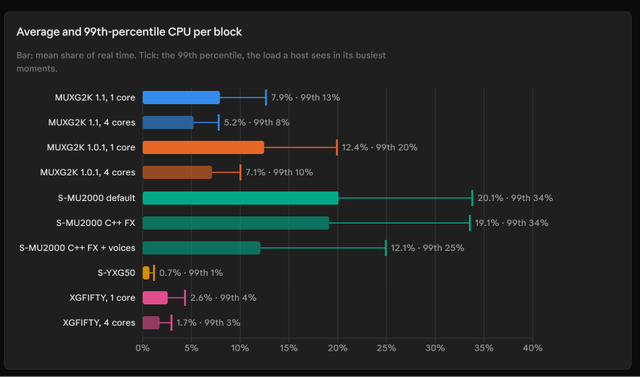
XGFIFTY (pink) looking very good on first builds and optimisation. This is basically an MU50 with GS, GM, MT-32 / CM-64 and DOC

image.png

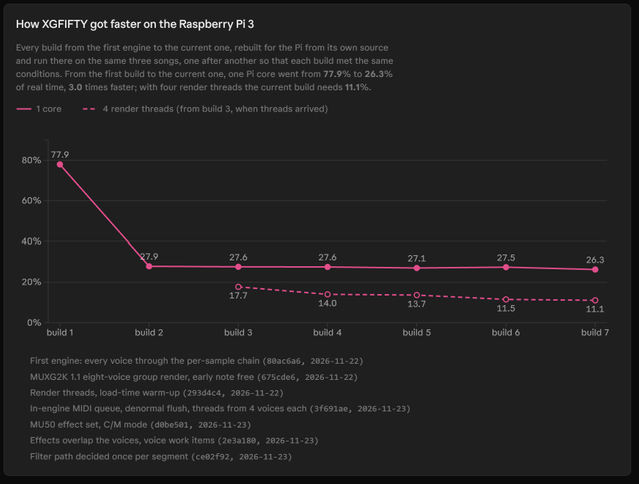
And on my Raspberry PI 3 it's looking very useable for that community either as a lighter XG instrument and of course gaming

image.png

Reply 383 of 388, by zaphod77

User metadata
Rank Member
Rank
Member

DOC is Disk Orchestra Collection.

It's outside of gm, gs, and xg.

I don't think anyone will miss it , and has ever used it in a game. I don't even know what can trigger it's use.

Do think about XGONEHUNDERED, though. It has more parts, more effects in variation, better insertion blocks (copies of the mu80 variation block), and the improved gm instruments. At least investigate the performance impact.

hmnmmm. DBPiXG50? 😀

Reply 384 of 388, by hockinsk

User metadata
Rank Newbie
Rank
Newbie

I'll see what the demand is for something more. For gaming it isn't needed, everything I've tested so far is XG Level 1, so the standard 480 voices and 11 drum/SFX kits. These games were clearly targeting SYXG range, DB50XG so anything more than MU50 is simply never going to be hit by any MIDI anyway.

XGFIFTY.png
https://www.demix.me/xgfifty/

The Yamaha line-up

  • MU50 (1995): desktop XG tone generator: XG, TG300B (GS) and C/M (MT-32 / CM-64) modes.
  • DB50XG (1995): WaveBlaster-style daughterboard for a host sound card; no drivers of its own.
  • S-YXG50/70: Windows software synth, the same XG and TG300B voice counts as the DB50XG (676 + 21).
  • S-YXG100: the S-YXG50's engine and wavetable plus VL physical-modelling voices (PolyVL) and an optional SG "singing" add-on.

Voice coverage

  • XG mode: all of them have the full XG Level 1 set: 480 voices and 11 drum/SFX kits. XGFIFTY: 480 + 11.
  • GS / TG300B mode: DB50XG: 579 voices + 10 kits (per its manual). XGFIFTY: 472 voices + 10 GS kits, using the MU2000's TG300B map.
  • Distinct sounds overall: DB50XG / S-YXG50: 676 + 21 kits. MU50: 737 + 22 kits (per its manual). XGFIFTY: 766 + 22 kits.
  • MT-32 / CM-32L: MU50 and XGFIFTY have a C/M mode; XGFIFTY switches to it automatically on an MT-32 SysEx. The DB50XG and the soft synths have none.
  • VL physical modelling: S-YXG100 only (PolyVL, 4-8 notes). SG singing voices: S-YXG100 add-on only.

Polyphony and sound

  • Polyphony: MU50 and DB50XG: 32 notes (a review measured about 24 in practice, since 2-element voices use two). S-YXG50: up to 128, depending on the CPU. XGFIFTY: 64, growing automatically to 128 while the CPU has room.
  • Samples: MU50 / DB50XG use Yamaha's AWM2 hardware wave ROM. The soft synths use a compact wavetable (2 MB per the S-YXG100 documentation) with simpler interpolation and filtering. XGFIFTY uses MU-series hardware samples at 16-bit, with the MU hardware's filter, envelopes and LFOs modelled.
  • Effects: DB50XG: 11 reverb, 11 chorus, 42 variation types (the MU50 is similar; published counts vary slightly). S-YXG50/70: 8 reverb, 8 chorus, 36 variation. XGFIFTY: the MU50's set by default, every MU-series type as an option, plus an overall effects-level control.
  • Sample rate: the hardware runs at its fixed chip rate. The soft synths run at 44, 22 or 11 kHz depending on the CPU. XGFIFTY renders at 44.1 kHz with exact resampling to the output device.

Platforms and features

  • Connection: MU50: MIDI in/out, serial or Mac/PC host port. DB50XG: a sound card's WaveBlaster header. S-YXG50/100: Windows 9x drivers (the S-YXG100 is Windows 98 only; some S-YXG50 builds reached NT/XP).
  • XGFIFTY runs on: Windows 10/11 (a MIDI driver for 32- and 64-bit games, listed as device 0), Linux and Raspberry Pi (a service), Zynthian (LV2), and any CLAP host.
  • Old games on modern Windows: XGFIFTY's classic driver works around a Windows MIDI Services limitation that stops some older games reaching newer MIDI ports. The unpatched Final Fantasy VII (1998) plays its Yamaha XG soundtrack through it. DOS games that offer a "DB50XG" option (e.g. Settlers II via DOSBox) play through it too.
  • Audio output (XGFIFTY): WASAPI (following the Windows default device, with low-latency and exclusive modes), JACK and ASIO.
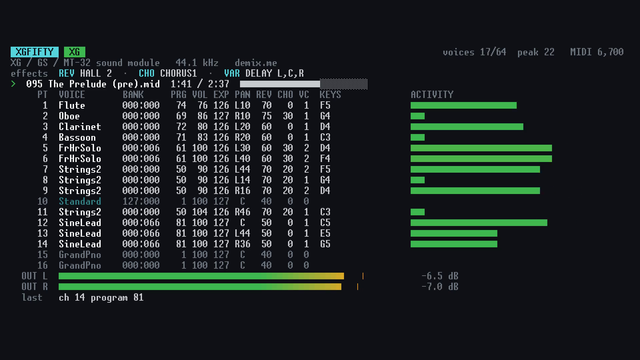
  • Extras (XGFIFTY): a live monitor (16 parts, meters, mute/solo), offline rendering to WAV or MP4 video (including whole folders of MIDI files), and auto polyphony.

In short
In XG mode XGFIFTY matches the whole MU50 / DB50XG / S-YXG50 family's XG Level 1 set, with more polyphony, plus MT-32 / CM-32L like the MU50. The DB50XG's TG300B mode maps more GS program slots (579) than XGFIFTY's GS mode currently does (472). The S-YXG100's VL and SG voices aren't covered. Sound-wise XGFIFTY aims at the MU-series hardware these soundtracks were composed on, rather than the lighter soft-synth versions.

Last edited by hockinsk on 2026-11-25, 16:15. Edited 1 time in total.

Reply 385 of 388, by hockinsk

User metadata
Rank Newbie
Rank
Newbie

Looking at FF7

All 98 midi tracks of xg.lgp, use 160 distinct voice/kit selections:

154 are XG Level 1, all inside the 480 + 11.
5 point at slots no Yamaha model has (e.g. 0:19 prog 36 in oa/ob, 0:6 prog 57 in fan2). XG's rule is that an empty variation slot plays the basic voice, so these sound as GM voices on a real MU50, on the S-YXG70 and on XGFIFTY alike.
1 is an MU100-era voice (TcklBell, 0:64 prog 113 in kurai). On the S-YXG70 it was composed for, that slot is empty and plays the basic Tinkle Bell, and so does XGFIFTY.
So nothing in FF7's XG music needs more than the MU50 / S-YXG70 set, which fits it being composed for the S-YXG70. XGFIFTY's extra GS and MT-32 coverage matters for other games, not this one.

FF7's two GM sets differ:

ygm.lgp (98 tracks; FF7 uses it in GM mode when the device is named "YAMAHA SXG70 Driver"): 89 selections, all in the GM / XG Level 1 set.
midi.lgp (94 tracks; GM mode on any other device, including XGFIFTY): written for Roland GS synths. It uses GS variation banks (CC0 = 1 and 3, e.g. 1:0 prog 48 in lb2, oa, roll and tb) and GS drum-kit programs. XGFIFTY switches to XG mode on its GM System On, and in XG mode a bank MSB of 1 isn't a melodic bank, so those parts may play nothing.

Reply 386 of 388, by zaphod77

User metadata
Rank Member
Rank
Member

YGM.lgp is the actual gm set.

MIDI.lgp is simply the awe32 set with bank select numbers reduced by one. it is NOT gs variation banks. XGFIFTY would totally mangle it, because it's not actually GM at all.

these sets do not use standard percussion or melodic banks, but ones placed in the awe soundfont specifically for various songs. for example there's a "Dokubo Percussion" (dokubo=Underneath the Rotting Pizza) bank. please actually look at the darn soundfonts. 😀

the YGM one is actually standard GM, composed for s-yxg20.

There are 2 MB and 4 MB versions of s-yxg50. the usual VST found on the net comes with the 4MB version embedded. Both exist as external tables as well.

The other lineup.

yamaha DS-XG (YMF7xx sereies) . this is a standalone full pci soundcard that also has an xg level 1 synth that loads samples form computer memory. small sample size. can be upgraded with powerYMF 3rd party software to a higher qualitry bank.
sw1000X. this is a mu100 on a card, and was sold as a professional soundcard for music production use. it also has a PLG socket. It's existence is the sole case for the XGONEHUNDERED.

Also, supposedly there are certain JP games with XG soundtracks. All the references to this claim Falcom wrote them, but i've found no proof, and people who own the games in Japan should chime in here to clarify.
Reply 387 of 388, by hockinsk

User metadata
Rank Newbie
Rank
Newbie

Yep, good correction. FF7 only uses ygm.lgp when it detects the "YAMAHA SXG70 Driver", or when MIDI_data is set to YAMAHA_GM. Playing the Sound Blaster AWE32 on XG wouldn't be a good idea .
Playlist of the 98 XG midi from FF7 here.

https://youtube.com/playlist?list=PLA5FocVGoO … -NTnAzgZPrJtXLv

Reply 388 of 388, by RetroGamer4Ever

User metadata
Rank Oldbie
Rank
Oldbie

From what I've seen Falcom was very much in the Roland GS camp and not the Yamaha XG one, once the music hardware moved past FM synths and they released multiple MIDI albums/compilations for Roland synths, around the same time Roland went hard on soft-synth options for PC users that didn't or couldn't use Roland hardware synths.